

218
due to snow and ice conditions followed by
spring floods. Otherwise, they generally have a
water table which could be a metre or more below
the surface. In addition, the peatlands in cooler
climates may have hydro-periods with little pronounced seasonal fluctuation.
14.4.1 Year-to-Year Fluctuations
It is important to note here that the hydro-period
is not the same each year. It may vary statistically
according to climate and antecedent conditions.
Moreover, in some wetlands, great variability
may be seen from year to year, e.g. in the Prairie
Pothole Regional wetland in Canada and big
Cypress Swamp region of south Florida. In the
former, spring is always wetter than fall, but
depths vary significantly from year to year.
14.4.2 Pulsing Water Levels
In most wetlands, water levels are generally not
stable, but fluctuate seasonally as in high-order
riparian wetlands, daily or semi-daily as in tidal
wetlands or even unpredictably as in coastal wetlands. In fact, the riverine wetlands generally
show the greatest differences between high and
low water levels in the hydro-periods. These are
said to be caused by flooding ‘pulses’ which
occur seasonally or periodically (Junk et al.
1989). These pulses are said to nourish the riverine wetlands with additional nutrients and also
carry away detritus and wastes. The pulse-fed
wetlands are said to be very productive wetlands.
They are also, perhaps, most favourable for transporting materials, energy and biota to neighbouring ecosystems. It is sad to note here that, despite
this obvious fact, some of the wetland managers
(especially, those who manage wetlands for
waterfowls) often try to control water levels by
isolating formerly open wetlands with dykes and
pumps (Mitsch 1992). According to Kushlan
(1989), the active manipulation of water levels
may be appropriate in artificially managed wetlands because the avifauna, which use the wetlands, often possess adaptations to fluctuating
water levels.
14.5 The Wetland Water Budget
The hydro-period or hydrologic state of a given
wetland may be summarised as being a result of
the following factors:
(a) The balance between the inflow(s) and
outflow(s) of water
(b) The surface contours of the landscape
(c) Sub-surface soil, geology and groundwater
conditions
The first condition defines the water budget of
the wetland. The second and third define the
capacity of the wetland to store water.
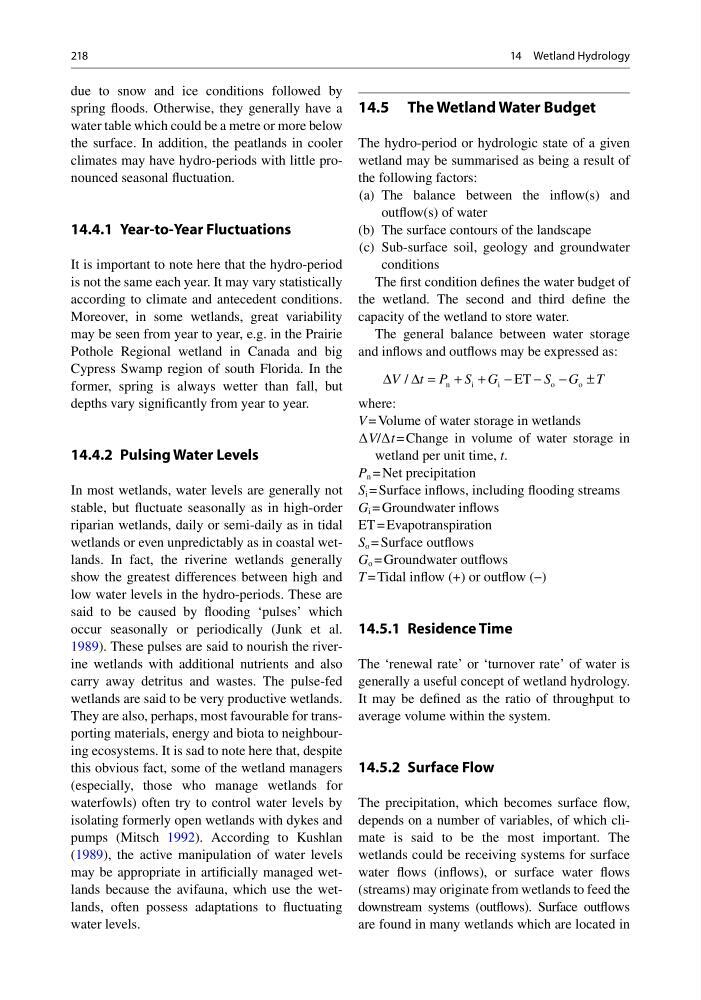
The general balance between water storage
and inflows and outflows may be expressed as:
∆ ∆ = + + −
− − ±
V t P S G
S G T
/
n
i
i
o
o
ET
where:
V = Volume of water storage in wetlands
∆V/∆t = Change in volume of water storage in
wetland per unit time, t.
P n = Net precipitation
S i = Surface inflows, including flooding streams
G i = Groundwater inflows
ET = Evapotranspiration
S o = Surface outflows
G o = Groundwater outflows
T = Tidal inflow (+) or outflow (−)
14.5.1 Residence Time
The ‘renewal rate’ or ‘turnover rate’ of water is
generally a useful concept of wetland hydrology.
It may be defined as the ratio of throughput to
average volume within the system.
14.5.2 Surface Flow
The precipitation, which becomes surface flow,
depends on a number of variables, of which climate is said to be the most important. The
wetlands could be receiving systems for surface
water flows (inflows), or surface water flows
(streams) may originate from wetlands to feed the
downstream systems (outflows). Surface outflows
are found in many wetlands which are located in
14 Wetland Hydrology
due to snow and ice conditions followed by
spring floods. Otherwise, they generally have a
water table which could be a metre or more below
the surface. In addition, the peatlands in cooler
climates may have hydro-periods with little pronounced seasonal fluctuation.
14.4.1 Year-to-Year Fluctuations
It is important to note here that the hydro-period
is not the same each year. It may vary statistically
according to climate and antecedent conditions.
Moreover, in some wetlands, great variability
may be seen from year to year, e.g. in the Prairie
Pothole Regional wetland in Canada and big
Cypress Swamp region of south Florida. In the
former, spring is always wetter than fall, but
depths vary significantly from year to year.
14.4.2 Pulsing Water Levels
In most wetlands, water levels are generally not
stable, but fluctuate seasonally as in high-order
riparian wetlands, daily or semi-daily as in tidal
wetlands or even unpredictably as in coastal wetlands. In fact, the riverine wetlands generally
show the greatest differences between high and
low water levels in the hydro-periods. These are
said to be caused by flooding ‘pulses’ which
occur seasonally or periodically (Junk et al.
1989). These pulses are said to nourish the riverine wetlands with additional nutrients and also
carry away detritus and wastes. The pulse-fed
wetlands are said to be very productive wetlands.
They are also, perhaps, most favourable for transporting materials, energy and biota to neighbouring ecosystems. It is sad to note here that, despite
this obvious fact, some of the wetland managers
(especially, those who manage wetlands for
waterfowls) often try to control water levels by
isolating formerly open wetlands with dykes and
pumps (Mitsch 1992). According to Kushlan
(1989), the active manipulation of water levels
may be appropriate in artificially managed wetlands because the avifauna, which use the wetlands, often possess adaptations to fluctuating
water levels.
14.5 The Wetland Water Budget
The hydro-period or hydrologic state of a given
wetland may be summarised as being a result of
the following factors:
(a) The balance between the inflow(s) and
outflow(s) of water
(b) The surface contours of the landscape
(c) Sub-surface soil, geology and groundwater
conditions
The first condition defines the water budget of
the wetland. The second and third define the
capacity of the wetland to store water.
The general balance between water storage
and inflows and outflows may be expressed as:
∆ ∆ = + + −
− − ±
V t P S G
S G T
/
n
i
i
o
o
ET
where:
V = Volume of water storage in wetlands
∆V/∆t = Change in volume of water storage in
wetland per unit time, t.
P n = Net precipitation
S i = Surface inflows, including flooding streams
G i = Groundwater inflows
ET = Evapotranspiration
S o = Surface outflows
G o = Groundwater outflows
T = Tidal inflow (+) or outflow (−)
14.5.1 Residence Time
The ‘renewal rate’ or ‘turnover rate’ of water is
generally a useful concept of wetland hydrology.
It may be defined as the ratio of throughput to
average volume within the system.
14.5.2 Surface Flow
The precipitation, which becomes surface flow,
depends on a number of variables, of which climate is said to be the most important. The
wetlands could be receiving systems for surface
water flows (inflows), or surface water flows
(streams) may originate from wetlands to feed the
downstream systems (outflows). Surface outflows
are found in many wetlands which are located in
14 Wetland Hydrology