

209
13.4 Sulphur Transformations
In wetlands, sulphur occurs in several different
states of oxidation. It is transformed through several pathways like nitrogen. These are mediated by
microbes. Further, in wetlands, sulphur is rarely
present in such low concentrations which could be
a limiting factor for plant and animal growth.
When the wetland sediments are disturbed, the
release of reduced form of sulphur, sulphide, etc.,
causes an odour which is familiar to smell of rotten
eggs. Further, ‘sulphate reduction’ may take place
as ‘assimilatory sulphate reduction’, in which certain sulphur-reducing obligate anaerobes, e.g.
Desulfovibrio bacteria, use the sulphates as terminal electron acceptors in anaerobic respiration:
4
2
2
2
4
2
H SO
H S H O OH
s
+
→
+
+
−
It may occur over a wide range of pH, with
highest rates prevalent near neutral pH.
In addition to above, sulphides could be oxidised by both chemoautotrophic and photosynthetic microbes to elemental sulphur and sulphates
in the aerobic zones of some wetland soils.
13.4.1 Sulphide Toxicity
H 2 S is usually characteristic of anaerobic wetland
sediments. However, it may be toxic to rooted
higher plants and microbes. However, the toxicity of free H 2 S could be reduced when sulphides
could combine with iron to form insoluble ferrous sulphides in wetland soils which contain
high concentrations of ferrous iron (Fe
2+
)
(Gambrell and Patrick 1978).
13.5 Carbon Transformations
The major processes of carbon transformation
under aerobic and anaerobic conditions include
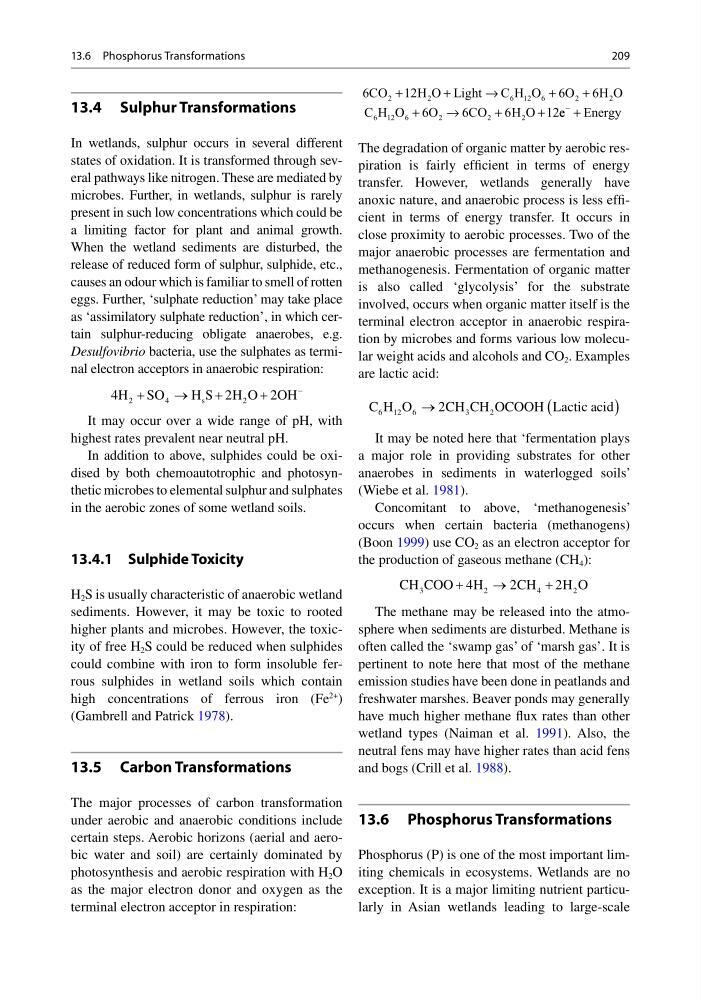
certain steps. Aerobic horizons (aerial and aerobic water and soil) are certainly dominated by
photosynthesis and aerobic respiration with H 2 O
as the major electron donor and oxygen as the
terminal electron acceptor in respiration:
6
12
6
6
6
6
6
12
2
2
6 12 6
2
2
6 12 6
2
2
2
CO
H O Light C H O
O
H O
C H O
O
CO
H O
+
+
→
+
+
+
→
+
+ e e Energy
−
+
The degradation of organic matter by aerobic respiration is fairly efficient in terms of energy
transfer. However, wetlands generally have
anoxic nature, and anaerobic process is less efficient in terms of energy transfer. It occurs in
close proximity to aerobic processes. Two of the
major anaerobic processes are fermentation and
methanogenesis. Fermentation of organic matter
is also called ‘glycolysis’ for the substrate
involved, occurs when organic matter itself is the
terminal electron acceptor in anaerobic respiration by microbes and forms various low molecular weight acids and alcohols and CO 2 . Examples
are lactic acid:
C H O
CH CH OCOOH Lactic acid
6 12 6
3
2
2
→
(
)
It may be noted here that ‘fermentation plays
a major role in providing substrates for other
anaerobes in sediments in waterlogged soils’
(Wiebe et al. 1981).
Concomitant to above, ‘methanogenesis’
occurs when certain bacteria (methanogens)
(Boon 1999) use CO 2 as an electron acceptor for
the production of gaseous methane (CH 4 ):
CH COO H
CH
H O
3
2
4
2
4
2
2
+
→
+
The methane may be released into the atmosphere when sediments are disturbed. Methane is
often called the ‘swamp gas’ of ‘marsh gas’. It is
pertinent to note here that most of the methane
emission studies have been done in peatlands and
freshwater marshes. Beaver ponds may generally
have much higher methane flux rates than other
wetland types (Naiman et al. 1991). Also, the
neutral fens may have higher rates than acid fens
and bogs (Crill et al. 1988).
13.6 Phosphorus Transformations
Phosphorus (P) is one of the most important limiting chemicals in ecosystems. Wetlands are no
exception. It is a major limiting nutrient particularly in Asian wetlands leading to large-scale
13.6 Phosphorus Transformations
13.4 Sulphur Transformations
In wetlands, sulphur occurs in several different
states of oxidation. It is transformed through several pathways like nitrogen. These are mediated by
microbes. Further, in wetlands, sulphur is rarely
present in such low concentrations which could be
a limiting factor for plant and animal growth.
When the wetland sediments are disturbed, the
release of reduced form of sulphur, sulphide, etc.,
causes an odour which is familiar to smell of rotten
eggs. Further, ‘sulphate reduction’ may take place
as ‘assimilatory sulphate reduction’, in which certain sulphur-reducing obligate anaerobes, e.g.
Desulfovibrio bacteria, use the sulphates as terminal electron acceptors in anaerobic respiration:
4
2
2
2
4
2
H SO
H S H O OH
s
+
→
+
+
−
It may occur over a wide range of pH, with
highest rates prevalent near neutral pH.
In addition to above, sulphides could be oxidised by both chemoautotrophic and photosynthetic microbes to elemental sulphur and sulphates
in the aerobic zones of some wetland soils.
13.4.1 Sulphide Toxicity
H 2 S is usually characteristic of anaerobic wetland
sediments. However, it may be toxic to rooted
higher plants and microbes. However, the toxicity of free H 2 S could be reduced when sulphides
could combine with iron to form insoluble ferrous sulphides in wetland soils which contain
high concentrations of ferrous iron (Fe
2+
)
(Gambrell and Patrick 1978).
13.5 Carbon Transformations
The major processes of carbon transformation
under aerobic and anaerobic conditions include
certain steps. Aerobic horizons (aerial and aerobic water and soil) are certainly dominated by
photosynthesis and aerobic respiration with H 2 O
as the major electron donor and oxygen as the
terminal electron acceptor in respiration:
6
12
6
6
6
6
6
12
2
2
6 12 6
2
2
6 12 6
2
2
2
CO
H O Light C H O
O
H O
C H O
O
CO
H O
+
+
→
+
+
+
→
+
+ e e Energy
−
+
The degradation of organic matter by aerobic respiration is fairly efficient in terms of energy
transfer. However, wetlands generally have
anoxic nature, and anaerobic process is less efficient in terms of energy transfer. It occurs in
close proximity to aerobic processes. Two of the
major anaerobic processes are fermentation and
methanogenesis. Fermentation of organic matter
is also called ‘glycolysis’ for the substrate
involved, occurs when organic matter itself is the
terminal electron acceptor in anaerobic respiration by microbes and forms various low molecular weight acids and alcohols and CO 2 . Examples
are lactic acid:
C H O
CH CH OCOOH Lactic acid
6 12 6
3
2
2
→
(
)
It may be noted here that ‘fermentation plays
a major role in providing substrates for other
anaerobes in sediments in waterlogged soils’
(Wiebe et al. 1981).
Concomitant to above, ‘methanogenesis’
occurs when certain bacteria (methanogens)
(Boon 1999) use CO 2 as an electron acceptor for
the production of gaseous methane (CH 4 ):
CH COO H
CH
H O
3
2
4
2
4
2
2
+
→
+
The methane may be released into the atmosphere when sediments are disturbed. Methane is
often called the ‘swamp gas’ of ‘marsh gas’. It is
pertinent to note here that most of the methane
emission studies have been done in peatlands and
freshwater marshes. Beaver ponds may generally
have much higher methane flux rates than other
wetland types (Naiman et al. 1991). Also, the
neutral fens may have higher rates than acid fens
and bogs (Crill et al. 1988).
13.6 Phosphorus Transformations
Phosphorus (P) is one of the most important limiting chemicals in ecosystems. Wetlands are no
exception. It is a major limiting nutrient particularly in Asian wetlands leading to large-scale
13.6 Phosphorus Transformations