

104
has been found to be a much better practice,
where run-off, soil erosion and nutrient loss
were found to be minimum.
(i) The offerings made by the pilgrims may turn
the lake water acidic. This is to be taken care
of. Alternatively, removal of offerings from
the lake water on daily basis by local conservation body (Khecheopalri Holy Lake
Welfare Committee) may be initiated.
(j) ‘Ecotourism’ could be an important source of
economic generation for the local community.
(k) Long-term scientifi c monitoring is very
much essential to know the status and changing trend of the lake ecosystem.
(l) Last but not the least, community awareness
and code of conduct for visitors are to be
established.
The holistic view of degradation and decrease
in longevity of the lake takes into account various
factors, like growth of population, fragmentation
of families, land use/cover change, livestock
grazing, timber and fi rewood extraction, growth
of tourism and pilgrimage. Assessment of these
factors may help in management.
Gurudogmar Lake
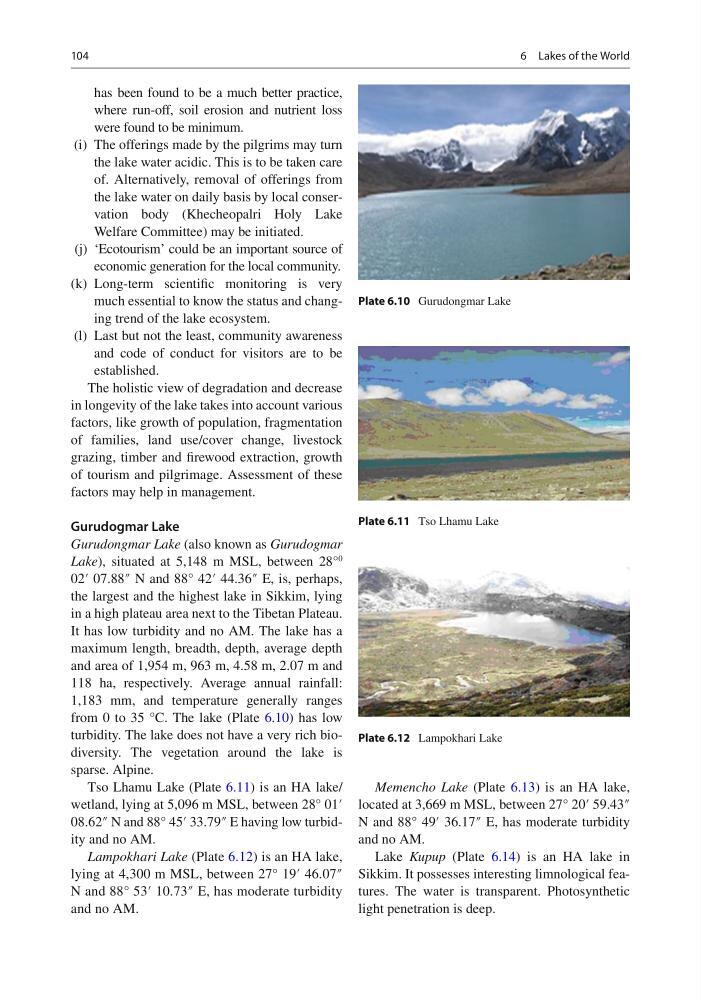
Gurudongmar Lake (also known as Gurudogmar
Lake ), situated at 5,148 m MSL, between 28°
0
02′ 07.88″ N and 88° 42′ 44.36″ E, is, perhaps,
the largest and the highest lake in Sikkim, lying
in a high plateau area next to the Tibetan Plateau.
It has low turbidity and no AM. The lake has a
maximum length, breadth, depth, average depth
and area of 1,954 m, 963 m, 4.58 m, 2.07 m and
118 ha, respectively. Average annual rainfall:
1,183 mm, and temperature generally ranges
from 0 to 35 °C. The lake (Plate 6.10 ) has low
turbidity. The lake does not have a very rich biodiversity. The vegetation around the lake is
sparse. Alpine.
Tso Lhamu Lake (Plate 6.11 ) is an HA lake/
wetland, lying at 5,096 m MSL, between 28° 01′
08.62″ N and 88° 45′ 33.79″ E having low turbidity and no AM.
Lampokhari Lake (Plate 6.12 ) is an HA lake,
lying at 4,300 m MSL, between 27° 19′ 46.07″
N and 88° 53′ 10.73″ E, has moderate turbidity
and no AM.
Memencho Lake (Plate 6.13 ) is an HA lake,
located at 3,669 m MSL, between 27° 20′ 59.43″
N and 88° 49′ 36.17″ E, has moderate turbidity
and no AM.
Lake Kupup (Plate 6.14 ) is an HA lake in
Sikkim. It possesses interesting limnological features. The water is transparent. Photosynthetic
light penetration is deep.
Plate 6.10 Gurudongmar Lake
Plate 6.11 Tso Lhamu Lake
Plate 6.12 Lampokhari Lake
6 Lakes of the World
has been found to be a much better practice,
where run-off, soil erosion and nutrient loss
were found to be minimum.
(i) The offerings made by the pilgrims may turn
the lake water acidic. This is to be taken care
of. Alternatively, removal of offerings from
the lake water on daily basis by local conservation body (Khecheopalri Holy Lake
Welfare Committee) may be initiated.
(j) ‘Ecotourism’ could be an important source of
economic generation for the local community.
(k) Long-term scientifi c monitoring is very
much essential to know the status and changing trend of the lake ecosystem.
(l) Last but not the least, community awareness
and code of conduct for visitors are to be
established.
The holistic view of degradation and decrease
in longevity of the lake takes into account various
factors, like growth of population, fragmentation
of families, land use/cover change, livestock
grazing, timber and fi rewood extraction, growth
of tourism and pilgrimage. Assessment of these
factors may help in management.
Gurudogmar Lake
Gurudongmar Lake (also known as Gurudogmar
Lake ), situated at 5,148 m MSL, between 28°
0
02′ 07.88″ N and 88° 42′ 44.36″ E, is, perhaps,
the largest and the highest lake in Sikkim, lying
in a high plateau area next to the Tibetan Plateau.
It has low turbidity and no AM. The lake has a
maximum length, breadth, depth, average depth
and area of 1,954 m, 963 m, 4.58 m, 2.07 m and
118 ha, respectively. Average annual rainfall:
1,183 mm, and temperature generally ranges
from 0 to 35 °C. The lake (Plate 6.10 ) has low
turbidity. The lake does not have a very rich biodiversity. The vegetation around the lake is
sparse. Alpine.
Tso Lhamu Lake (Plate 6.11 ) is an HA lake/
wetland, lying at 5,096 m MSL, between 28° 01′
08.62″ N and 88° 45′ 33.79″ E having low turbidity and no AM.
Lampokhari Lake (Plate 6.12 ) is an HA lake,
lying at 4,300 m MSL, between 27° 19′ 46.07″
N and 88° 53′ 10.73″ E, has moderate turbidity
and no AM.
Memencho Lake (Plate 6.13 ) is an HA lake,
located at 3,669 m MSL, between 27° 20′ 59.43″
N and 88° 49′ 36.17″ E, has moderate turbidity
and no AM.
Lake Kupup (Plate 6.14 ) is an HA lake in
Sikkim. It possesses interesting limnological features. The water is transparent. Photosynthetic
light penetration is deep.
Plate 6.10 Gurudongmar Lake
Plate 6.11 Tso Lhamu Lake
Plate 6.12 Lampokhari Lake
6 Lakes of the World