

98
6.9.1.2 High Altitude Lentic Bodies
of Arunachal Pradesh (ArP)
Wetlands of Arunachal Pradesh
In ArP, the estimated total wetland area is
154,609 ha, which is c 1.91 % of the total geographic area of the province. Of these, the high
altitude (HA) wetlands account for 11,422 ha and
waterlogged areas for 8,146 ha.
Analysis of wetland status in terms of open
water and aquatic vegetation showed that c 43
and 37 % of wetland area is under open-water
category during post-monsoon and pre-monsoon
seasons, respectively. AM (fl oating/emergent)
occupy c 3.8 and 3.3 % of the wetland area during post- and pre-monsoon seasons, respectively.
During the post-monsoon season, turbidity
depicted low and moderate values in 85 and 12 %
of the wetlands, respectively.
A General Account of Floodplain
Wetlands of ArP
Floodplain wetlands are known by various names
in different parts of the country. For example,
they are called by Beel, Haor, Baor, Anua, Jala,
Doloni, etc. in NE India and Bangladesh. These
resources represent one of the most potential
waterbodies for fi sheries. And they are losing
their inherent potentials day by day in the absence
or lack of proper management practices. As such,
considering their importance from piscicultural
point of view, the urgent step would be to save
them from eutrophication and dereliction through
sustainable management practices and piscicultural developments.
Interestingly, the Ganga, Brahmaputra and the
Barak basins of India have large number of wetlands which are extensively distributed. The people living in the vicinity of such ecosystems
depend much on these lentic bodies for agriculture, horticulture, fi sheries, cottage industries,
etc. The utility of the Beels, thus, could be summarised under three major aspects, namely, economic, aesthetic and cultural. In recent years,
however, these ecosystems have been subjected
to severe stress in the face of increasing demographic pressure followed by altered land use
patterns, changing face of rivers valleys on
account of man-induced modifi cations (due to
confl icting demands by user groups), etc. It is
time that all-out efforts are being made to conserve the wetland ecosystem so as to take care of
the legitimate needs of the various user groups in
addition to sustained conservation of the aquatic
biodiversity.
ArP, largely, has a hilly terrain. It is blessed
with a good number of rivers, streams, etc., notably, the Siang, Lohit, Dibang, Noadhing,
Subansiri and Dikrong, which fi nally confl uent
with river Brahmaputra. However, at the debouching point of most of the rivers/streams, there are a
large number of potential Beels in Arunachal
Pradesh. Besides, there are other natural waterbodies having link with the main river/tributaries
in the medium altitude regime beyond 500 m
MSL. It is believed that the changes in the river
courses coupled with occasional earthquakes
have resulted in the formation of different types
of wetlands in the middle altitude region. The
wetlands including the swamps account for c .
2,500 ha of the water area of the province. In ArP,
316.62 ha of water area has, possibly, been registered under lentic bodies. The important medium
altitude lakes are Ganga (Gekiar Syni), Sally,
Glow, Mehao, etc.
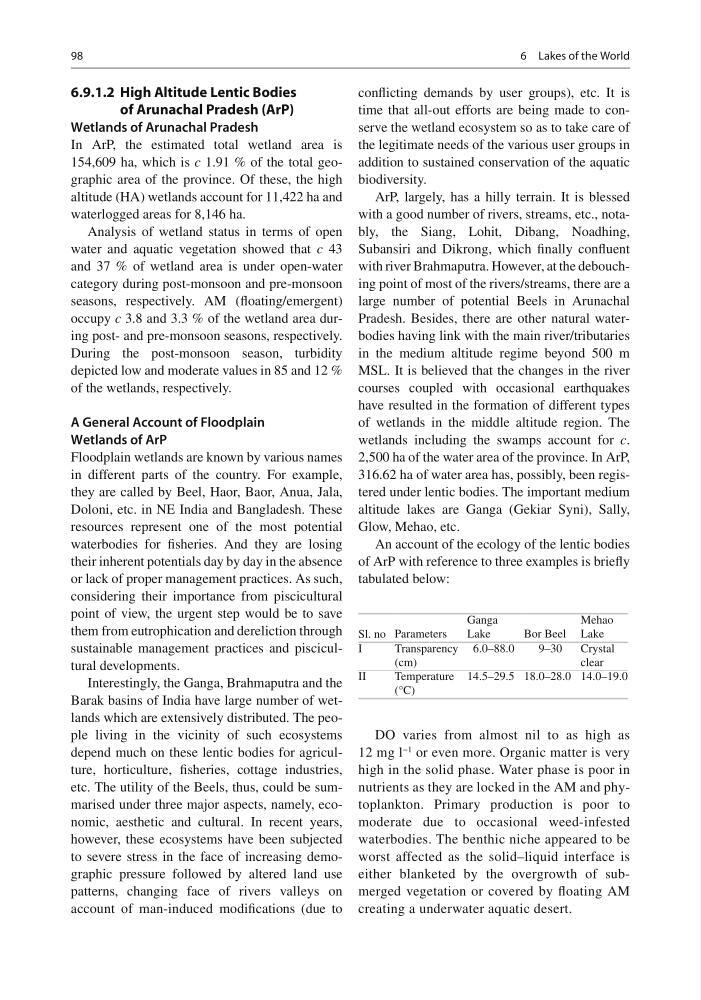
An account of the ecology of the lentic bodies
of ArP with reference to three examples is briefl y
tabulated below:
Sl. no Parameters
Ganga
Lake
Bor Beel
Mehao
Lake
I
Transparency
(cm)
6.0–88.0
9–30
Crystal
clear
II
Temperature
(°C)
14.5–29.5 18.0–28.0 14.0–19.0
DO varies from almost nil to as high as
12 mg l
−1 or even more. Organic matter is very
high in the solid phase. Water phase is poor in
nutrients as they are locked in the AM and phytoplankton. Primary production is poor to
moderate due to occasional weed-infested
waterbodies. The benthic niche appeared to be
worst affected as the solid–liquid interface is
either blanketed by the overgrowth of submerged vegetation or covered by fl oating AM
creating a underwater aquatic desert.
6 Lakes of the World
6.9.1.2 High Altitude Lentic Bodies
of Arunachal Pradesh (ArP)
Wetlands of Arunachal Pradesh
In ArP, the estimated total wetland area is
154,609 ha, which is c 1.91 % of the total geographic area of the province. Of these, the high
altitude (HA) wetlands account for 11,422 ha and
waterlogged areas for 8,146 ha.
Analysis of wetland status in terms of open
water and aquatic vegetation showed that c 43
and 37 % of wetland area is under open-water
category during post-monsoon and pre-monsoon
seasons, respectively. AM (fl oating/emergent)
occupy c 3.8 and 3.3 % of the wetland area during post- and pre-monsoon seasons, respectively.
During the post-monsoon season, turbidity
depicted low and moderate values in 85 and 12 %
of the wetlands, respectively.
A General Account of Floodplain
Wetlands of ArP
Floodplain wetlands are known by various names
in different parts of the country. For example,
they are called by Beel, Haor, Baor, Anua, Jala,
Doloni, etc. in NE India and Bangladesh. These
resources represent one of the most potential
waterbodies for fi sheries. And they are losing
their inherent potentials day by day in the absence
or lack of proper management practices. As such,
considering their importance from piscicultural
point of view, the urgent step would be to save
them from eutrophication and dereliction through
sustainable management practices and piscicultural developments.
Interestingly, the Ganga, Brahmaputra and the
Barak basins of India have large number of wetlands which are extensively distributed. The people living in the vicinity of such ecosystems
depend much on these lentic bodies for agriculture, horticulture, fi sheries, cottage industries,
etc. The utility of the Beels, thus, could be summarised under three major aspects, namely, economic, aesthetic and cultural. In recent years,
however, these ecosystems have been subjected
to severe stress in the face of increasing demographic pressure followed by altered land use
patterns, changing face of rivers valleys on
account of man-induced modifi cations (due to
confl icting demands by user groups), etc. It is
time that all-out efforts are being made to conserve the wetland ecosystem so as to take care of
the legitimate needs of the various user groups in
addition to sustained conservation of the aquatic
biodiversity.
ArP, largely, has a hilly terrain. It is blessed
with a good number of rivers, streams, etc., notably, the Siang, Lohit, Dibang, Noadhing,
Subansiri and Dikrong, which fi nally confl uent
with river Brahmaputra. However, at the debouching point of most of the rivers/streams, there are a
large number of potential Beels in Arunachal
Pradesh. Besides, there are other natural waterbodies having link with the main river/tributaries
in the medium altitude regime beyond 500 m
MSL. It is believed that the changes in the river
courses coupled with occasional earthquakes
have resulted in the formation of different types
of wetlands in the middle altitude region. The
wetlands including the swamps account for c .
2,500 ha of the water area of the province. In ArP,
316.62 ha of water area has, possibly, been registered under lentic bodies. The important medium
altitude lakes are Ganga (Gekiar Syni), Sally,
Glow, Mehao, etc.
An account of the ecology of the lentic bodies
of ArP with reference to three examples is briefl y
tabulated below:
Sl. no Parameters
Ganga
Lake
Bor Beel
Mehao
Lake
I
Transparency
(cm)
6.0–88.0
9–30
Crystal
clear
II
Temperature
(°C)
14.5–29.5 18.0–28.0 14.0–19.0
DO varies from almost nil to as high as
12 mg l
−1 or even more. Organic matter is very
high in the solid phase. Water phase is poor in
nutrients as they are locked in the AM and phytoplankton. Primary production is poor to
moderate due to occasional weed-infested
waterbodies. The benthic niche appeared to be
worst affected as the solid–liquid interface is
either blanketed by the overgrowth of submerged vegetation or covered by fl oating AM
creating a underwater aquatic desert.
6 Lakes of the World