

83
is 148 km long and comes from northern
Mongolia and is said to supply c 50 % of the total
infl ow to the lake.
6.4.3 Lake Malawi
It was earlier called Lake Nyasa. It is (Plate 6.2 )
the fourth deepest lake in the world. There are
many similarities between Lake Malawi and
Tanganyika. It also has large volume of deoxygenated hypolimnion. It was, perhaps, clearly
isolated from other water bodies for a long period
to develop a very diverse fi sh fauna, in which
most of the fi sh species are endemic.
Lake Malawi (14° S–36° E, altitude 470 m,
catchment area 65,000 km
2
, lake area 30,000 km
2 ,
lake volume 8,400 km
3
, max. depth 704 m, mean
depth 273 m) is situated in Malawi in Africa.
Many of the fi sh fauna of Lake Malawi live in
small, localised area of the lake. There are also
groups of species which seem to be exploiting the
same resources. Some fi sh species eat Vallisneria.
Some others scrape off algae which grow on its
leaves. Some eat algae which grow on the surface
of the sand. About 245 species of fi shes have
been reported from Lake Malawi. Of these, c 200
species are cichlids, of which >95 % are endemic.
6.4.4 Loch Ness and Loch Morar
Loch Morar is the deepest lake in Britain with
maximum depth of 310 m. However, the greatest mean depth (132 m) is found in the Loch
Ness. Loch Morar basin was formed by the glacier fl owing east–west. Loch Ness lies east–
west in the rift called Great Glen which is
tectonic in origin.
Loch Ness drains the catchment ten times
larger than Loch Morar. It is subjected to greater
human infl uence. It is (57° 20′ N; 4° 30′ W, altitude
15.8 m, catchment area 1,775 km
2 , lake area
57 km
2 , lake volume 7.45 km
3 , max. depth 230 m,
mean depth 132 m) situated in Scotland of Great
Britain. River Oich is the principal infl ow while
River Ness is the main outfl ow.
Loch Morar is very clear with Secchi disc
transparency between 5.7 and 10.2 m depending
on season.
Loch Ness has more phytoplankton than Loch
Morar. Both the lochs are very cold. The features
like cold temperature, lack of nutrients and great
depth all combine to keep primary production
low and ensure that few animals can live in these
lakes. Insects dominate the invertebrates of the
littoral zone. Fishes are rarely found in water
deeper than 30–40 m. Both the lakes contain
Atlantic salmon, brown trout, eel, etc.
6.5
Shallow Lakes
It could be said that lakes in the globe may range
in depth from >1,000 m to no water at all. So,
how could we say where deep lakes end and
shallow lakes begin? It is easy to distinguish the
extremes. But it is also much less easy to defi ne
shallow lakes. The most useful defi nition of
shallow lake is one which never experiences
thermal stratifi cation continuously for a long
period. It is shallow enough for the wind to keep
all the water more or less permanently mixed.
This has profound consequences for the structure of the lake community and the way the lake
functions. Whether or not, a lake is functionally
shallow, thus depends not only on actual depth
but also on its area and the degree to which the
surface of the lake is exposed to the wind. Some
of the largest lakes are actually very shallow,
e.g . Lough Neagh in Northern Ireland is the
largest expanse of freshwater in the British Isles
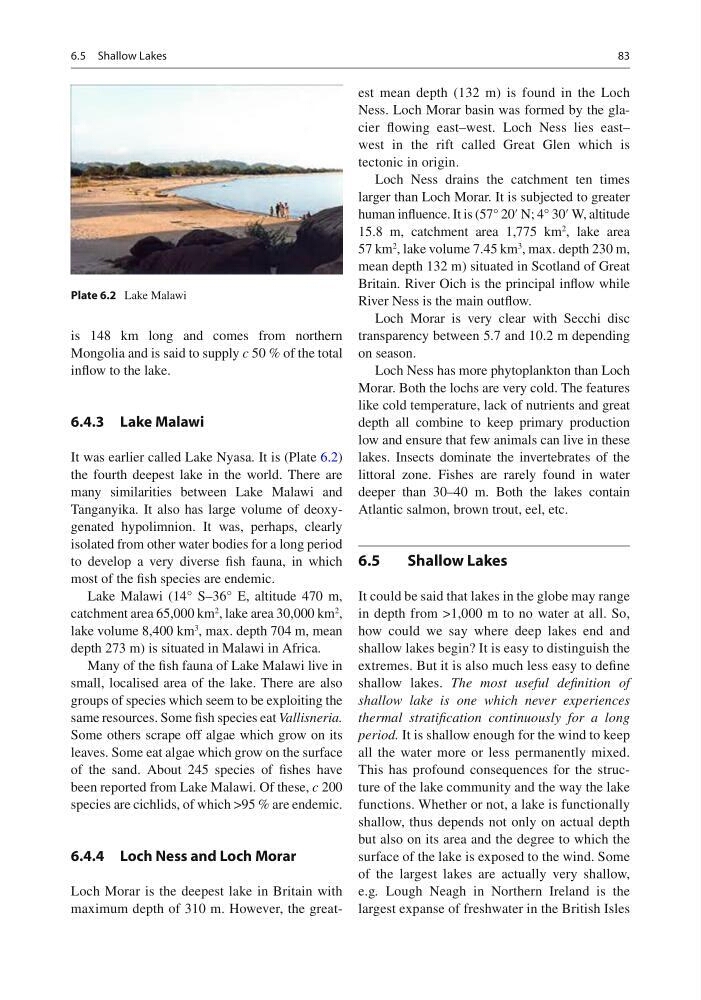
Plate 6.2 Lake Malawi
6.5 Shallow Lakes
is 148 km long and comes from northern
Mongolia and is said to supply c 50 % of the total
infl ow to the lake.
6.4.3 Lake Malawi
It was earlier called Lake Nyasa. It is (Plate 6.2 )
the fourth deepest lake in the world. There are
many similarities between Lake Malawi and
Tanganyika. It also has large volume of deoxygenated hypolimnion. It was, perhaps, clearly
isolated from other water bodies for a long period
to develop a very diverse fi sh fauna, in which
most of the fi sh species are endemic.
Lake Malawi (14° S–36° E, altitude 470 m,
catchment area 65,000 km
2
, lake area 30,000 km
2 ,
lake volume 8,400 km
3
, max. depth 704 m, mean
depth 273 m) is situated in Malawi in Africa.
Many of the fi sh fauna of Lake Malawi live in
small, localised area of the lake. There are also
groups of species which seem to be exploiting the
same resources. Some fi sh species eat Vallisneria.
Some others scrape off algae which grow on its
leaves. Some eat algae which grow on the surface
of the sand. About 245 species of fi shes have
been reported from Lake Malawi. Of these, c 200
species are cichlids, of which >95 % are endemic.
6.4.4 Loch Ness and Loch Morar
Loch Morar is the deepest lake in Britain with
maximum depth of 310 m. However, the greatest mean depth (132 m) is found in the Loch
Ness. Loch Morar basin was formed by the glacier fl owing east–west. Loch Ness lies east–
west in the rift called Great Glen which is
tectonic in origin.
Loch Ness drains the catchment ten times
larger than Loch Morar. It is subjected to greater
human infl uence. It is (57° 20′ N; 4° 30′ W, altitude
15.8 m, catchment area 1,775 km
2 , lake area
57 km
2 , lake volume 7.45 km
3 , max. depth 230 m,
mean depth 132 m) situated in Scotland of Great
Britain. River Oich is the principal infl ow while
River Ness is the main outfl ow.
Loch Morar is very clear with Secchi disc
transparency between 5.7 and 10.2 m depending
on season.
Loch Ness has more phytoplankton than Loch
Morar. Both the lochs are very cold. The features
like cold temperature, lack of nutrients and great
depth all combine to keep primary production
low and ensure that few animals can live in these
lakes. Insects dominate the invertebrates of the
littoral zone. Fishes are rarely found in water
deeper than 30–40 m. Both the lakes contain
Atlantic salmon, brown trout, eel, etc.
6.5
Shallow Lakes
It could be said that lakes in the globe may range
in depth from >1,000 m to no water at all. So,
how could we say where deep lakes end and
shallow lakes begin? It is easy to distinguish the
extremes. But it is also much less easy to defi ne
shallow lakes. The most useful defi nition of
shallow lake is one which never experiences
thermal stratifi cation continuously for a long
period. It is shallow enough for the wind to keep
all the water more or less permanently mixed.
This has profound consequences for the structure of the lake community and the way the lake
functions. Whether or not, a lake is functionally
shallow, thus depends not only on actual depth
but also on its area and the degree to which the
surface of the lake is exposed to the wind. Some
of the largest lakes are actually very shallow,
e.g . Lough Neagh in Northern Ireland is the
largest expanse of freshwater in the British Isles
Plate 6.2 Lake Malawi
6.5 Shallow Lakes