

91
In the Elbe River, Dissolved Cd decreased from 5.4 nM in the overlying water to
0.4 nM near the sediment-water interface. In the Main River, Such a decrease
occurred between 0 and 8 cm depth. The concentrations of dissolved Cd were lower
than 0.4 nM in the Rhine River sediments, even in the presence of elevated paticulate
Cd concentrations.
In contrast to the porewater profiles of Cu, Zn, Pb, and Cd, dissolved Cr and Co
increased with depth (Fig. 4.47, 4.48).
In summary, the concentrations of heavy metals in the porewater were independent
of those in the sediments. A general downward increase of the concentrations of
particulate Cd, Zn, Pb, Cu can be observed. In contrast, a downward decrease of the
concentrations of dissolved Cd, Zn, Pb, and Cu was found. As reported for the Neckar
River sediments, the decrease of porewater Cu, Zn, Pb, and Cd with depth can be
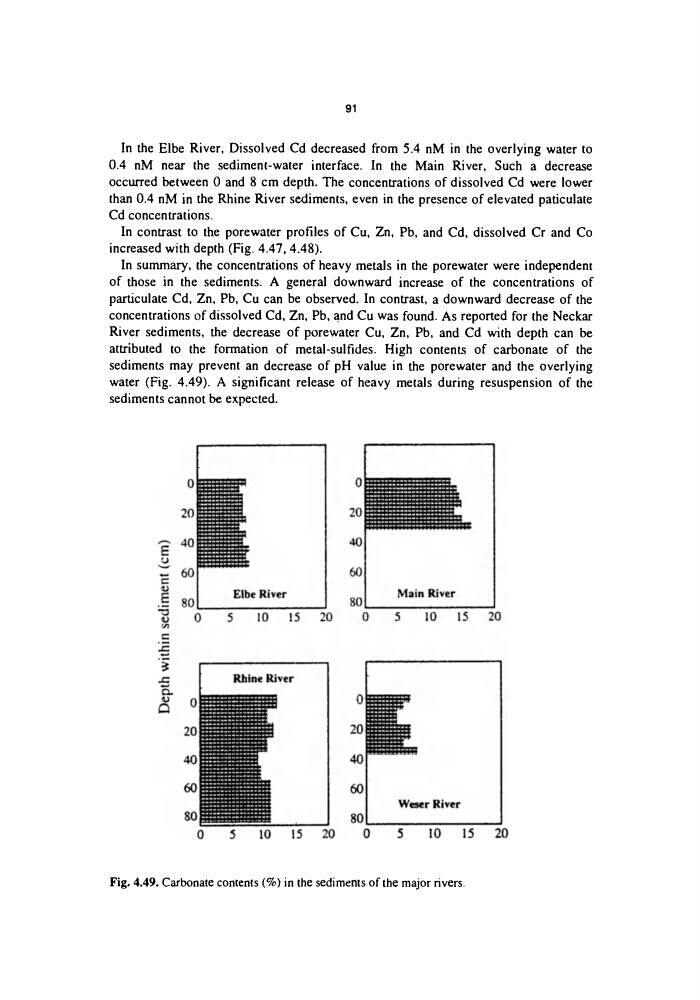
attributed to the formation of metal-sulfides. High contents of carbonate of the
sediments may prevent an decrease of pH value in the porewater and the overlying
water (Fig. 4.49). A significant release of heavy metals during resuspension of the
sediments cannot be expected.
E
e - '
.s_
~
~ J
0
2o
4o
6O
8o
0
0
20
40
60
80
0
e River
] Main River
5
10
15 20
0
5
I0
15 20
20
i] Weser River
5
10
15 20
0
5
10
15
20
Fig. 4.49. Carbonate contents (%) in the sediments of the major rivers.
In the Elbe River, Dissolved Cd decreased from 5.4 nM in the overlying water to
0.4 nM near the sediment-water interface. In the Main River, Such a decrease
occurred between 0 and 8 cm depth. The concentrations of dissolved Cd were lower
than 0.4 nM in the Rhine River sediments, even in the presence of elevated paticulate
Cd concentrations.
In contrast to the porewater profiles of Cu, Zn, Pb, and Cd, dissolved Cr and Co
increased with depth (Fig. 4.47, 4.48).
In summary, the concentrations of heavy metals in the porewater were independent
of those in the sediments. A general downward increase of the concentrations of
particulate Cd, Zn, Pb, Cu can be observed. In contrast, a downward decrease of the
concentrations of dissolved Cd, Zn, Pb, and Cu was found. As reported for the Neckar
River sediments, the decrease of porewater Cu, Zn, Pb, and Cd with depth can be
attributed to the formation of metal-sulfides. High contents of carbonate of the
sediments may prevent an decrease of pH value in the porewater and the overlying
water (Fig. 4.49). A significant release of heavy metals during resuspension of the
sediments cannot be expected.
E
e - '
.s_
~
~ J
0
2o
4o
6O
8o
0
0
20
40
60
80
0
e River
] Main River
5
10
15 20
0
5
I0
15 20
20
i] Weser River
5
10
15 20
0
5
10
15
20
Fig. 4.49. Carbonate contents (%) in the sediments of the major rivers.