

68
other heavy metals, the concentrations of dissolved Cr in the bottom water and in the
porewater were lower than the international standard for drinking water (960 nM,
WHO). This reflects that porewater Cr has no direct influence on the quality of the
overlying water and groundwater.
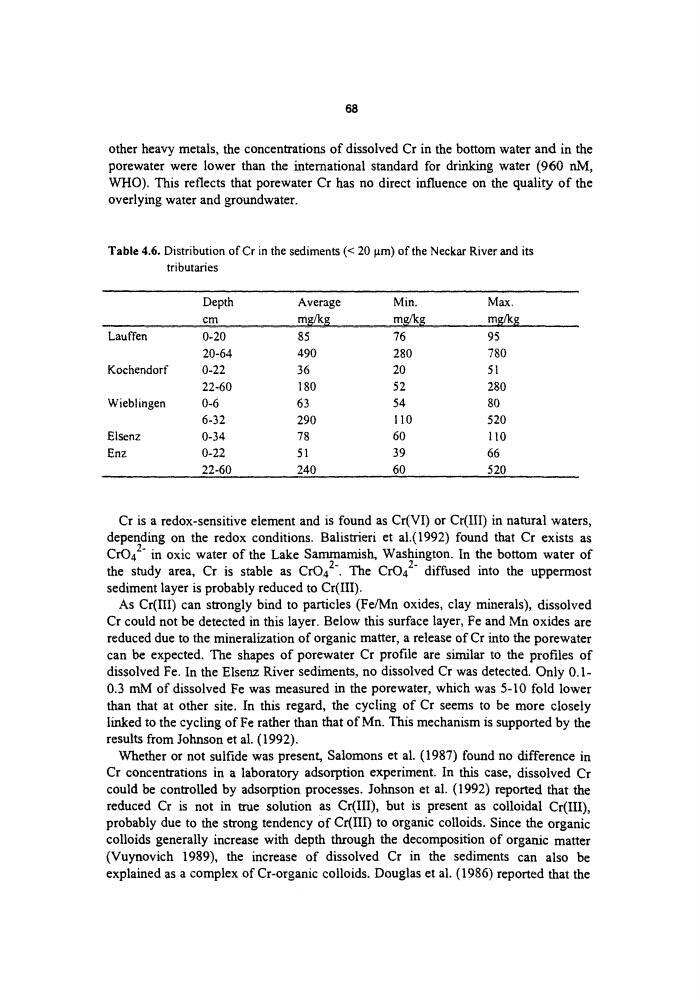
Table 4.6. Distribution of Cr in the sediments (< 20 ~tm) of the Neckar River and its
tributaries
Depth
Average
Min.
Max.
cm
mg/kg
mg/kg
mg/kg
Lauffen
0-20
85
76
95
20-64
490
280
780
Kochendorf
0-22
36
20
51
22-60
180
52
280
Wieblingen
0-6
63
54
80
6-32
290
110
520
EIsenz
0-34
78
60
110
Enz
0-22
51
39
66
22-60
240
60
520
Cr is a redox-sensitive element and is found as Cr(VI) or Cr(III) in natural waters,
depending on the redox conditions. Balistrieri et a1.(1992) found that Cr exists as
CrO42" in oxic water of the Lake Sarnmamish, Washington. In the bottom water of
the study area, Cr is stable as CrO~ 2-. The CrO42" diffused into the uppermost
sediment layer is probably reduced to Cr(III).
As Cr(III) can strongly bind to particles (Fe/Mn oxides, clay minerals), dissolved
Cr could not be detected in this layer. Below this surface layer, Fe and Mn oxides are
reduced due to the mineralization of organic matter, a release of Cr into the porewater
can be expected. The shapes of porewater Cr profile are similar to the profiles of
dissolved Fe. In the Elsenz River sediments, no dissolved Cr was detected. Only 0.10.3 mM of dissolved Fe was measured in the porewater, which was 5-10 fold lower
than that at other site. In this regard, the cycling of Cr seems to be more closely
linked to the cycling of Fe rather than that of Mn. This mechanism is supported by the
results from Johnson et al. (1992).
Whether or not sulfide was present, Salomons et al. (1987) found no difference in
Cr concentrations in a laboratory adsorption experiment. In this case, dissolved Cr
could be controlled by adsorption processes. Johnson et al. (1992) reported that the
reduced Cr is not in true solution as Cr(III), but is present as colloidal Cr(III),
probably due to the strong tendency Of Cr(III) to organic colloids. Since the organic
colloids generally increase with depth through the decomposition of organic matter
(Vuynovich 1989), the increase of dissolved Cr in the sediments can also be
explained as a complex of Cr-organic colloids. Douglas et al. (1986) reported that the
other heavy metals, the concentrations of dissolved Cr in the bottom water and in the
porewater were lower than the international standard for drinking water (960 nM,
WHO). This reflects that porewater Cr has no direct influence on the quality of the
overlying water and groundwater.
Table 4.6. Distribution of Cr in the sediments (< 20 ~tm) of the Neckar River and its
tributaries
Depth
Average
Min.
Max.
cm
mg/kg
mg/kg
mg/kg
Lauffen
0-20
85
76
95
20-64
490
280
780
Kochendorf
0-22
36
20
51
22-60
180
52
280
Wieblingen
0-6
63
54
80
6-32
290
110
520
EIsenz
0-34
78
60
110
Enz
0-22
51
39
66
22-60
240
60
520
Cr is a redox-sensitive element and is found as Cr(VI) or Cr(III) in natural waters,
depending on the redox conditions. Balistrieri et a1.(1992) found that Cr exists as
CrO42" in oxic water of the Lake Sarnmamish, Washington. In the bottom water of
the study area, Cr is stable as CrO~ 2-. The CrO42" diffused into the uppermost
sediment layer is probably reduced to Cr(III).
As Cr(III) can strongly bind to particles (Fe/Mn oxides, clay minerals), dissolved
Cr could not be detected in this layer. Below this surface layer, Fe and Mn oxides are
reduced due to the mineralization of organic matter, a release of Cr into the porewater
can be expected. The shapes of porewater Cr profile are similar to the profiles of
dissolved Fe. In the Elsenz River sediments, no dissolved Cr was detected. Only 0.10.3 mM of dissolved Fe was measured in the porewater, which was 5-10 fold lower
than that at other site. In this regard, the cycling of Cr seems to be more closely
linked to the cycling of Fe rather than that of Mn. This mechanism is supported by the
results from Johnson et al. (1992).
Whether or not sulfide was present, Salomons et al. (1987) found no difference in
Cr concentrations in a laboratory adsorption experiment. In this case, dissolved Cr
could be controlled by adsorption processes. Johnson et al. (1992) reported that the
reduced Cr is not in true solution as Cr(III), but is present as colloidal Cr(III),
probably due to the strong tendency Of Cr(III) to organic colloids. Since the organic
colloids generally increase with depth through the decomposition of organic matter
(Vuynovich 1989), the increase of dissolved Cr in the sediments can also be
explained as a complex of Cr-organic colloids. Douglas et al. (1986) reported that the