

58
appears that the interaction of Cu with DOC is not sufficiently strong to prevent Cusulfide formation. The decrease of dissolved Cu in the porewater of the study area
indicates that Cu was fixed in the particulate phase. From the porewater profiles, a
release of Cu from the sediments into the overlying water can not be expected. In
contrast, the sediments appear to act as a sink rather than a source for Cu.
4.2.2 Cadmium
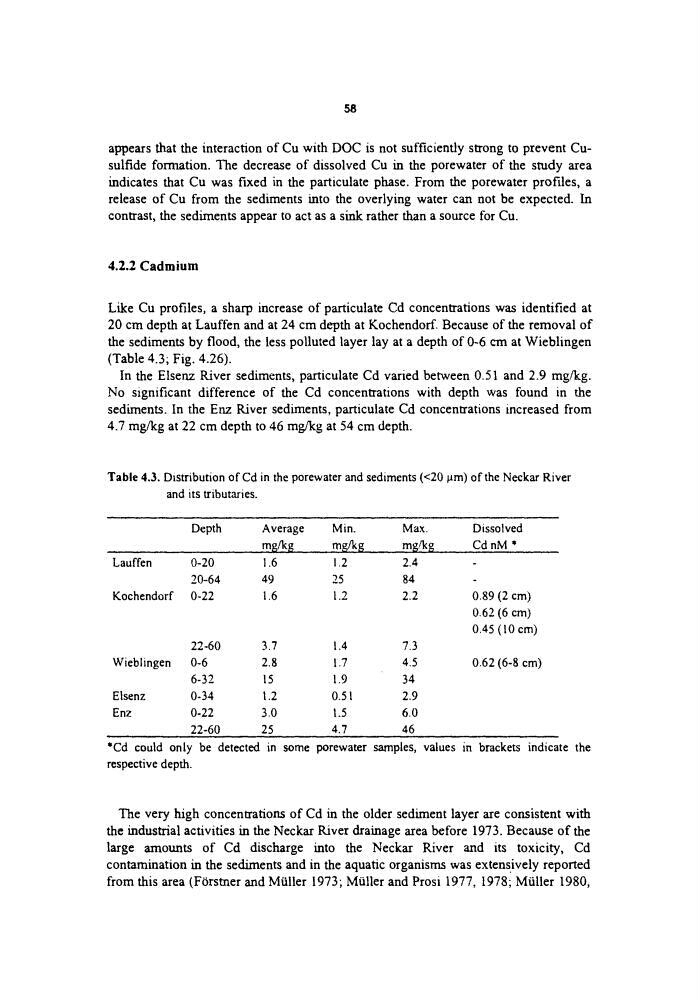
Like Cu profiles, a sharp increase of particulate Cd concentrations was identified at
20 cm depth at Lauffen and at 24 cm depth at Kochendorf. Because of the removal of
the sediments by flood, the less polluted layer lay at a depth of 0-6 cm at Wieblingen
(Table 4.3; Fig. 4.26).
In the Elsertz River sediments, particulate Cd varied between 0.51 and 2.9 mg/kg.
No significant difference of the Cd concentrations with depth was found in the
sediments. In the Enz River sediments, particulate Cd concentrations increased from
4.7 mg/kg at 22 cm depth to 46 mg/kg at 54 cm depth.
Table 4.3. Distribution of Cd in the porewater and sediments (<20 lam) of the Neckar River
and its tributaries.
Depth
Average
Min.
Max.
Dissolved
l
m~&~
mgJkg
rn$./k 8
Cd nM *
Lauffen
0-20
1.6
1.2
2.4
20-64
49
25
84
Kochendorf 0-22
1.6
1.2
2.2
0.89 (2 cm)
0.62 (6 cm)
0.45 (10 cm)
22-60
3.7
1.4
7.3
Wieblingen
0-6
2.8
1.7
4.5
6-32
15
1.9
34
Elsenz
0-34
1.2
0.51
2.9
Enz
0-22
3.0
1.5
6.0
22-60
25
4.7
46
062 (6-8 cm)
*Cd could only be detected in some porewater samples, values in brackets indicate the
respective depth.
The very high concentrations of Cd in the older sediment layer are consistent with
the industrial activities in the Neckar River drainage area before 1973. Because of the
large amounts of Cd discharge into the Neckar River and its toxicity, Cd
contamination in the sediments and in the aquatic organisms was extensively reported
from this area (F6rstner and Miiller 1973; Mtiller and Prosi 1977, 1978; Mtiller 1980,
appears that the interaction of Cu with DOC is not sufficiently strong to prevent Cusulfide formation. The decrease of dissolved Cu in the porewater of the study area
indicates that Cu was fixed in the particulate phase. From the porewater profiles, a
release of Cu from the sediments into the overlying water can not be expected. In
contrast, the sediments appear to act as a sink rather than a source for Cu.
4.2.2 Cadmium
Like Cu profiles, a sharp increase of particulate Cd concentrations was identified at
20 cm depth at Lauffen and at 24 cm depth at Kochendorf. Because of the removal of
the sediments by flood, the less polluted layer lay at a depth of 0-6 cm at Wieblingen
(Table 4.3; Fig. 4.26).
In the Elsertz River sediments, particulate Cd varied between 0.51 and 2.9 mg/kg.
No significant difference of the Cd concentrations with depth was found in the
sediments. In the Enz River sediments, particulate Cd concentrations increased from
4.7 mg/kg at 22 cm depth to 46 mg/kg at 54 cm depth.
Table 4.3. Distribution of Cd in the porewater and sediments (<20 lam) of the Neckar River
and its tributaries.
Depth
Average
Min.
Max.
Dissolved
l
m~&~
mgJkg
rn$./k 8
Cd nM *
Lauffen
0-20
1.6
1.2
2.4
20-64
49
25
84
Kochendorf 0-22
1.6
1.2
2.2
0.89 (2 cm)
0.62 (6 cm)
0.45 (10 cm)
22-60
3.7
1.4
7.3
Wieblingen
0-6
2.8
1.7
4.5
6-32
15
1.9
34
Elsenz
0-34
1.2
0.51
2.9
Enz
0-22
3.0
1.5
6.0
22-60
25
4.7
46
062 (6-8 cm)
*Cd could only be detected in some porewater samples, values in brackets indicate the
respective depth.
The very high concentrations of Cd in the older sediment layer are consistent with
the industrial activities in the Neckar River drainage area before 1973. Because of the
large amounts of Cd discharge into the Neckar River and its toxicity, Cd
contamination in the sediments and in the aquatic organisms was extensively reported
from this area (F6rstner and Miiller 1973; Mtiller and Prosi 1977, 1978; Mtiller 1980,