

32
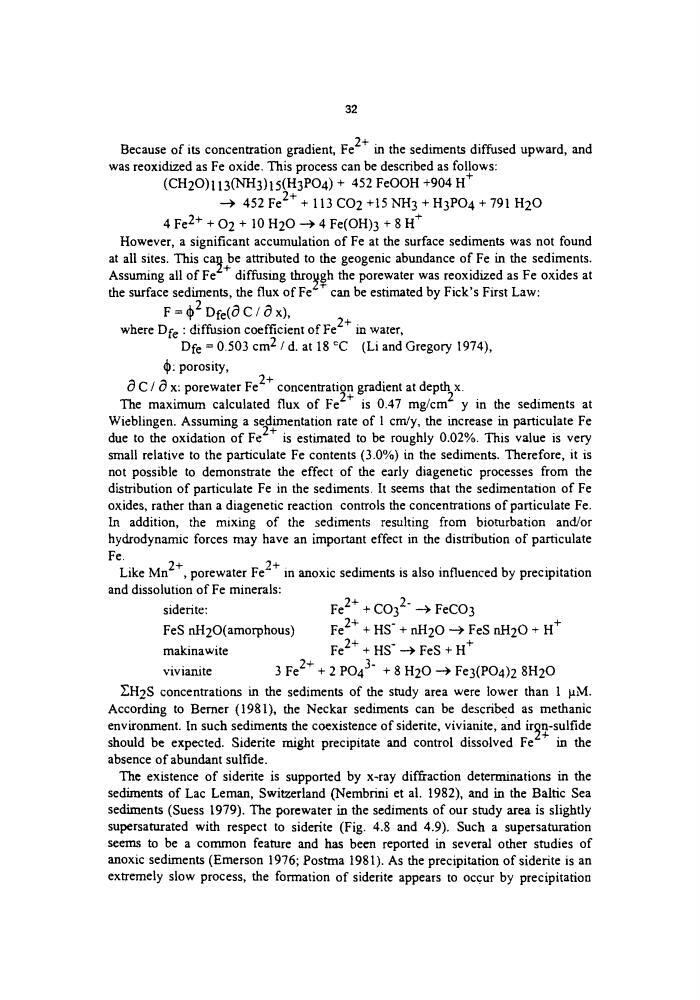
Because of its concentration gradient, Fe 2+ in the sediments diffused upward, and
was reoxidized as Fe oxide. This process can be described as follows:
(CH20)113(NH3)15(H3PO4) + 452 FeOOH +904 H +
--~ 452 Fe 2+ + 113 CO2 +15 NH 3 + H3PO4 + 791 H20
4 Fe 2+ + 02 + 10 H20 ~ 4 Fe(OH)3 + 8 H +
However, a significant accumulation of Fe at the surface sediments was not found
at all sitess 9 This ca~ be attributed to the geogenic abundance of Fe in the sedimentss 9
9
2+
.
.
.
.
.
Assuming all of Fe
diffusing through the porewater was reoxldlzed as Fe oxides at
the surface sedunents, the flux of Fe can be estamated by Ftck s First Law:
F = qb 2 Dfe(C 3 C / 0 x),
where Dfe : diffusion coefficient of Fe 2+ in water,
Dfe = 0.503 cm 2 / d. at 18 ~
(Li and Gregory 1974),
d~: porosity,
0 C / c3 x: porewater Fe 2+ concentration gradient at depthx.
The maximum calculated flux of Fe 2+ is 0.47 mg/cm 2 y in the sediments at
Wieblingen. Assuming a sedimentation rate of 1 cm/y, the increase in particulate Fe
9
2+.
due to the oxidation of Fe
~s estimated to be roughly 0.02%. This value is very
small relative to the particulate Fe contents (3.0%) in the sediments. Therefore, it is
not possible to demonstrate the effect of the early diagenetic processes from the
distribution of particulate Fe in the sediments. It seems that the sedimentation of Fe
oxides, rather than a diagenetic reaction controls the concentrations of particulate Fe.
In addition, the mixing of the sediments resulting from biomrbation and/or
hydrodynamic forces may have an important effect in the distribution of particulate
Fe.
Like Mn 2+, porewater Fe 2+ in anoxic sediments is also influenced by precipitation
and dissolution of Fe minerals:
siderite:
Fe 2+ + CO32- -~ FeCO 3
FeS nH20(amorphous )
Fe 2+ + HS- + ntt20 --> FeS nH20 * H +
makinawite
Fe 2+ + HS" --~ FeS + H +
vivianite
3 Fe 2+ + 2 PO43" + 8 H20 --~ Fe3(PO4)2 8H20
Y.H2S concentrations in the sediments of the study area were lower than 1 !aM.
According to Berner (1981), the Neckar sediments can be described as methanic
environment. In such sediments the coexistence of siderite, vivianite, and iron-sulfide
2+
should be expected. Siderite might precipitate and control dissolved Fe
in the
absence of abundant sulfide.
The existence of siderite is supported by x-ray diffraction determinations in the
sediments of Lac Leman, Switzerland (Nembrini et al. 1982), and in the Baltic Sea
sediments (Suess 1979). The porewater in the sediments of our study area is slightly
supersaturated with respect to siderite (Fig. 4.8 and 4.9). Such a supersaturation
seems to be a common feature and has been reported in several other studies of
anoxic sediments (Emerson 1976; Postma 1981). As the precipitation of siderite is an
extremely slow process, the formation of siderite appears to occur by precipitation
Because of its concentration gradient, Fe 2+ in the sediments diffused upward, and
was reoxidized as Fe oxide. This process can be described as follows:
(CH20)113(NH3)15(H3PO4) + 452 FeOOH +904 H +
--~ 452 Fe 2+ + 113 CO2 +15 NH 3 + H3PO4 + 791 H20
4 Fe 2+ + 02 + 10 H20 ~ 4 Fe(OH)3 + 8 H +
However, a significant accumulation of Fe at the surface sediments was not found
at all sitess 9 This ca~ be attributed to the geogenic abundance of Fe in the sedimentss 9
9
2+
.
.
.
.
.
Assuming all of Fe
diffusing through the porewater was reoxldlzed as Fe oxides at
the surface sedunents, the flux of Fe can be estamated by Ftck s First Law:
F = qb 2 Dfe(C 3 C / 0 x),
where Dfe : diffusion coefficient of Fe 2+ in water,
Dfe = 0.503 cm 2 / d. at 18 ~
(Li and Gregory 1974),
d~: porosity,
0 C / c3 x: porewater Fe 2+ concentration gradient at depthx.
The maximum calculated flux of Fe 2+ is 0.47 mg/cm 2 y in the sediments at
Wieblingen. Assuming a sedimentation rate of 1 cm/y, the increase in particulate Fe
9
2+.
due to the oxidation of Fe
~s estimated to be roughly 0.02%. This value is very
small relative to the particulate Fe contents (3.0%) in the sediments. Therefore, it is
not possible to demonstrate the effect of the early diagenetic processes from the
distribution of particulate Fe in the sediments. It seems that the sedimentation of Fe
oxides, rather than a diagenetic reaction controls the concentrations of particulate Fe.
In addition, the mixing of the sediments resulting from biomrbation and/or
hydrodynamic forces may have an important effect in the distribution of particulate
Fe.
Like Mn 2+, porewater Fe 2+ in anoxic sediments is also influenced by precipitation
and dissolution of Fe minerals:
siderite:
Fe 2+ + CO32- -~ FeCO 3
FeS nH20(amorphous )
Fe 2+ + HS- + ntt20 --> FeS nH20 * H +
makinawite
Fe 2+ + HS" --~ FeS + H +
vivianite
3 Fe 2+ + 2 PO43" + 8 H20 --~ Fe3(PO4)2 8H20
Y.H2S concentrations in the sediments of the study area were lower than 1 !aM.
According to Berner (1981), the Neckar sediments can be described as methanic
environment. In such sediments the coexistence of siderite, vivianite, and iron-sulfide
2+
should be expected. Siderite might precipitate and control dissolved Fe
in the
absence of abundant sulfide.
The existence of siderite is supported by x-ray diffraction determinations in the
sediments of Lac Leman, Switzerland (Nembrini et al. 1982), and in the Baltic Sea
sediments (Suess 1979). The porewater in the sediments of our study area is slightly
supersaturated with respect to siderite (Fig. 4.8 and 4.9). Such a supersaturation
seems to be a common feature and has been reported in several other studies of
anoxic sediments (Emerson 1976; Postma 1981). As the precipitation of siderite is an
extremely slow process, the formation of siderite appears to occur by precipitation