

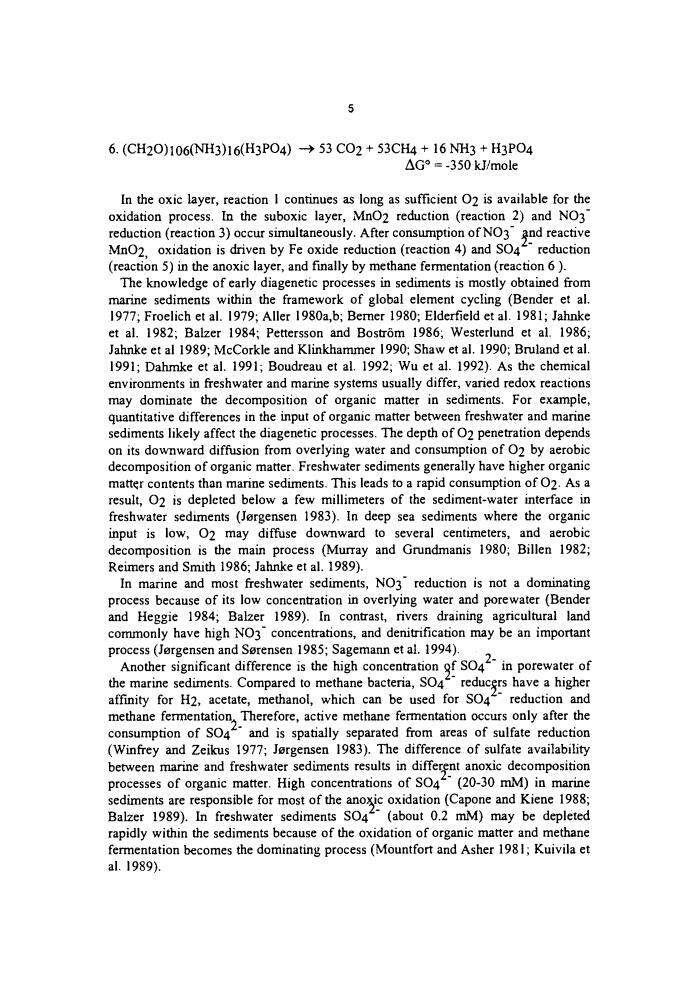
6. (CH20)I06(NH3)16(H3PO4) ~ 53 CO2 + 53CH4 + 16 NH3 + H3PO4
AG ~ = -350 kJfmole
In the oxic layer, reaction I continues as long as sufficient 02 is available for the
oxidation process. In the suboxic layer, MnO 2 reduction (reaction 2) and NO 3reduction (reaction 3) occur simultaneously. After consumption of NO 3- ~nd reactive
MnO2, oxidation is driven by Fe oxide reduction (reaction 4) and SO4 " reduction
(reaction 5) m the anoxic layer, and f'mally by methane fermentation (reaction 6 ).
The knowledge of early diagenetic processes in sediments is mostly obtained from
marine sediments within the framework of global element cycling (Bender et al.
1977; Froelich et al. 1979; Aller 1980a,b; Berner 1980; Elderfield et al. 1981; Jahnke
et al. 1982; Balzer 1984; Pettersson and Bostr6m 1986; Westerlund et al. 1986;
Jahnke et al 1989; McCorkle and Klinkhammer 1990; Shaw et al. 1990; Bruland et al.
1991; Dahmke et al. 1991; Boudreau et al. 1992; Wu et al. 1992). As the chemical
environments in freshwater and marine systems usually differ, varied redox reactions
may dominate the decomposition of organic matter in sediments. For example,
quantitative differences in the input of organic matter between freshwater and marine
sediments likely affect the diagenetic processes. The depth of 02 penetration depends
on its downward diffusion from overlying water and consumption of 02 by aerobic
decomposition of organic matter. Freshwater sediments generally have higher organic
mattgr contents than marine sediments. This leads to a rapid consumption of 02. As a
result, O 2 is depleted below a few millimeters of the sediment-water interface in
freshwater sedtments (J~rgensen 1983). In deep sea sediments where the organic
input is low, 02 may diffuse downward to several centimeters, and aerobic
decomposition is the main process (Murray and Grundmanis 1980; Billen 1982;
Reimers and Smith 1986; Jahnke et al. 1989).
In marine and most freshwater sediments, NO 3- reduction is not a dominating
process because of its low concentration in overlying water and porewater (Bender
and Heggie 1984; Balzer 1989). In contrast, rivers draining agricultural land
commonly have high NO3" concentrations, and denitrification may be an important
process (Jorgensen and S~rensen 1985; Sagemarm et al. 1994).
2
Another significant difference is the high concentration ~f SO4 - in porewater of
the marine sediments. Compared to methane bacteria, SO4 - reducers have a higher
affinity for H2, acetate, methanol, which can be used for SO4 " reduction and
methane fermentation 2 Therefore, active methane fermentation occurs only after the
consumption of SO4 " and is spatially separated from areas of sulfate reduction
(Winfrey and Zeikus 1977; Jargensen 1983). The difference of sulfate availability
between marine and freshwater sediments results in different anoxic decomposition
processes of organic matter. High concentrations of SO42" (20-30 mM) in marine
sediments are responsible for most of the ano~!c oxidation (Capone and Kiene 1988;
Balzer 1989). In freshwater sediments SO4 +- (about 0.2 mM) may be depleted
rapidly within the sediments because of the oxidation of organic matter and methane
fermentation becomes the dominating process (Mountfort and Asher 1981; Kuivila et
al. 1989).
AG ~ = -350 kJfmole
In the oxic layer, reaction I continues as long as sufficient 02 is available for the
oxidation process. In the suboxic layer, MnO 2 reduction (reaction 2) and NO 3reduction (reaction 3) occur simultaneously. After consumption of NO 3- ~nd reactive
MnO2, oxidation is driven by Fe oxide reduction (reaction 4) and SO4 " reduction
(reaction 5) m the anoxic layer, and f'mally by methane fermentation (reaction 6 ).
The knowledge of early diagenetic processes in sediments is mostly obtained from
marine sediments within the framework of global element cycling (Bender et al.
1977; Froelich et al. 1979; Aller 1980a,b; Berner 1980; Elderfield et al. 1981; Jahnke
et al. 1982; Balzer 1984; Pettersson and Bostr6m 1986; Westerlund et al. 1986;
Jahnke et al 1989; McCorkle and Klinkhammer 1990; Shaw et al. 1990; Bruland et al.
1991; Dahmke et al. 1991; Boudreau et al. 1992; Wu et al. 1992). As the chemical
environments in freshwater and marine systems usually differ, varied redox reactions
may dominate the decomposition of organic matter in sediments. For example,
quantitative differences in the input of organic matter between freshwater and marine
sediments likely affect the diagenetic processes. The depth of 02 penetration depends
on its downward diffusion from overlying water and consumption of 02 by aerobic
decomposition of organic matter. Freshwater sediments generally have higher organic
mattgr contents than marine sediments. This leads to a rapid consumption of 02. As a
result, O 2 is depleted below a few millimeters of the sediment-water interface in
freshwater sedtments (J~rgensen 1983). In deep sea sediments where the organic
input is low, 02 may diffuse downward to several centimeters, and aerobic
decomposition is the main process (Murray and Grundmanis 1980; Billen 1982;
Reimers and Smith 1986; Jahnke et al. 1989).
In marine and most freshwater sediments, NO 3- reduction is not a dominating
process because of its low concentration in overlying water and porewater (Bender
and Heggie 1984; Balzer 1989). In contrast, rivers draining agricultural land
commonly have high NO3" concentrations, and denitrification may be an important
process (Jorgensen and S~rensen 1985; Sagemarm et al. 1994).
2
Another significant difference is the high concentration ~f SO4 - in porewater of
the marine sediments. Compared to methane bacteria, SO4 - reducers have a higher
affinity for H2, acetate, methanol, which can be used for SO4 " reduction and
methane fermentation 2 Therefore, active methane fermentation occurs only after the
consumption of SO4 " and is spatially separated from areas of sulfate reduction
(Winfrey and Zeikus 1977; Jargensen 1983). The difference of sulfate availability
between marine and freshwater sediments results in different anoxic decomposition
processes of organic matter. High concentrations of SO42" (20-30 mM) in marine
sediments are responsible for most of the ano~!c oxidation (Capone and Kiene 1988;
Balzer 1989). In freshwater sediments SO4 +- (about 0.2 mM) may be depleted
rapidly within the sediments because of the oxidation of organic matter and methane
fermentation becomes the dominating process (Mountfort and Asher 1981; Kuivila et
al. 1989).