

78
(Nolet and Rosell 1998) and in many parts of the United States, however, is beaver
restoration (Pollock et al. 2014; US FWS 2015).
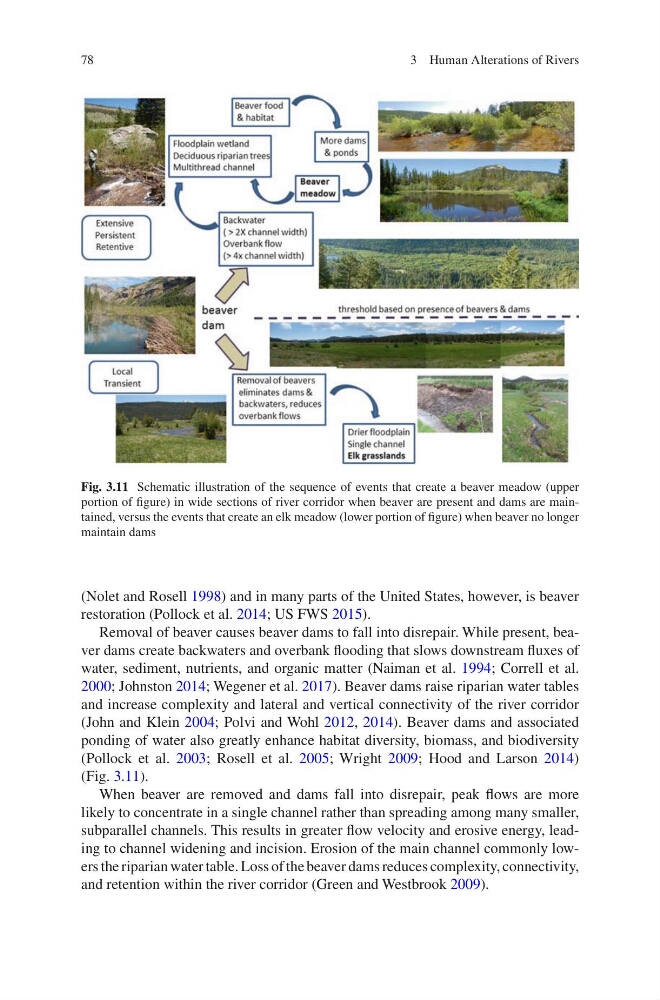
Removal of beaver causes beaver dams to fall into disrepair. While present, beaver dams create backwaters and overbank flooding that slows downstream fluxes of
water, sediment, nutrients, and organic matter (Naiman et al. 1994; Correll et al.
2000; Johnston 2014; Wegener et al. 2017). Beaver dams raise riparian water tables
and increase complexity and lateral and vertical connectivity of the river corridor
(John and Klein 2004; Polvi and Wohl 2012, 2014). Beaver dams and associated
ponding of water also greatly enhance habitat diversity, biomass, and biodiversity
(Pollock et al. 2003; Rosell et al. 2005; Wright 2009; Hood and Larson 2014)
(Fig. 3.11).
When beaver are removed and dams fall into disrepair, peak flows are more
likely to concentrate in a single channel rather than spreading among many smaller,
subparallel channels. This results in greater flow velocity and erosive energy, leading to channel widening and incision. Erosion of the main channel commonly lowers the riparian water table. Loss of the beaver dams reduces complexity, connectivity,
and retention within the river corridor (Green and Westbrook 2009).
Fig. 3.11 Schematic illustration of the sequence of events that create a beaver meadow (upper
portion of figure) in wide sections of river corridor when beaver are present and dams are maintained, versus the events that create an elk meadow (lower portion of figure) when beaver no longer
maintain dams
3 Human Alterations of Rivers
(Nolet and Rosell 1998) and in many parts of the United States, however, is beaver
restoration (Pollock et al. 2014; US FWS 2015).
Removal of beaver causes beaver dams to fall into disrepair. While present, beaver dams create backwaters and overbank flooding that slows downstream fluxes of
water, sediment, nutrients, and organic matter (Naiman et al. 1994; Correll et al.
2000; Johnston 2014; Wegener et al. 2017). Beaver dams raise riparian water tables
and increase complexity and lateral and vertical connectivity of the river corridor
(John and Klein 2004; Polvi and Wohl 2012, 2014). Beaver dams and associated
ponding of water also greatly enhance habitat diversity, biomass, and biodiversity
(Pollock et al. 2003; Rosell et al. 2005; Wright 2009; Hood and Larson 2014)
(Fig. 3.11).
When beaver are removed and dams fall into disrepair, peak flows are more
likely to concentrate in a single channel rather than spreading among many smaller,
subparallel channels. This results in greater flow velocity and erosive energy, leading to channel widening and incision. Erosion of the main channel commonly lowers the riparian water table. Loss of the beaver dams reduces complexity, connectivity,
and retention within the river corridor (Green and Westbrook 2009).
Fig. 3.11 Schematic illustration of the sequence of events that create a beaver meadow (upper
portion of figure) in wide sections of river corridor when beaver are present and dams are maintained, versus the events that create an elk meadow (lower portion of figure) when beaver no longer
maintain dams
3 Human Alterations of Rivers