

63
3.1.1 Changes in Land Cover
Changes in land cover within a drainage basin but outside of the river network
include removal of forest vegetation; natural or human-induced growth of forest
cover (e.g., commercial tree plantations); grazing; cropping; and altered fire regime.
Each of these can change the relations among precipitation inputs, infiltration, runoff, and evapotranspiration, and thus change water yields—volume, mechanism of
delivery (diffuse surface flow, diffuse or conduit subsurface flow), speed, episodicity—to river corridors (Fig. 3.2). Liu et al. (2008) illustrate these effects across
China, where rapid change in land cover during the twentieth century has changed
evapotranspiration and water yield. In general, deforestation in China has increased
evapotranspiration and decreased water yield, whereas urbanization has decreased
evapotranspiration and increased water yield.
Changes in land cover also affect the interception of precipitation, ground cover,
and soil compaction. Through these alterations, changes in land cover can substantially change sediment yields with respect to volume, grain-size distribution, and
episodicity of sediment inputs (Fig. 3.3). The magnitude and effects of the changes in
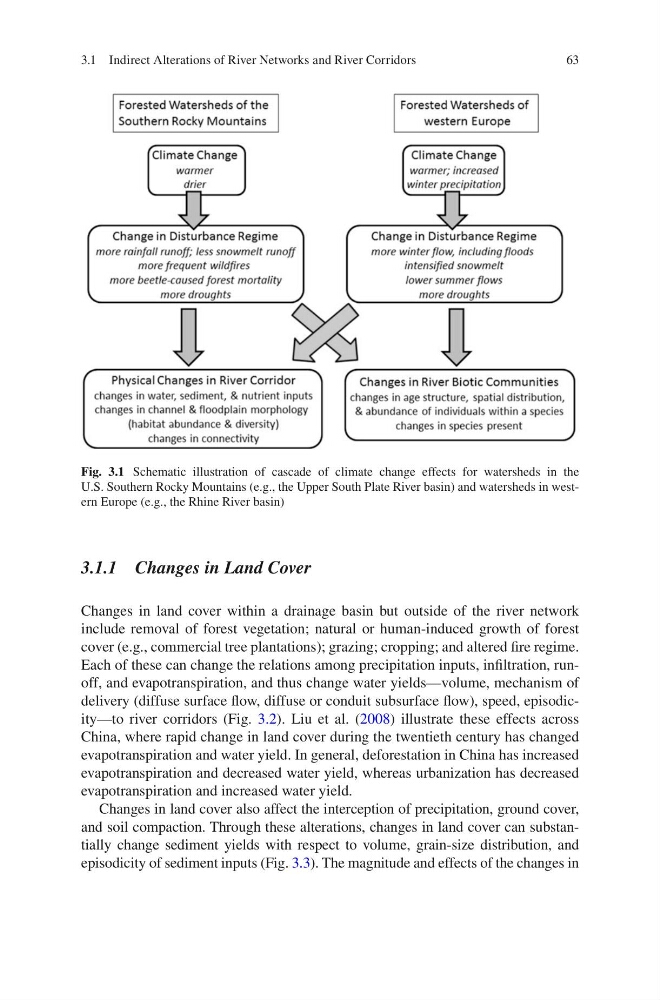
Fig. 3.1 Schematic illustration of cascade of climate change effects for watersheds in the
U.S. Southern Rocky Mountains (e.g., the Upper South Plate River basin) and watersheds in western Europe (e.g., the Rhine River basin)
3.1 Indirect Alterations of River Networks and River Corridors
3.1.1 Changes in Land Cover
Changes in land cover within a drainage basin but outside of the river network
include removal of forest vegetation; natural or human-induced growth of forest
cover (e.g., commercial tree plantations); grazing; cropping; and altered fire regime.
Each of these can change the relations among precipitation inputs, infiltration, runoff, and evapotranspiration, and thus change water yields—volume, mechanism of
delivery (diffuse surface flow, diffuse or conduit subsurface flow), speed, episodicity—to river corridors (Fig. 3.2). Liu et al. (2008) illustrate these effects across
China, where rapid change in land cover during the twentieth century has changed
evapotranspiration and water yield. In general, deforestation in China has increased
evapotranspiration and decreased water yield, whereas urbanization has decreased
evapotranspiration and increased water yield.
Changes in land cover also affect the interception of precipitation, ground cover,
and soil compaction. Through these alterations, changes in land cover can substantially change sediment yields with respect to volume, grain-size distribution, and
episodicity of sediment inputs (Fig. 3.3). The magnitude and effects of the changes in
Fig. 3.1 Schematic illustration of cascade of climate change effects for watersheds in the
U.S. Southern Rocky Mountains (e.g., the Upper South Plate River basin) and watersheds in western Europe (e.g., the Rhine River basin)
3.1 Indirect Alterations of River Networks and River Corridors