

48
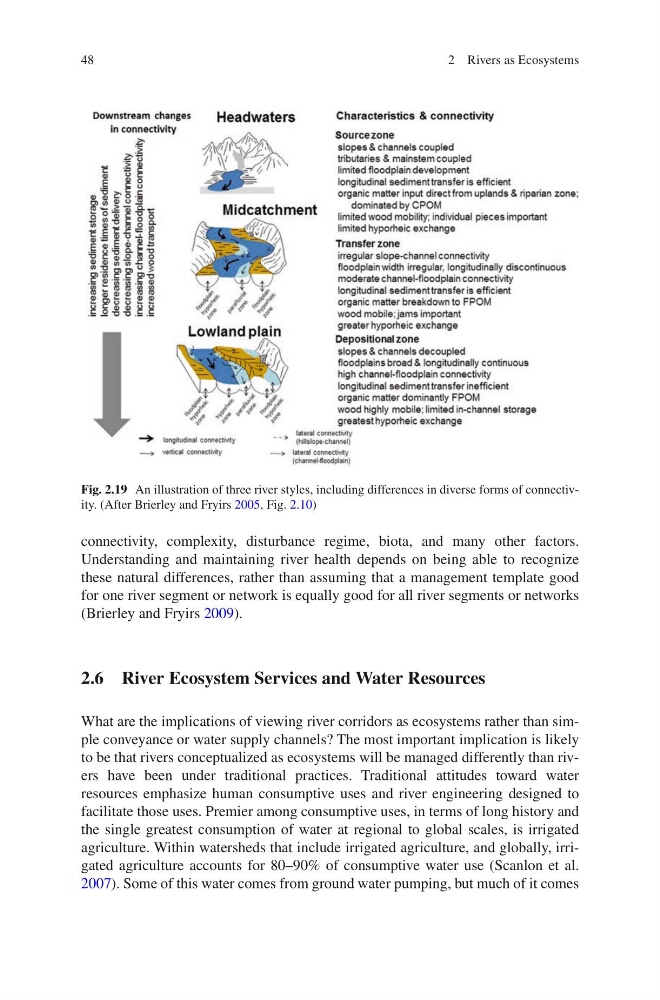
connectivity, complexity, disturbance regime, biota, and many other factors.
Understanding and maintaining river health depends on being able to recognize
these natural differences, rather than assuming that a management template good
for one river segment or network is equally good for all river segments or networks
(Brierley and Fryirs 2009).
2.6 River Ecosystem Services and Water Resources
What are the implications of viewing river corridors as ecosystems rather than simple conveyance or water supply channels? The most important implication is likely
to be that rivers conceptualized as ecosystems will be managed differently than rivers have been under traditional practices. Traditional attitudes toward water
resources emphasize human consumptive uses and river engineering designed to
facilitate those uses. Premier among consumptive uses, in terms of long history and
the single greatest consumption of water at regional to global scales, is irrigated
agriculture. Within watersheds that include irrigated agriculture, and globally, irrigated agriculture accounts for 80–90% of consumptive water use (Scanlon et al.
2007). Some of this water comes from ground water pumping, but much of it comes
Fig. 2.19 An illustration of three river styles, including differences in diverse forms of connectivity. (After Brierley and Fryirs 2005, Fig. 2.10)
2 Rivers as Ecosystems
connectivity, complexity, disturbance regime, biota, and many other factors.
Understanding and maintaining river health depends on being able to recognize
these natural differences, rather than assuming that a management template good
for one river segment or network is equally good for all river segments or networks
(Brierley and Fryirs 2009).
2.6 River Ecosystem Services and Water Resources
What are the implications of viewing river corridors as ecosystems rather than simple conveyance or water supply channels? The most important implication is likely
to be that rivers conceptualized as ecosystems will be managed differently than rivers have been under traditional practices. Traditional attitudes toward water
resources emphasize human consumptive uses and river engineering designed to
facilitate those uses. Premier among consumptive uses, in terms of long history and
the single greatest consumption of water at regional to global scales, is irrigated
agriculture. Within watersheds that include irrigated agriculture, and globally, irrigated agriculture accounts for 80–90% of consumptive water use (Scanlon et al.
2007). Some of this water comes from ground water pumping, but much of it comes
Fig. 2.19 An illustration of three river styles, including differences in diverse forms of connectivity. (After Brierley and Fryirs 2005, Fig. 2.10)
2 Rivers as Ecosystems