

93
the late 1970s; and, since the 1970s, water consumption that reduces river flow
(Wang et al. 2007a, b). By the start of the twenty-first century, Miao et al. (2011)
estimate that human activities were responsible for 55% of the reductions in water
discharge and 54% of the reduced sediment load in the basin observed since 1970,
with the remaining portions attributed to climate change.
Reduced water and sediment discharges to the Huanghe delta, along with oil
drilling and associated development, have caused substantial salinization, wetland
degradation, and delta erosion. Restoration of delta wetlands within nature reserves
on the delta began in 2002, when altered water management within the river basin
stabilized river discharge to the delta (Cui et al. 2009). Water quality, soil fertility,
habitat, and bird diversity have all increased as a result of restoration activities,
although delta erosion remains a serious problem (Peng et al. 2010). As with other
river drainage basins, the cumulative effects across the watershed and throughout
the channel network have resulted in severe alterations of the Huanghe River delta,
which historically was a dynamic depositional area that buffered coastal regions
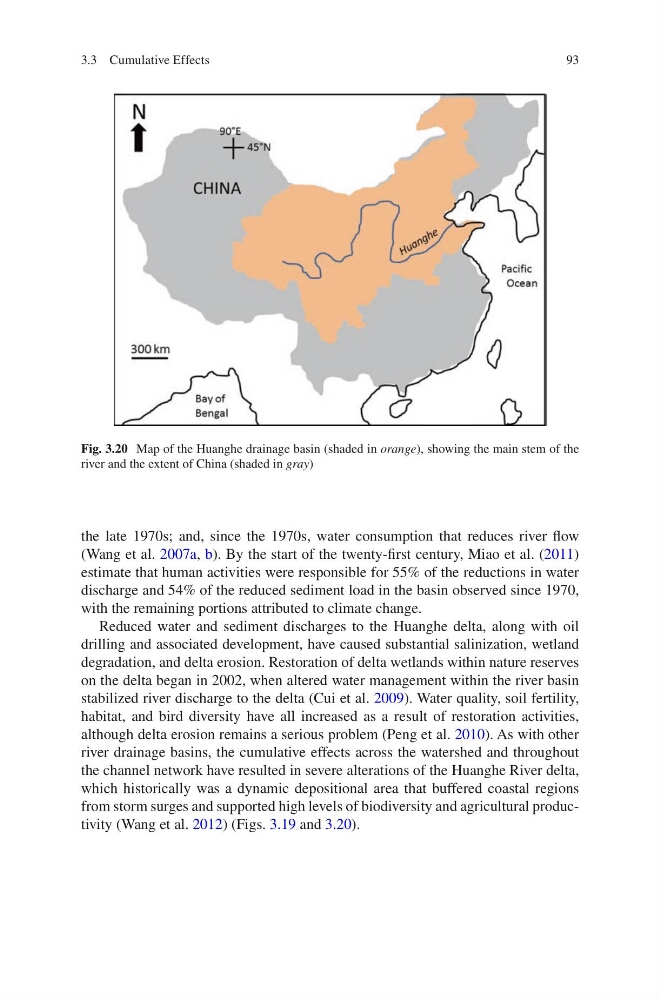
from storm surges and supported high levels of biodiversity and agricultural productivity (Wang et al. 2012) (Figs. 3.19 and 3.20).
Fig. 3.20 Map of the Huanghe drainage basin (shaded in orange), showing the main stem of the
river and the extent of China (shaded in gray)
3.3 Cumulative Effects
the late 1970s; and, since the 1970s, water consumption that reduces river flow
(Wang et al. 2007a, b). By the start of the twenty-first century, Miao et al. (2011)
estimate that human activities were responsible for 55% of the reductions in water
discharge and 54% of the reduced sediment load in the basin observed since 1970,
with the remaining portions attributed to climate change.
Reduced water and sediment discharges to the Huanghe delta, along with oil
drilling and associated development, have caused substantial salinization, wetland
degradation, and delta erosion. Restoration of delta wetlands within nature reserves
on the delta began in 2002, when altered water management within the river basin
stabilized river discharge to the delta (Cui et al. 2009). Water quality, soil fertility,
habitat, and bird diversity have all increased as a result of restoration activities,
although delta erosion remains a serious problem (Peng et al. 2010). As with other
river drainage basins, the cumulative effects across the watershed and throughout
the channel network have resulted in severe alterations of the Huanghe River delta,
which historically was a dynamic depositional area that buffered coastal regions
from storm surges and supported high levels of biodiversity and agricultural productivity (Wang et al. 2012) (Figs. 3.19 and 3.20).
Fig. 3.20 Map of the Huanghe drainage basin (shaded in orange), showing the main stem of the
river and the extent of China (shaded in gray)
3.3 Cumulative Effects