

68
H. Rubin et al.
x flatten and become more linear with time due to the reduction in the interphase
mass transfer coefficient with the diminishing NAPL saturation.
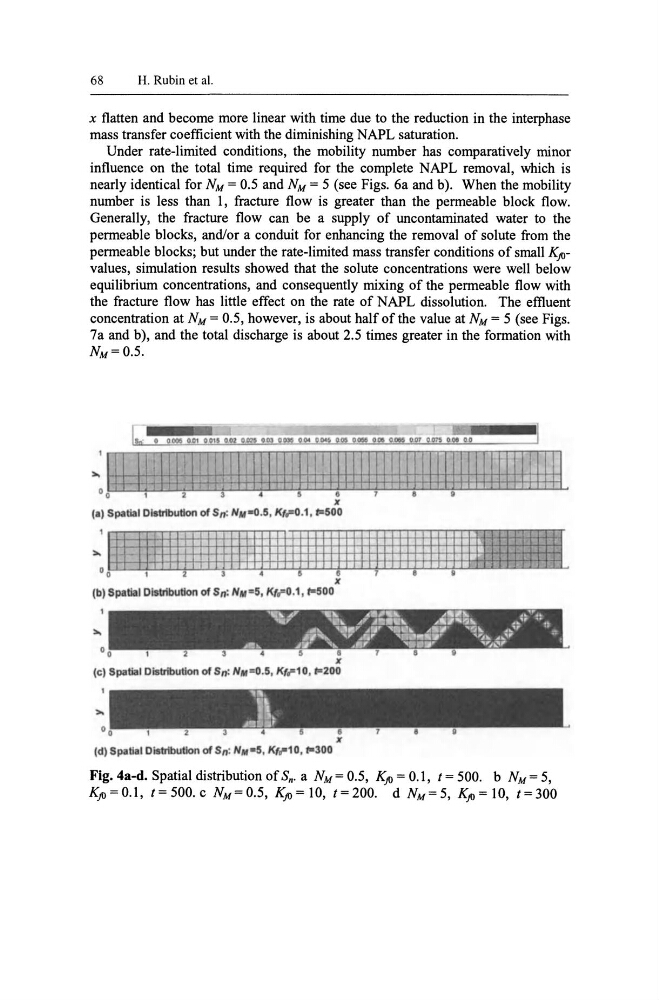
Under rate-limited conditions, the mobility number has comparatively minor
influence on the total time required for the complete NAPL removal, which is
nearly identical for NM = 0.5 and NM = 5 (see Figs. 6a and b). When the mobility
number is less than I, fracture flow is greater than the permeable block flow.
Generally, the fracture flow can be a supply of uncontaminated water to the
permeable blocks, and/or a conduit for enhancing the removal of solute from the
permeable blocks; but under the rate-limited mass transfer conditions of small K"r
values, simulation results showed that the solute concentrations were well below
equilibrium concentrations, and consequently mixing of the permeable flow with
the fracture flow has little effect on the rate of NAPL dissolution. The effluent
concentration at NM = 0.5, however, is about half of the value at NM = 5 (see Figs.
7a and b), and the total discharge is about 2.5 times greater in the formation with
NM = 0.5.
•
00!! 0.01 00" 0.G2 om 09) 0 . OOA DOtS 001 0-' 001 gO!! OJ:1 Oart 00! 00
~ ~~~~~e~~~~m
It
(.) Spatial Distribution of Sn: H", -0.5, 1<1i" 0.1 , t=500
~ rmw _ _ _ •
1!±dtt
&
f
It
(b) Spatial Distribution of Sn: H", =5, /('(i"0.1, t-500
0 0
5
6
It
(e) Spatial Distribution of Sn: H", =0.5 , I
!>oo
00
5
e
It
(d) Spatial Distribution of Sn: H",-5 , 1<, .-10, t-300
Fig. 4a-d. Spatial distribution of Sn- a NM = 0.5, KfJ = 0.1, t = 500. b NM = 5,
KfJ=O.l, t=500.c NM =0.5, KfJ=lO, t=200. d NM =5, K fJ =lO, t=300
H. Rubin et al.
x flatten and become more linear with time due to the reduction in the interphase
mass transfer coefficient with the diminishing NAPL saturation.
Under rate-limited conditions, the mobility number has comparatively minor
influence on the total time required for the complete NAPL removal, which is
nearly identical for NM = 0.5 and NM = 5 (see Figs. 6a and b). When the mobility
number is less than I, fracture flow is greater than the permeable block flow.
Generally, the fracture flow can be a supply of uncontaminated water to the
permeable blocks, and/or a conduit for enhancing the removal of solute from the
permeable blocks; but under the rate-limited mass transfer conditions of small K"r
values, simulation results showed that the solute concentrations were well below
equilibrium concentrations, and consequently mixing of the permeable flow with
the fracture flow has little effect on the rate of NAPL dissolution. The effluent
concentration at NM = 0.5, however, is about half of the value at NM = 5 (see Figs.
7a and b), and the total discharge is about 2.5 times greater in the formation with
NM = 0.5.
•
00!! 0.01 00" 0.G2 om 09) 0 . OOA DOtS 001 0-' 001 gO!! OJ:1 Oart 00! 00
~ ~~~~~e~~~~m
It
(.) Spatial Distribution of Sn: H", -0.5, 1<1i" 0.1 , t=500
~ rmw _ _ _ •
1!±dtt
&
f
It
(b) Spatial Distribution of Sn: H", =5, /('(i"0.1, t-500
0 0
5
6
It
(e) Spatial Distribution of Sn: H", =0.5 , I
00
5
e
It
(d) Spatial Distribution of Sn: H",-5 , 1<, .-10, t-300
Fig. 4a-d. Spatial distribution of Sn- a NM = 0.5, KfJ = 0.1, t = 500. b NM = 5,
KfJ=O.l, t=500.c NM =0.5, KfJ=lO, t=200. d NM =5, K fJ =lO, t=300