

66
H. Rubin et al.
5 Simulation of Aquifer Remediation
5.1 Simulation Parameters
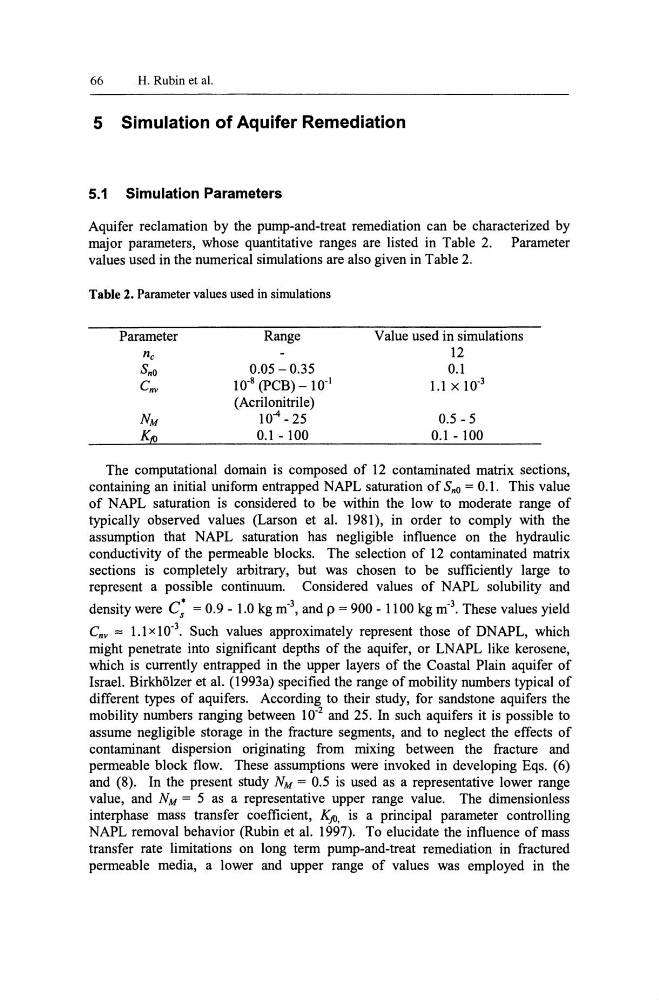
Aquifer reclamation by the pump-and-treat remediation can be characterized by
major parameters, whose quantitative ranges are listed in Table 2. Parameter
values used in the numerical simulations are also given in Table 2.
Table 2. Parameter values used in simulations
Parameter
Range
0.05 - 0.35
10- 8 (PCB) - 10- 1
(Acrilonitrile)
10-4 _ 25
0.1 - 100
Value used in simulations
12
0.1
1.1 x 10- 3
0.5 - 5
0.1 - 100
The computational domain is composed of 12 contaminated matrix sections,
containing an initial uniform entrapped NAPL saturation of SnO = 0.1. This value
of NAPL saturation is considered to be within the low to moderate range of
typically observed values (Larson et al. 1981), in order to comply with the
assumption that NAPL saturation has negligible influence on the hydraulic
conductivity of the permeable blocks. The selection of 12 contaminated matrix
sections is completely arbitrary, but was chosen to be sufficiently large to
represent a possible continuum. Considered values of NAPL solubility and
density were C; = 0.9 - 1.0 kg m- 3 , and p = 900 - 1100 kg m- 3 • These values yield
env =:: 1.1 x 10- 3 • Such values approximately represent those of DNAPL, which
might penetrate into significant depths of the aquifer, or LNAPL like kerosene,
which is currently entrapped in the upper layers of the Coastal Plain aquifer of
Israel. Birkholzer et al. (1993a) specified the range of mobility numbers typical of
different types of aquifers. According to their study, for sandstone aquifers the
mobility numbers ranging between 10- 2 and 25. In such aquifers it is possible to
assume negligible storage in the fracture segments, and to neglect the effects of
contaminant dispersion originating from mixing between the fracture and
permeable block flow. These assumptions were invoked in developing Eqs. (6)
and (8). In the present study NM = 0.5 is used as a representative lower range
value, and N M = 5 as a representative upper range value. The dimensionless
interphase mass transfer coefficient, KjO, is a principal parameter controlling
NAPL removal behavior (Rubin et al. 1997). To elucidate the influence of mass
transfer rate limitations on long term pump-and-treat remediation in fractured
permeable media, a lower and upper range of values was employed in the
H. Rubin et al.
5 Simulation of Aquifer Remediation
5.1 Simulation Parameters
Aquifer reclamation by the pump-and-treat remediation can be characterized by
major parameters, whose quantitative ranges are listed in Table 2. Parameter
values used in the numerical simulations are also given in Table 2.
Table 2. Parameter values used in simulations
Parameter
Range
0.05 - 0.35
10- 8 (PCB) - 10- 1
(Acrilonitrile)
10-4 _ 25
0.1 - 100
Value used in simulations
12
0.1
1.1 x 10- 3
0.5 - 5
0.1 - 100
The computational domain is composed of 12 contaminated matrix sections,
containing an initial uniform entrapped NAPL saturation of SnO = 0.1. This value
of NAPL saturation is considered to be within the low to moderate range of
typically observed values (Larson et al. 1981), in order to comply with the
assumption that NAPL saturation has negligible influence on the hydraulic
conductivity of the permeable blocks. The selection of 12 contaminated matrix
sections is completely arbitrary, but was chosen to be sufficiently large to
represent a possible continuum. Considered values of NAPL solubility and
density were C; = 0.9 - 1.0 kg m- 3 , and p = 900 - 1100 kg m- 3 • These values yield
env =:: 1.1 x 10- 3 • Such values approximately represent those of DNAPL, which
might penetrate into significant depths of the aquifer, or LNAPL like kerosene,
which is currently entrapped in the upper layers of the Coastal Plain aquifer of
Israel. Birkholzer et al. (1993a) specified the range of mobility numbers typical of
different types of aquifers. According to their study, for sandstone aquifers the
mobility numbers ranging between 10- 2 and 25. In such aquifers it is possible to
assume negligible storage in the fracture segments, and to neglect the effects of
contaminant dispersion originating from mixing between the fracture and
permeable block flow. These assumptions were invoked in developing Eqs. (6)
and (8). In the present study NM = 0.5 is used as a representative lower range
value, and N M = 5 as a representative upper range value. The dimensionless
interphase mass transfer coefficient, KjO, is a principal parameter controlling
NAPL removal behavior (Rubin et al. 1997). To elucidate the influence of mass
transfer rate limitations on long term pump-and-treat remediation in fractured
permeable media, a lower and upper range of values was employed in the