

The Effect of Fractures on the Reclamation ofNAPL
57
NAPL distribution after long term
Redistribution and water table fluctuation
Fracture flow
permeable ~,~~~~~
block flow ---r Jl
NAPL contamination zone
residual NAPL
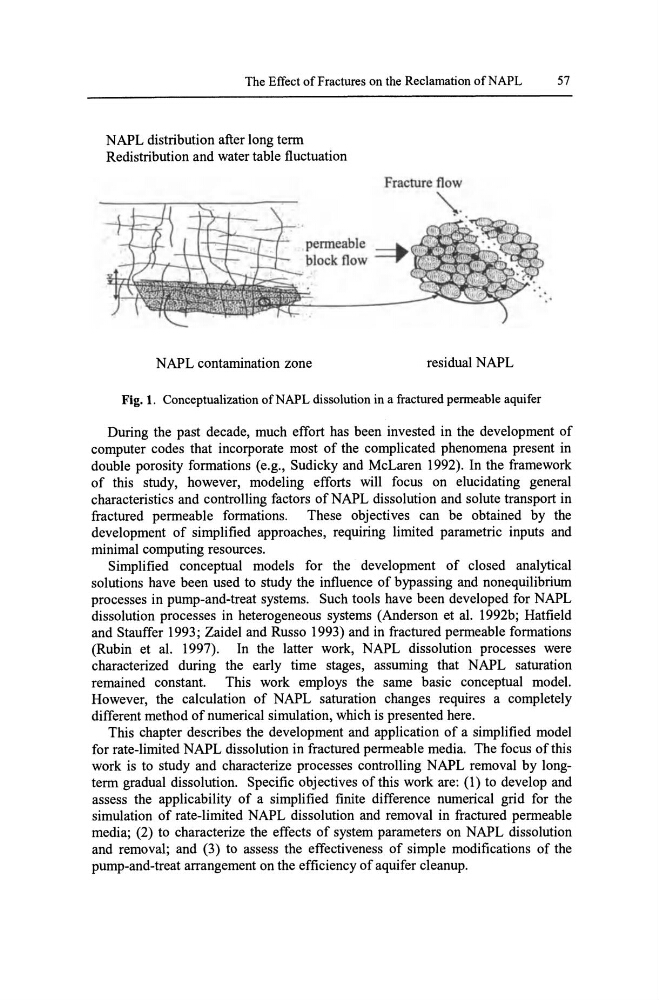
Fig. 1. Conceptualization ofNAPL dissolution in a fractured permeable aquifer
During the past decade, much effort has been invested in the development of
computer codes that incorporate most of the complicated phenomena present in
double porosity formations (e.g., Sudicky and McLaren 1992). In the framework
of this study, however, modeling efforts will focus on elucidating general
characteristics and controlling factors of NAPL dissolution and solute transport in
fractured permeable formations. These objectives can be obtained by the
development of simplified approaches, requiring limited parametric inputs and
minimal computing resources.
Simplified conceptual models for the development of closed analytical
solutions have been used to study the influence of bypassing and nonequilibrium
processes in pump-and-treat systems. Such tools have been developed for NAPL
dissolution processes in heterogeneous systems (Anderson et al. 1992b; Hatfield
and Stauffer 1993; Zaidel and Russo 1993) and in fractured permeable formations
(Rubin et al. 1997). In the latter work, NAPL dissolution processes were
characterized during the early time stages, assuming that NAPL saturation
remained constant. This work employs the same basic conceptual model.
However, the calculation of NAPL saturation changes requires a completely
different method of numerical simulation, which is presented here.
This chapter describes the development and application of a simplified model
for rate-limited NAPL dissolution in fractured permeable media. The focus of this
work is to study and characterize processes controlling NAPL removal by longterm gradual dissolution. Specific objectives of this work are: (1) to develop and
assess the applicability of a simplified finite difference numerical grid for the
simulation of rate-limited NAPL dissolution and removal in fractured permeable
media; (2) to characterize the effects of system parameters on NAPL dissolution
and removal; and (3) to assess the effectiveness of simple modifications of the
pump-and-treat arrangement on the efficiency of aquifer cleanup.
57
NAPL distribution after long term
Redistribution and water table fluctuation
Fracture flow
permeable ~,~~~~~
block flow ---r Jl
NAPL contamination zone
residual NAPL
Fig. 1. Conceptualization ofNAPL dissolution in a fractured permeable aquifer
During the past decade, much effort has been invested in the development of
computer codes that incorporate most of the complicated phenomena present in
double porosity formations (e.g., Sudicky and McLaren 1992). In the framework
of this study, however, modeling efforts will focus on elucidating general
characteristics and controlling factors of NAPL dissolution and solute transport in
fractured permeable formations. These objectives can be obtained by the
development of simplified approaches, requiring limited parametric inputs and
minimal computing resources.
Simplified conceptual models for the development of closed analytical
solutions have been used to study the influence of bypassing and nonequilibrium
processes in pump-and-treat systems. Such tools have been developed for NAPL
dissolution processes in heterogeneous systems (Anderson et al. 1992b; Hatfield
and Stauffer 1993; Zaidel and Russo 1993) and in fractured permeable formations
(Rubin et al. 1997). In the latter work, NAPL dissolution processes were
characterized during the early time stages, assuming that NAPL saturation
remained constant. This work employs the same basic conceptual model.
However, the calculation of NAPL saturation changes requires a completely
different method of numerical simulation, which is presented here.
This chapter describes the development and application of a simplified model
for rate-limited NAPL dissolution in fractured permeable media. The focus of this
work is to study and characterize processes controlling NAPL removal by longterm gradual dissolution. Specific objectives of this work are: (1) to develop and
assess the applicability of a simplified finite difference numerical grid for the
simulation of rate-limited NAPL dissolution and removal in fractured permeable
media; (2) to characterize the effects of system parameters on NAPL dissolution
and removal; and (3) to assess the effectiveness of simple modifications of the
pump-and-treat arrangement on the efficiency of aquifer cleanup.