

Identifying Soil and Transport Properties Using a Model
23
Zr = Zo
Z f ~zo
ZO(Or + KdPb)+ rKst
Z =
zf>ZO;t~ti
r
OJ + KdPb
1 + zotOr + KdPb)
Z =
()
zf>ZO;t~ti'
r
Of t + KdPb
(11)
Equation (11) implies that until the wetting front reaches the initial solute
pulse, i.e., zpzo, the latter remains stationary. After the wetting front reaches the
solute location, the solute is distributed instantaneously between the mobile and
immobile phases and advected by the moving fluid [Eq. (9)].
We now apply solution (11) to multiple cycles of infiltration and redistribution.
Let Zk,O be the location of solute front at the beginning of cycle k. whereas Ik and
tk,i are the times of the beginning of the cycle k and the end of its infiltration stage,
respectively. Initially (/=/1=0) the front is located at the soil surface, i.e.,
z1,o=zrIH=0. Since at the beginning of each infiltration cycle the previous cycle
has been fully redistributed, the location of the solute front zr(/) during the cycle
k=I,2 ... is obtained as follows:
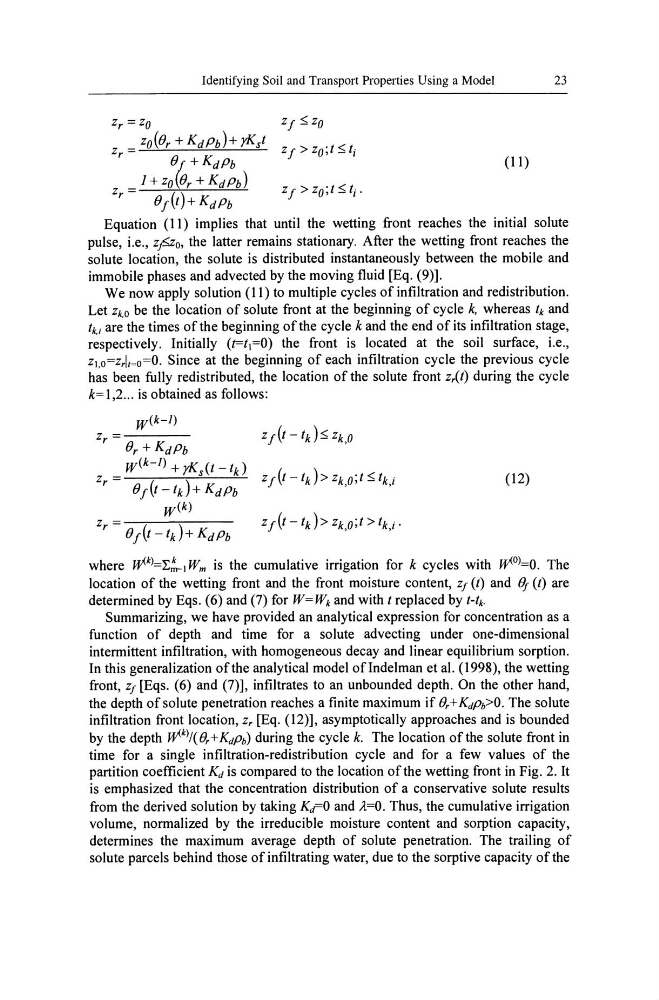
(12)
where Wk)=L~1Wm is the cumulative irrigation for k cycles with WO)=O. The
location of the wetting front and the front moisture content, Zj (I) and Or (I) are
determined by Eqs. (6) and (7) for W= Wk and with 1 replaced by t-tk'
Summarizing, we have provided an analytical expression for concentration as a
function of depth and time for a solute advecting under one-dimensional
intermittent infiltration, with homogeneous decay and linear equilibrium sorption.
In this generalization of the analytical model ofIndelman et al. (1998), the wetting
front, Zj [Eqs. (6) and (7)], infiltrates to an unbounded depth. On the other hand,
the depth of solute penetration reaches a finite maximum if Or + KdPb>O. The solute
infiltration front location, Zr [Eq. (12)], asymptotically approaches and is bounded
by the depth Wk)/(Or+KdPb) during the cycle k. The location of the solute front in
time for a single infiltration-redistribution cycle and for a few values of the
partition coefficient Kd is compared to the location of the wetting front in Fig. 2. It
is emphasized that the concentration distribution of a conservative solute results
from the derived solution by taking KrO and A=O. Thus, the cumulative irrigation
volume, normalized by the irreducible moisture content and sorption capacity,
determines the maximum average depth of solute penetration. The trailing of
solute parcels behind those of infiltrating water, due to the sorptive capacity of the
23
Zr = Zo
Z f ~zo
ZO(Or + KdPb)+ rKst
Z =
zf>ZO;t~ti
r
OJ + KdPb
1 + zotOr + KdPb)
Z =
()
zf>ZO;t~ti'
r
Of t + KdPb
(11)
Equation (11) implies that until the wetting front reaches the initial solute
pulse, i.e., zpzo, the latter remains stationary. After the wetting front reaches the
solute location, the solute is distributed instantaneously between the mobile and
immobile phases and advected by the moving fluid [Eq. (9)].
We now apply solution (11) to multiple cycles of infiltration and redistribution.
Let Zk,O be the location of solute front at the beginning of cycle k. whereas Ik and
tk,i are the times of the beginning of the cycle k and the end of its infiltration stage,
respectively. Initially (/=/1=0) the front is located at the soil surface, i.e.,
z1,o=zrIH=0. Since at the beginning of each infiltration cycle the previous cycle
has been fully redistributed, the location of the solute front zr(/) during the cycle
k=I,2 ... is obtained as follows:
(12)
where Wk)=L~1Wm is the cumulative irrigation for k cycles with WO)=O. The
location of the wetting front and the front moisture content, Zj (I) and Or (I) are
determined by Eqs. (6) and (7) for W= Wk and with 1 replaced by t-tk'
Summarizing, we have provided an analytical expression for concentration as a
function of depth and time for a solute advecting under one-dimensional
intermittent infiltration, with homogeneous decay and linear equilibrium sorption.
In this generalization of the analytical model ofIndelman et al. (1998), the wetting
front, Zj [Eqs. (6) and (7)], infiltrates to an unbounded depth. On the other hand,
the depth of solute penetration reaches a finite maximum if Or + KdPb>O. The solute
infiltration front location, Zr [Eq. (12)], asymptotically approaches and is bounded
by the depth Wk)/(Or+KdPb) during the cycle k. The location of the solute front in
time for a single infiltration-redistribution cycle and for a few values of the
partition coefficient Kd is compared to the location of the wetting front in Fig. 2. It
is emphasized that the concentration distribution of a conservative solute results
from the derived solution by taking KrO and A=O. Thus, the cumulative irrigation
volume, normalized by the irreducible moisture content and sorption capacity,
determines the maximum average depth of solute penetration. The trailing of
solute parcels behind those of infiltrating water, due to the sorptive capacity of the