

Biological Nitrogen Removal Using Immobilized Bacteria
397
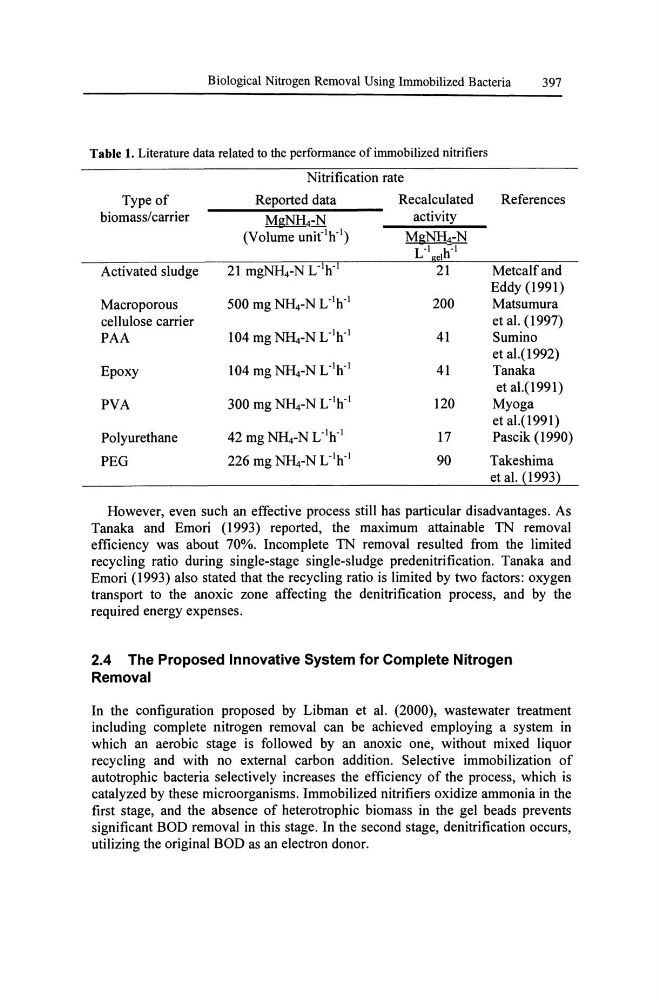
Table 1. Literature data related to the performance of immobilized nitrifiers
Nitrification rate
Type of
Reported data
Recalculated
References
biomass/carrier
MgNH4-N
activity
(Volume unirlh- I )
Mg~-N
L-Igelh-I
Activated sludge
21 mgNJL-N L·lh- I
21
Metcalf and
Eddy (1991)
Macroporous
500 mg NJL-N L-Ih- I
200
Matsumura
cellulose carrier
et al. (1997)
PAA
104 mg NH4-N L-Ih- I
41
Sumino
et al.(1992)
Epoxy
104 mg NJL-N L-Ih- I
41
Tanaka
et al.(l991)
PVA
300 mg NJL-N L-Ih- I
120
Myoga
et al.(1991)
Polyurethane
42 mg NH4-N L-Ih- I
17
Pascik (1990)
PEG
226 mg NJL-N L-Ih- I
90
Takeshima
et al. {1993}
However, even such an effective process still has particular disadvantages. As
Tanaka and Emori (1993) reported, the maximum attainable TN removal
efficiency was about 70%. Incomplete TN removal resulted from the limited
recycling ratio during single-stage single-sludge predenitrification. Tanaka and
Emori (1993) also stated that the recycling ratio is limited by two factors: oxygen
transport to the anoxic zone affecting the denitrification process, and by the
required energy expenses.
2.4 The Proposed Innovative System for Complete Nitrogen
Removal
In the configuration proposed by Libman et al. (2000), wastewater treatment
including complete nitrogen removal can be achieved employing a system in
which an aerobic stage is followed by an anoxic one, without mixed liquor
recycling and with no external carbon addition. Selective immobilization of
autotrophic bacteria selectively increases the efficiency of the process, which is
catalyzed by these microorganisms. Immobilized nitrifiers oxidize ammonia in the
first stage, and the absence of heterotrophic biomass in the gel beads prevents
significant BOD removal in this stage. In the second stage, denitrification occurs,
utilizing the original BOD as an electron donor.
397
Table 1. Literature data related to the performance of immobilized nitrifiers
Nitrification rate
Type of
Reported data
Recalculated
References
biomass/carrier
MgNH4-N
activity
(Volume unirlh- I )
Mg~-N
L-Igelh-I
Activated sludge
21 mgNJL-N L·lh- I
21
Metcalf and
Eddy (1991)
Macroporous
500 mg NJL-N L-Ih- I
200
Matsumura
cellulose carrier
et al. (1997)
PAA
104 mg NH4-N L-Ih- I
41
Sumino
et al.(1992)
Epoxy
104 mg NJL-N L-Ih- I
41
Tanaka
et al.(l991)
PVA
300 mg NJL-N L-Ih- I
120
Myoga
et al.(1991)
Polyurethane
42 mg NH4-N L-Ih- I
17
Pascik (1990)
PEG
226 mg NJL-N L-Ih- I
90
Takeshima
et al. {1993}
However, even such an effective process still has particular disadvantages. As
Tanaka and Emori (1993) reported, the maximum attainable TN removal
efficiency was about 70%. Incomplete TN removal resulted from the limited
recycling ratio during single-stage single-sludge predenitrification. Tanaka and
Emori (1993) also stated that the recycling ratio is limited by two factors: oxygen
transport to the anoxic zone affecting the denitrification process, and by the
required energy expenses.
2.4 The Proposed Innovative System for Complete Nitrogen
Removal
In the configuration proposed by Libman et al. (2000), wastewater treatment
including complete nitrogen removal can be achieved employing a system in
which an aerobic stage is followed by an anoxic one, without mixed liquor
recycling and with no external carbon addition. Selective immobilization of
autotrophic bacteria selectively increases the efficiency of the process, which is
catalyzed by these microorganisms. Immobilized nitrifiers oxidize ammonia in the
first stage, and the absence of heterotrophic biomass in the gel beads prevents
significant BOD removal in this stage. In the second stage, denitrification occurs,
utilizing the original BOD as an electron donor.