

Chemical Pre-Treatment of Sewage - A Cost-Benefit Method
385
10
20
30
40
6Cl
7.0
6.0
~
5.0
QIl
.!
~
4.0
Eo-<
"C
= 3.0
"
~
I
0
2.0
l:J.. ,----- --~_l:J.. ___
~ -~
-
t:~
V,., . . . ' "
) ,
/1
•
P04-P with Fe3+
0 P04-P wilh AI3+
•
TPwith Fe3+
~ TPwithAl3+
II •
......... P04-P removal (Fe3+) --,a--
[!II
•
1.0
~.
~
<>
• •
0
0
•
•
0.0
o
5
10
15
20
25
30
35
40
45
50
Metal dose [mg Me 3 +/I1
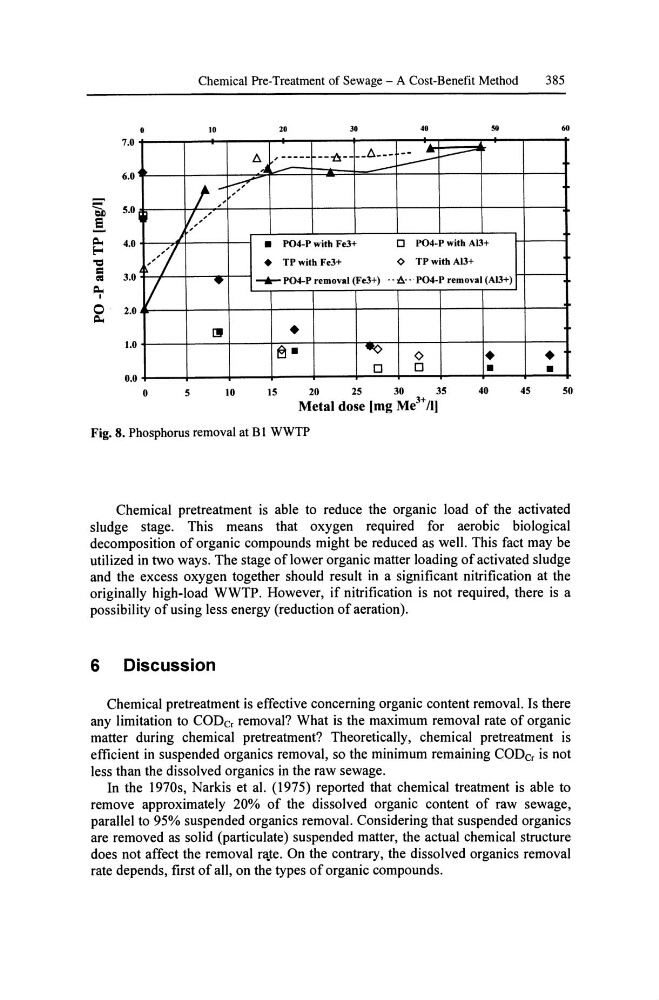
Fig. 8. Phosphorus removal at B I WWTP
Chemical pretreatment is able to reduce the organic load of the activated
sludge stage. This means that oxygen required for aerobic biological
decomposition of organic compounds might be reduced as well. This fact may be
utilized in two ways. The stage of lower organic matter loading of activated sludge
and the excess oxygen together should result in a significant nitrification at the
originally high-load WWTP. However, if nitrification is not required, there is a
possibility of using less energy (reduction of aeration).
6 Discussion
Chemical pretreatment is effective concerning organic content removal. Is there
any limitation to CODcr removal? What is the maximum removal rate of organic
matter during chemical pretreatment? Theoretically, chemical pretreatment is
efficient in suspended organics removal, so the minimum remaining CODcr is not
less than the dissolved organics in the raw sewage.
In the 1970s, Narkis et al. (1975) reported that chemical treatment is able to
remove approximately 20% of the dissolved organic content of raw sewage,
parallel to 95% suspended organics removal. Considering that suspended organics
are removed as solid (particulate) suspended matter, the actual chemical structure
does not affect the removal rl!,te. On the contrary, the dissolved organics removal
rate depends, first of all, on the types of organic compounds.
385
10
20
30
40
6Cl
7.0
6.0
~
5.0
QIl
.!
~
4.0
Eo-<
"C
= 3.0
"
~
I
0
2.0
l:J.. ,----- --~_l:J.. ___
~ -~
-
t:~
V,., . . . ' "
) ,
/1
•
P04-P with Fe3+
0 P04-P wilh AI3+
•
TPwith Fe3+
~ TPwithAl3+
II •
......... P04-P removal (Fe3+) --,a--
[!II
•
1.0
~.
~
<>
• •
0
0
•
•
0.0
o
5
10
15
20
25
30
35
40
45
50
Metal dose [mg Me 3 +/I1
Fig. 8. Phosphorus removal at B I WWTP
Chemical pretreatment is able to reduce the organic load of the activated
sludge stage. This means that oxygen required for aerobic biological
decomposition of organic compounds might be reduced as well. This fact may be
utilized in two ways. The stage of lower organic matter loading of activated sludge
and the excess oxygen together should result in a significant nitrification at the
originally high-load WWTP. However, if nitrification is not required, there is a
possibility of using less energy (reduction of aeration).
6 Discussion
Chemical pretreatment is effective concerning organic content removal. Is there
any limitation to CODcr removal? What is the maximum removal rate of organic
matter during chemical pretreatment? Theoretically, chemical pretreatment is
efficient in suspended organics removal, so the minimum remaining CODcr is not
less than the dissolved organics in the raw sewage.
In the 1970s, Narkis et al. (1975) reported that chemical treatment is able to
remove approximately 20% of the dissolved organic content of raw sewage,
parallel to 95% suspended organics removal. Considering that suspended organics
are removed as solid (particulate) suspended matter, the actual chemical structure
does not affect the removal rl!,te. On the contrary, the dissolved organics removal
rate depends, first of all, on the types of organic compounds.