

378
I. Licsko et al.
600
500
I.Pralloc 4BOPAC I
•
I o FeCI3 DAI2(S04)31
• •
~
400
E.
~
300
V
~
0
U
200
•
~M
0
• • > ..
0
0
4
14
•
0
•
0
~
In
0#
~
~
~o
"
~
0
I!
-
4
~
•
100
o
o
10
20
~
~
~
00
ro
00
~
100
110
Coagulant dose [mg Me 3 +/I1
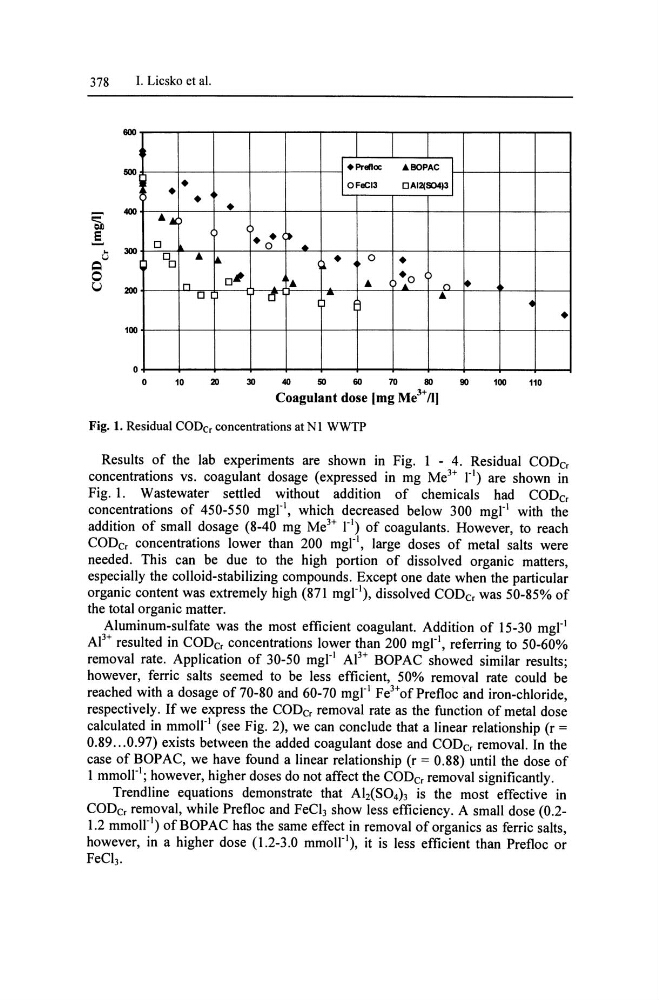
Fig. 1. Residual CODer concentrations at Nl WWTP
Results of the lab experiments are shown in Fig. I - 4. Residual CODer
concentrations vs. coagulant dosage (expressed in mg Me H rl) are shown in
Fig. 1. Wastewater settled without addition of chemicals had CODer
concentrations of 450-550 mgr l , which decreased below 300 mgr l with the
addition of small dosage (8-40 mg Me H rl) of coagulants. However, to reach
CODer concentrations lower than 200 mgr l , large doses of metal salts were
needed. This can be due to the high portion of dissolved organic matters,
especially the colloid-stabilizing compounds. Except one date when the particular
organic content was extremely high (871 mgr l ), dissolved CODer was 50-85% of
the total organic matter.
Aluminum-sulfate was the most efficient coagulant. Addition of 15-30 mgr l
AIH resulted in CODer concentrations lower than 200 mgr l , referring to 50-60%
removal rate. Application of 30-50 mgr l AIH BOPAC showed similar results;
however, ferric salts seemed to be less efficient, 50% removal rate could be
reached with a dosage of 70-80 and 60-70 mgr l Fe H of Prefloc and iron-chloride,
respectively. If we express the CODer removal rate as the function of metal dose
calculated in mmolr l (see Fig. 2), we can conclude that a linear relationship (r =
0.89 ... 0.97) exists between the added coagulant dose and CODer removal. In the
case of BOPAC, we have found a linear relationship (r = 0.88) until the dose of
I mmolr l ; however, higher doses do not affect the CODer removal significantly.
Trendline equations demonstrate that AIz(S04)3 is the most effective in
CODer removal, while Prefloc and FeCh show less efficiency. A small dose (0.21.2 mmolrl) of BOPAC has the same effect in removal of organics as ferric salts,
however, in a higher dose (1.2-3.0 mmolr\ it is less efficient than Prefloc or
FeCh.
I. Licsko et al.
600
500
I.Pralloc 4BOPAC I
•
I o FeCI3 DAI2(S04)31
• •
~
400
E.
~
300
V
~
0
U
200
•
~M
0
• • > ..
0
0
4
14
•
0
•
0
~
In
0#
~
~
~o
"
~
0
I!
-
4
~
•
100
o
o
10
20
~
~
~
00
ro
00
~
100
110
Coagulant dose [mg Me 3 +/I1
Fig. 1. Residual CODer concentrations at Nl WWTP
Results of the lab experiments are shown in Fig. I - 4. Residual CODer
concentrations vs. coagulant dosage (expressed in mg Me H rl) are shown in
Fig. 1. Wastewater settled without addition of chemicals had CODer
concentrations of 450-550 mgr l , which decreased below 300 mgr l with the
addition of small dosage (8-40 mg Me H rl) of coagulants. However, to reach
CODer concentrations lower than 200 mgr l , large doses of metal salts were
needed. This can be due to the high portion of dissolved organic matters,
especially the colloid-stabilizing compounds. Except one date when the particular
organic content was extremely high (871 mgr l ), dissolved CODer was 50-85% of
the total organic matter.
Aluminum-sulfate was the most efficient coagulant. Addition of 15-30 mgr l
AIH resulted in CODer concentrations lower than 200 mgr l , referring to 50-60%
removal rate. Application of 30-50 mgr l AIH BOPAC showed similar results;
however, ferric salts seemed to be less efficient, 50% removal rate could be
reached with a dosage of 70-80 and 60-70 mgr l Fe H of Prefloc and iron-chloride,
respectively. If we express the CODer removal rate as the function of metal dose
calculated in mmolr l (see Fig. 2), we can conclude that a linear relationship (r =
0.89 ... 0.97) exists between the added coagulant dose and CODer removal. In the
case of BOPAC, we have found a linear relationship (r = 0.88) until the dose of
I mmolr l ; however, higher doses do not affect the CODer removal significantly.
Trendline equations demonstrate that AIz(S04)3 is the most effective in
CODer removal, while Prefloc and FeCh show less efficiency. A small dose (0.21.2 mmolrl) of BOPAC has the same effect in removal of organics as ferric salts,
however, in a higher dose (1.2-3.0 mmolr\ it is less efficient than Prefloc or
FeCh.