

338
N.I. Galil and Y. Levinsky
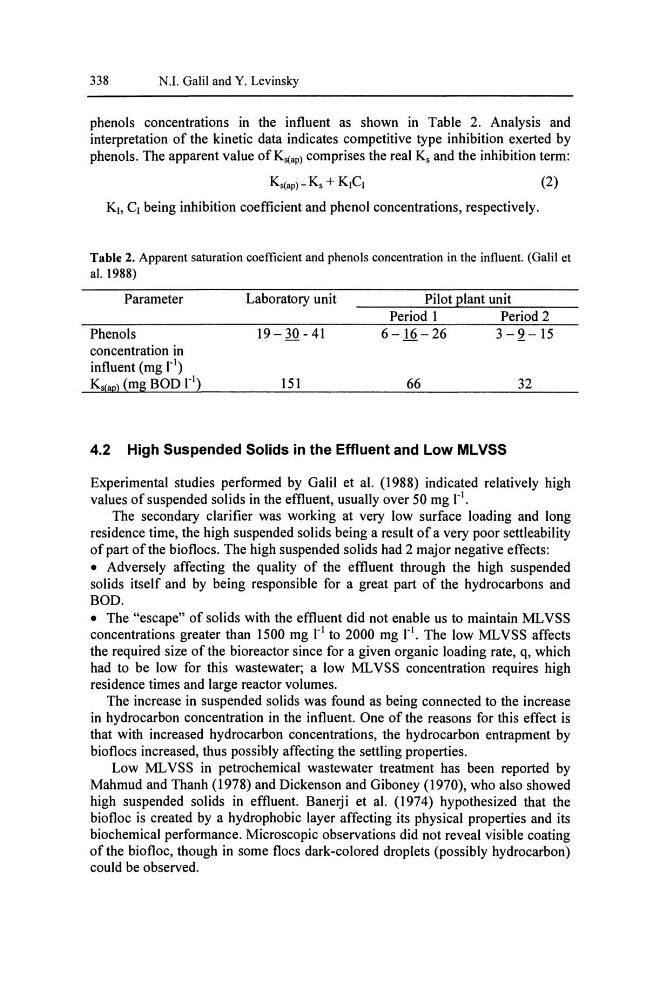
phenols concentrations in the influent as shown in Table 2. Analysis and
interpretation of the kinetic data indicates competitive type inhibition exerted by
phenols. The apparent value ofKs(ap) comprises the real Ks and the inhibition term:
(2)
K[, C, being inhibition coefficient and phenol concentrations, respectively.
Table 2. Apparent saturation coefficient and phenols concentration in the influent. (Galil et
al. 1988)
Parameter
Phenols
concentration in
influent (mg rl)
Ks(aol (mg BOD rl)
Laboratory unit
19 - 30 - 41
151
Pilot plant unit
Period 1
Period 2
6 - .1§. - 26
3 - .2. - 15
66
32
4.2 High Suspended Solids in the Effluent and Low MLVSS
Experimental studies performed by Galil et al. (1988) indicated relatively high
values of suspended solids in the effluent, usually over 50 mg rl.
The secondary clarifier was working at very low surface loading and long
residence time, the high suspended solids being a result of a very poor settleability
of part of the bioflocs. The high suspended solids had 2 major negative effects:
• Adversely affecting the quality of the effluent through the high suspended
solids itself and by being responsible for a great part of the hydrocarbons and
BOD.
• The "escape" of solids with the effluent did not enable us to maintain ML VSS
concentrations greater than 1500 mg rl to 2000 mg rl. The low MLVSS affects
the required size of the bioreactor since for a given organic loading rate, q, which
had to be low for this wastewater; a low ML VSS concentration requires high
residence times and large reactor volumes.
The increase in suspended solids was found as being connected to the increase
in hydrocarbon concentration in the influent. One of the reasons for this effect is
that with increased hydrocarbon concentrations, the hydrocarbon entrapment by
bioflocs increased, thus possibly affecting the settling properties.
Low ML VSS in petrochemical wastewater treatment has been reported by
Mahmud and Thanh (1978) and Dickenson and Giboney (1970), who also showed
high suspended solids in effluent. Banerji et al. (1974) hypothesized that the
biofloc is created by a hydrophobic layer affecting its physical properties and its
biochemical performance. Microscopic observations did not reveal visible coating
of the biofloc, though in some flocs dark-colored droplets (possibly hydrocarbon)
could be observed.
N.I. Galil and Y. Levinsky
phenols concentrations in the influent as shown in Table 2. Analysis and
interpretation of the kinetic data indicates competitive type inhibition exerted by
phenols. The apparent value ofKs(ap) comprises the real Ks and the inhibition term:
(2)
K[, C, being inhibition coefficient and phenol concentrations, respectively.
Table 2. Apparent saturation coefficient and phenols concentration in the influent. (Galil et
al. 1988)
Parameter
Phenols
concentration in
influent (mg rl)
Ks(aol (mg BOD rl)
Laboratory unit
19 - 30 - 41
151
Pilot plant unit
Period 1
Period 2
6 - .1§. - 26
3 - .2. - 15
66
32
4.2 High Suspended Solids in the Effluent and Low MLVSS
Experimental studies performed by Galil et al. (1988) indicated relatively high
values of suspended solids in the effluent, usually over 50 mg rl.
The secondary clarifier was working at very low surface loading and long
residence time, the high suspended solids being a result of a very poor settleability
of part of the bioflocs. The high suspended solids had 2 major negative effects:
• Adversely affecting the quality of the effluent through the high suspended
solids itself and by being responsible for a great part of the hydrocarbons and
BOD.
• The "escape" of solids with the effluent did not enable us to maintain ML VSS
concentrations greater than 1500 mg rl to 2000 mg rl. The low MLVSS affects
the required size of the bioreactor since for a given organic loading rate, q, which
had to be low for this wastewater; a low ML VSS concentration requires high
residence times and large reactor volumes.
The increase in suspended solids was found as being connected to the increase
in hydrocarbon concentration in the influent. One of the reasons for this effect is
that with increased hydrocarbon concentrations, the hydrocarbon entrapment by
bioflocs increased, thus possibly affecting the settling properties.
Low ML VSS in petrochemical wastewater treatment has been reported by
Mahmud and Thanh (1978) and Dickenson and Giboney (1970), who also showed
high suspended solids in effluent. Banerji et al. (1974) hypothesized that the
biofloc is created by a hydrophobic layer affecting its physical properties and its
biochemical performance. Microscopic observations did not reveal visible coating
of the biofloc, though in some flocs dark-colored droplets (possibly hydrocarbon)
could be observed.