

336
N.!. Galil and Y. Levinsky
3.6 Recirculated Cooling System (RCS)
The behavior of RCS and its influence on the effluent quality in completing the
previous treatment stages by nitrification proved that good and reliable results
could be achieved over a period of 10 years (1990 to 2000). Daily monitoring
indicated that ammonia is completely biooxidized to nitrates and the acid
produced by nitrification serves for the neutralization of excess lime supplied with
the chemical softening-clarification. In this way, no external acid addition is
necessary. Biogrowth inside the RCS may be controlled by mechanical cleaning
and by the side-stream treatment.
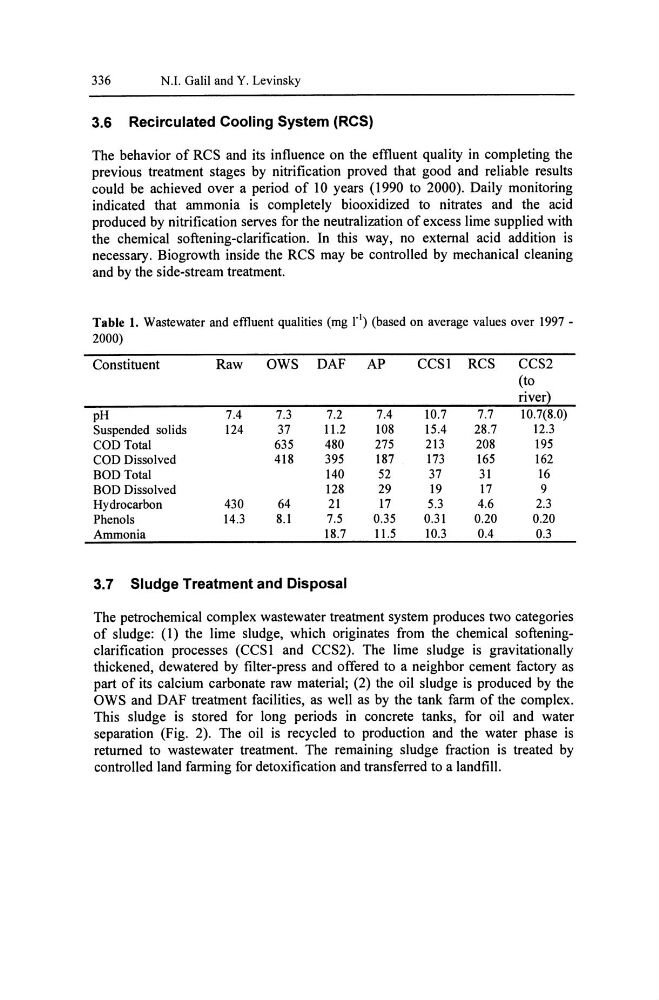
Table 1. Wastewater and effiuent qualities (mg r') (based on average values over 1997 -
2000)
Constituent
Raw
OWS DAF AP
CCSI RCS
CCS2
(to
river}
pH
7.4
7.3
7.2
7.4
10.7
7.7
10.7(8.0)
Suspended solids
124
37
11.2
108
15.4
28.7
12.3
COD Total
635
480
275
213
208
195
COD Dissolved
418
395
187
173
165
162
BOD Total
140
52
37
31
16
BOD Dissolved
128
29
19
17
9
Hydrocarbon
430
64
21
17
5.3
4.6
2.3
Phenols
14.3
8.1
7.5
0.35
0.31
0.20
0.20
Ammonia
18.7
11.5
10.3
0.4
0.3
3.7 Sludge Treatment and Disposal
The petrochemical complex wastewater treatment system produces two categories
of sludge: (1) the lime sludge, which originates from the chemical softeningclarification processes (CCS 1 and CCS2). The lime sludge is gravitationally
thickened, dewatered by filter-press and offered to a neighbor cement factory as
part of its calcium carbonate raw material; (2) the oil sludge is produced by the
OWS and DAF treatment facilities, as well as by the tank farm of the complex.
This sludge is stored for long periods in concrete tanks, for oil and water
separation (Fig. 2). The oil is recycled to production and the water phase is
returned to wastewater treatment. The remaining sludge fraction is treated by
controlled land farming for detoxification and transferred to a landfill.
N.!. Galil and Y. Levinsky
3.6 Recirculated Cooling System (RCS)
The behavior of RCS and its influence on the effluent quality in completing the
previous treatment stages by nitrification proved that good and reliable results
could be achieved over a period of 10 years (1990 to 2000). Daily monitoring
indicated that ammonia is completely biooxidized to nitrates and the acid
produced by nitrification serves for the neutralization of excess lime supplied with
the chemical softening-clarification. In this way, no external acid addition is
necessary. Biogrowth inside the RCS may be controlled by mechanical cleaning
and by the side-stream treatment.
Table 1. Wastewater and effiuent qualities (mg r') (based on average values over 1997 -
2000)
Constituent
Raw
OWS DAF AP
CCSI RCS
CCS2
(to
river}
pH
7.4
7.3
7.2
7.4
10.7
7.7
10.7(8.0)
Suspended solids
124
37
11.2
108
15.4
28.7
12.3
COD Total
635
480
275
213
208
195
COD Dissolved
418
395
187
173
165
162
BOD Total
140
52
37
31
16
BOD Dissolved
128
29
19
17
9
Hydrocarbon
430
64
21
17
5.3
4.6
2.3
Phenols
14.3
8.1
7.5
0.35
0.31
0.20
0.20
Ammonia
18.7
11.5
10.3
0.4
0.3
3.7 Sludge Treatment and Disposal
The petrochemical complex wastewater treatment system produces two categories
of sludge: (1) the lime sludge, which originates from the chemical softeningclarification processes (CCS 1 and CCS2). The lime sludge is gravitationally
thickened, dewatered by filter-press and offered to a neighbor cement factory as
part of its calcium carbonate raw material; (2) the oil sludge is produced by the
OWS and DAF treatment facilities, as well as by the tank farm of the complex.
This sludge is stored for long periods in concrete tanks, for oil and water
separation (Fig. 2). The oil is recycled to production and the water phase is
returned to wastewater treatment. The remaining sludge fraction is treated by
controlled land farming for detoxification and transferred to a landfill.