

The Application of Electrodialysis for Drinking Water Treatment
323
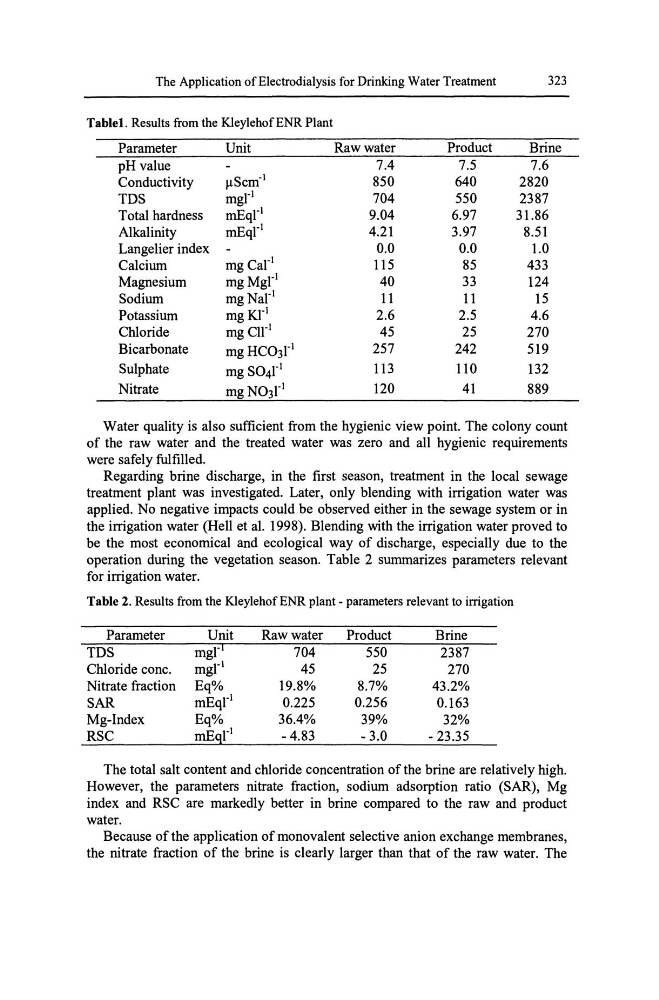
Table1. Results from the KleylehofENR Plant
Parameter
Unit
Raw water
Product
Brine
pH value
7.4
7.5
7.6
Conductivity
JlScm- l
850
640
2820
TDS
mgr l
704
550
2387
Total hardness
mEqr l
9.04
6.97
31.86
Alkalinity
mEqrl
4.21
3.97
8.51
Langelier index
0.0
0.0
1.0
Calcium
mgCar l
115
85
433
Magnesium
mgMgr l
40
33
124
Sodium
mgNar l
11
11
15
Potassium
mgKl- l
2.6
2.5
4.6
Chloride
mg Cll- l
45
25
270
Bicarbonate
mgHC03rl
257
242
519
Sulphate
mgS04 rl
113
110
132
Nitrate
mg N03 rl
120
41
889
Water quality is also sufficient from the hygienic view point. The colony count
of the raw water and the treated water was zero and all hygienic requirements
were safely fulfilled.
Regarding brine discharge, in the first season, treatment in the local sewage
treatment plant was investigated. Later, only blending with irrigation water was
applied. No negative impacts could be observed either in the sewage system or in
the irrigation water (Hell et a1. 1998). Blending with the irrigation water proved to
be the most economical and ecological way of discharge, especially due to the
operation during the vegetation season. Table 2 summarizes parameters relevant
for irrigation water.
Table 2. Results from the KleylehofENR plant - parameters relevant to irrigation
Parameter
Unit
Raw water
Product
Brine
TDS
mgr!
704
550
2387
Chloride conc.
mgr l
45
25
270
Nitrate fraction Eq%
19.8%
8.7%
43.2%
SAR
mEqrl
0.225
0.256
0.163
Mg-Index
Eq%
36.4%
39%
32%
RSC
mEqr l
- 4.83
- 3.0
- 23.35
The total salt content and chloride concentration of the brine are relatively high.
However, the parameters nitrate fraction, sodium adsorption ratio (SAR), Mg
index and RSC are markedly better in brine compared to the raw and product
water.
Because of the application of monovalent selective anion exchange membranes,
the nitrate fraction of the brine is clearly larger than that of the raw water. The
323
Table1. Results from the KleylehofENR Plant
Parameter
Unit
Raw water
Product
Brine
pH value
7.4
7.5
7.6
Conductivity
JlScm- l
850
640
2820
TDS
mgr l
704
550
2387
Total hardness
mEqr l
9.04
6.97
31.86
Alkalinity
mEqrl
4.21
3.97
8.51
Langelier index
0.0
0.0
1.0
Calcium
mgCar l
115
85
433
Magnesium
mgMgr l
40
33
124
Sodium
mgNar l
11
11
15
Potassium
mgKl- l
2.6
2.5
4.6
Chloride
mg Cll- l
45
25
270
Bicarbonate
mgHC03rl
257
242
519
Sulphate
mgS04 rl
113
110
132
Nitrate
mg N03 rl
120
41
889
Water quality is also sufficient from the hygienic view point. The colony count
of the raw water and the treated water was zero and all hygienic requirements
were safely fulfilled.
Regarding brine discharge, in the first season, treatment in the local sewage
treatment plant was investigated. Later, only blending with irrigation water was
applied. No negative impacts could be observed either in the sewage system or in
the irrigation water (Hell et a1. 1998). Blending with the irrigation water proved to
be the most economical and ecological way of discharge, especially due to the
operation during the vegetation season. Table 2 summarizes parameters relevant
for irrigation water.
Table 2. Results from the KleylehofENR plant - parameters relevant to irrigation
Parameter
Unit
Raw water
Product
Brine
TDS
mgr!
704
550
2387
Chloride conc.
mgr l
45
25
270
Nitrate fraction Eq%
19.8%
8.7%
43.2%
SAR
mEqrl
0.225
0.256
0.163
Mg-Index
Eq%
36.4%
39%
32%
RSC
mEqr l
- 4.83
- 3.0
- 23.35
The total salt content and chloride concentration of the brine are relatively high.
However, the parameters nitrate fraction, sodium adsorption ratio (SAR), Mg
index and RSC are markedly better in brine compared to the raw and product
water.
Because of the application of monovalent selective anion exchange membranes,
the nitrate fraction of the brine is clearly larger than that of the raw water. The