

Turbidity Removal by Polyelectrolytes as Flocculant Aids
301
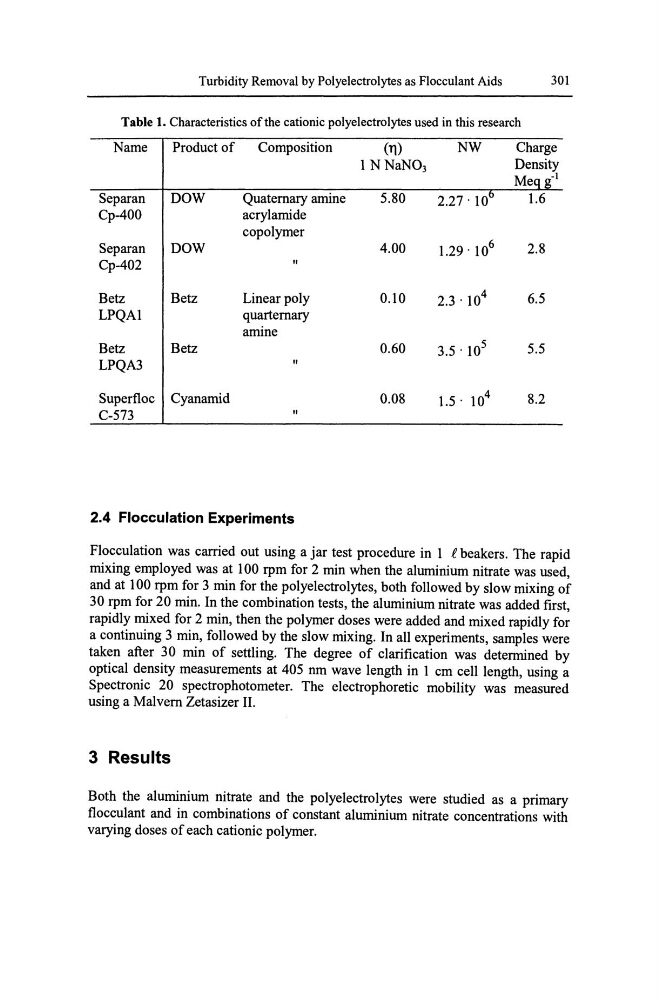
Table 1. Characteristics of the cationic polyelectrolytes used in this research
Name
Product of
Composition
(11)
NW
1 NNaN03
Separan
DOW
Quaternary amine
5.80
Cp-400
acrylamide
copolymer
Separan
DOW
4.00
1.29'10 6
2.8
Cp-402
Betz
Betz
Linear poly
0.10
2.3 . 10 4
6.5
LPQAl
quarternary
amine
Betz
Betz
0.60
3.5' 10 5
5.5
LPQA3
Superfloc Cyanamid
0.08
1.5'10 4
8.2
C-573
2.4 Flocculation Experiments
Flocculation was carried out using a jar test procedure in 1 £ beakers. The rapid
mixing employed was at 100 rpm for 2 min when the aluminium nitrate was used,
and at 100 rpm for 3 min for the polyelectrolytes, both followed by slow mixing of
30 rpm for 20 min. In the combination tests, the aluminium nitrate was added first,
rapidly mixed for 2 min, then the polymer doses were added and mixed rapidly for
a continuing 3 min, followed by the slow mixing. In all experiments, samples were
taken after 30 min of settling. The degree of clarification was determined by
optical density measurements at 405 nm wave length in 1 cm cell length, using a
Spectronic 20 spectrophotometer. The electrophoretic mobility was measured
using a Malvern Zetasizer II.
3 Results
Both the aluminium nitrate and the polyelectrolytes were studied as a primary
flocculant and in combinations of constant aluminium nitrate concentrations with
varying doses of each cationic polymer.
301
Table 1. Characteristics of the cationic polyelectrolytes used in this research
Name
Product of
Composition
(11)
NW
1 NNaN03
Separan
DOW
Quaternary amine
5.80
Cp-400
acrylamide
copolymer
Separan
DOW
4.00
1.29'10 6
2.8
Cp-402
Betz
Betz
Linear poly
0.10
2.3 . 10 4
6.5
LPQAl
quarternary
amine
Betz
Betz
0.60
3.5' 10 5
5.5
LPQA3
Superfloc Cyanamid
0.08
1.5'10 4
8.2
C-573
2.4 Flocculation Experiments
Flocculation was carried out using a jar test procedure in 1 £ beakers. The rapid
mixing employed was at 100 rpm for 2 min when the aluminium nitrate was used,
and at 100 rpm for 3 min for the polyelectrolytes, both followed by slow mixing of
30 rpm for 20 min. In the combination tests, the aluminium nitrate was added first,
rapidly mixed for 2 min, then the polymer doses were added and mixed rapidly for
a continuing 3 min, followed by the slow mixing. In all experiments, samples were
taken after 30 min of settling. The degree of clarification was determined by
optical density measurements at 405 nm wave length in 1 cm cell length, using a
Spectronic 20 spectrophotometer. The electrophoretic mobility was measured
using a Malvern Zetasizer II.
3 Results
Both the aluminium nitrate and the polyelectrolytes were studied as a primary
flocculant and in combinations of constant aluminium nitrate concentrations with
varying doses of each cationic polymer.