

290
H. S. Weinberg
photoelectric theory (Schwitzgebel et al. 1995) and its effectiveness has been
demonstrated on the oxidation of tri- and tetrachloroethylene in aqueous solutions
(Glaze et al. 1993).
4.9 Electron Beam
The use of high-energy electrons generated by a gamma ray emission source such
as 60 Co or as emissions from an electron accelerator can initiate a chain reaction in
water (Buxton et al. 1988) by promoting formation of radical species and free
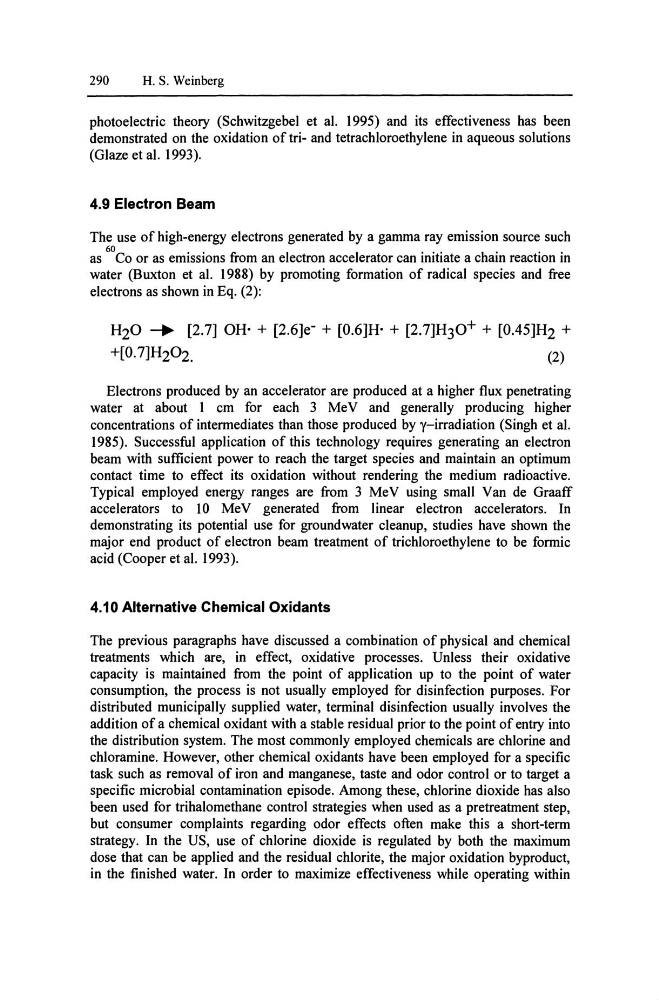
electrons as shown in Eq. (2):
H20 -+ [2.7] OH' + [2.6]e- + [O.6]H· + [2.7]H30+ + [0.4S]H2 +
+[O.7]H202.
(2)
Electrons produced by an accelerator are produced at a higher flux penetrating
water at about 1 cm for each 3 Me V and generally producing higher
concentrations of intermediates than those produced by y-irradiation (Singh et al.
1985). Successful application of this technology requires generating an electron
beam with sufficient power to reach the target species and maintain an optimum
contact time to effect its oxidation without rendering the medium radioactive.
Typical employed energy ranges are from 3 MeV using small Van de Graaff
accelerators to 10 MeV generated from linear electron accelerators. In
demonstrating its potential use for groundwater cleanup, studies have shown the
major end product of electron beam treatment of trichloroethylene to be formic
acid (Cooper et al. 1993).
4.10 Alternative Chemical Oxidants
The previous paragraphs have discussed a combination of physical and chemical
treatments which are, in effect, oxidative processes. Unless their oxidative
capacity is maintained from the point of application up to the point of water
consumption, the process is not usually employed for disinfection purposes. For
distributed municipally supplied water, terminal disinfection usually involves the
addition of a chemical oxidant with a stable residual prior to the point of entry into
the distribution system. The most commonly employed chemicals are chlorine and
chloramine. However, other chemical oxidants have been employed for a specific
task such as removal of iron and manganese, taste and odor control or to target a
specific microbial contamination episode. Among these, chlorine dioxide has also
been used for trihalomethane control strategies when used as a pretreatment step,
but consumer complaints regarding odor effects often make this a short-term
strategy. In the US, use of chlorine dioxide is regulated by both the maximum
dose that can be applied and the residual chlorite, the major oxidation byproduct,
in the finished water. In order to maximize effectiveness while operating within
H. S. Weinberg
photoelectric theory (Schwitzgebel et al. 1995) and its effectiveness has been
demonstrated on the oxidation of tri- and tetrachloroethylene in aqueous solutions
(Glaze et al. 1993).
4.9 Electron Beam
The use of high-energy electrons generated by a gamma ray emission source such
as 60 Co or as emissions from an electron accelerator can initiate a chain reaction in
water (Buxton et al. 1988) by promoting formation of radical species and free
electrons as shown in Eq. (2):
H20 -+ [2.7] OH' + [2.6]e- + [O.6]H· + [2.7]H30+ + [0.4S]H2 +
+[O.7]H202.
(2)
Electrons produced by an accelerator are produced at a higher flux penetrating
water at about 1 cm for each 3 Me V and generally producing higher
concentrations of intermediates than those produced by y-irradiation (Singh et al.
1985). Successful application of this technology requires generating an electron
beam with sufficient power to reach the target species and maintain an optimum
contact time to effect its oxidation without rendering the medium radioactive.
Typical employed energy ranges are from 3 MeV using small Van de Graaff
accelerators to 10 MeV generated from linear electron accelerators. In
demonstrating its potential use for groundwater cleanup, studies have shown the
major end product of electron beam treatment of trichloroethylene to be formic
acid (Cooper et al. 1993).
4.10 Alternative Chemical Oxidants
The previous paragraphs have discussed a combination of physical and chemical
treatments which are, in effect, oxidative processes. Unless their oxidative
capacity is maintained from the point of application up to the point of water
consumption, the process is not usually employed for disinfection purposes. For
distributed municipally supplied water, terminal disinfection usually involves the
addition of a chemical oxidant with a stable residual prior to the point of entry into
the distribution system. The most commonly employed chemicals are chlorine and
chloramine. However, other chemical oxidants have been employed for a specific
task such as removal of iron and manganese, taste and odor control or to target a
specific microbial contamination episode. Among these, chlorine dioxide has also
been used for trihalomethane control strategies when used as a pretreatment step,
but consumer complaints regarding odor effects often make this a short-term
strategy. In the US, use of chlorine dioxide is regulated by both the maximum
dose that can be applied and the residual chlorite, the major oxidation byproduct,
in the finished water. In order to maximize effectiveness while operating within