

8
A. Shaviv
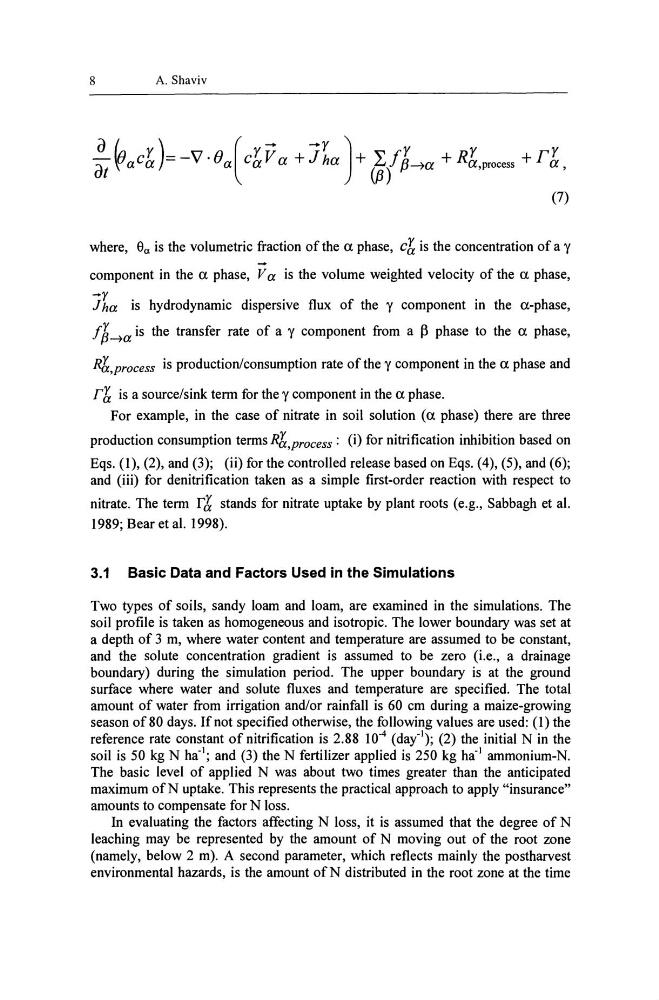
where, au is the volumetric fraction of the a phase, Clx is the concentration of a y
component in the a phase, Va is the volume weighted velocity of the a phase,
:ita is hydrodynamic dispersive flux of the y component in the a-phase,
ib~a is the transfer rate of a y component from a 13 phase to the a phase,
If/x,process is production/consumption rate of the y component in the a phase and
rlx is a source/sink term for the y component in the a phase.
For example, in the case of nitrate in soil solution (a phase) there are three
production consumption terms If/x,process: (i) for nitrification inhibition based on
Egs. (1), (2), and (3); (ii) for the controlled release based on Egs. (4), (5), and (6);
and (iii) for denitrification taken as a simple first-order reaction with respect to
nitrate. The term rZ stands for nitrate uptake by plant roots (e.g., Sabbagh et al.
1989; Bear et al. 1998).
3.1 Basic Data and Factors Used in the Simulations
Two types of soils, sandy loam and loam, are examined in the simulations. The
soil profile is taken as homogeneous and isotropic. The lower boundary was set at
a depth of 3 m, where water content and temperature are assumed to be constant,
and the solute concentration gradient is assumed to be zero (i.e., a drainage
boundary) during the simulation period. The upper boundary is at the ground
surface where water and solute fluxes and temperature are specified. The total
amount of water from irrigation and/or rainfall is 60 cm during a maize-growing
season of 80 days. Ifnot specified otherwise, the following values are used: (1) the
reference rate constant of nitrification is 2.88 10- 4 (day-I); (2) the initial N in the
soil is 50 kg N ha- I ; and (3) the N fertilizer applied is 250 kg ha- I ammonium-No
The basic level of applied N was about two times greater than the anticipated
maximum ofN uptake. This represents the practical approach to apply "insurance"
amounts to compensate for N loss.
In evaluating the factors affecting N loss, it is assumed that the degree of N
leaching may be represented by the amount of N moving out of the root zone
(namely, below 2 m). A second parameter, which reflects mainly the postharvest
environmental hazards, is the amount ofN distributed in the root zone at the time
A. Shaviv
where, au is the volumetric fraction of the a phase, Clx is the concentration of a y
component in the a phase, Va is the volume weighted velocity of the a phase,
:ita is hydrodynamic dispersive flux of the y component in the a-phase,
ib~a is the transfer rate of a y component from a 13 phase to the a phase,
If/x,process is production/consumption rate of the y component in the a phase and
rlx is a source/sink term for the y component in the a phase.
For example, in the case of nitrate in soil solution (a phase) there are three
production consumption terms If/x,process: (i) for nitrification inhibition based on
Egs. (1), (2), and (3); (ii) for the controlled release based on Egs. (4), (5), and (6);
and (iii) for denitrification taken as a simple first-order reaction with respect to
nitrate. The term rZ stands for nitrate uptake by plant roots (e.g., Sabbagh et al.
1989; Bear et al. 1998).
3.1 Basic Data and Factors Used in the Simulations
Two types of soils, sandy loam and loam, are examined in the simulations. The
soil profile is taken as homogeneous and isotropic. The lower boundary was set at
a depth of 3 m, where water content and temperature are assumed to be constant,
and the solute concentration gradient is assumed to be zero (i.e., a drainage
boundary) during the simulation period. The upper boundary is at the ground
surface where water and solute fluxes and temperature are specified. The total
amount of water from irrigation and/or rainfall is 60 cm during a maize-growing
season of 80 days. Ifnot specified otherwise, the following values are used: (1) the
reference rate constant of nitrification is 2.88 10- 4 (day-I); (2) the initial N in the
soil is 50 kg N ha- I ; and (3) the N fertilizer applied is 250 kg ha- I ammonium-No
The basic level of applied N was about two times greater than the anticipated
maximum ofN uptake. This represents the practical approach to apply "insurance"
amounts to compensate for N loss.
In evaluating the factors affecting N loss, it is assumed that the degree of N
leaching may be represented by the amount of N moving out of the root zone
(namely, below 2 m). A second parameter, which reflects mainly the postharvest
environmental hazards, is the amount ofN distributed in the root zone at the time