

155
'"":"
u! 150
1' 01
E
......
Qj 145
>
~
"C 140
Q)
III
Qj 135
>
~
...
Q)
- 130
1' 01
~
125
325
Application of the Integrated Water Management Approach
225
Gauging station
Bautzen UP
- Bed level [m .a.s.I.)
Water level measured [m .a.s.I.)
- Water level simulated [m.a.s.l.[
320
315
310
Station [km]
305
Gaugln station
Lieske
300
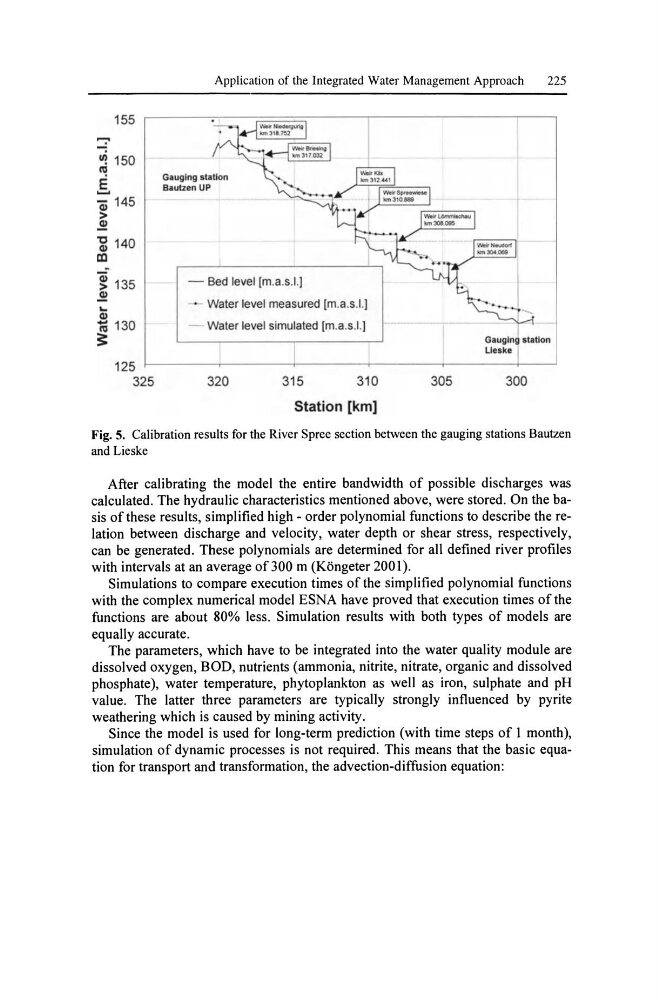
Fig. 5. Calibration results for the River Spree section between the gauging stations Bautzen
and Lieske
After calibrating the model the entire bandwidth of possible discharges was
calculated. The hydraulic characteristics mentioned above, were stored. On the basis of these results, simplified high - order polynomial functions to describe the relation between discharge and velocity, water depth or shear stress, respectively,
can be generated. These polynomials are determined for all defined river profiles
with intervals at an average of300 m (Kongeter 2001).
Simulations to compare execution times of the simplified polynomial functions
with the complex numerical model ESNA have proved that execution times of the
functions are about 80% less. Simulation results with both types of models are
equally accurate.
The parameters, which have to be integrated into the water quality module are
dissolved oxygen, BOD, nutrients (ammonia, nitrite, nitrate, organic and dissolved
phosphate), water temperature, phytoplankton as well as iron, sulphate and pH
value. The latter three parameters are typically strongly influenced by pyrite
weathering which is caused by mining activity.
Since the model is used for long-term prediction (with time steps of 1 month),
simulation of dynamic processes is not required. This means that the basic equation for transport and transformation, the advection-diffusion equation:
'"":"
u! 150
1' 01
E
......
Qj 145
>
~
"C 140
Q)
III
Qj 135
>
~
...
Q)
- 130
1' 01
~
125
325
Application of the Integrated Water Management Approach
225
Gauging station
Bautzen UP
- Bed level [m .a.s.I.)
Water level measured [m .a.s.I.)
- Water level simulated [m.a.s.l.[
320
315
310
Station [km]
305
Gaugln station
Lieske
300
Fig. 5. Calibration results for the River Spree section between the gauging stations Bautzen
and Lieske
After calibrating the model the entire bandwidth of possible discharges was
calculated. The hydraulic characteristics mentioned above, were stored. On the basis of these results, simplified high - order polynomial functions to describe the relation between discharge and velocity, water depth or shear stress, respectively,
can be generated. These polynomials are determined for all defined river profiles
with intervals at an average of300 m (Kongeter 2001).
Simulations to compare execution times of the simplified polynomial functions
with the complex numerical model ESNA have proved that execution times of the
functions are about 80% less. Simulation results with both types of models are
equally accurate.
The parameters, which have to be integrated into the water quality module are
dissolved oxygen, BOD, nutrients (ammonia, nitrite, nitrate, organic and dissolved
phosphate), water temperature, phytoplankton as well as iron, sulphate and pH
value. The latter three parameters are typically strongly influenced by pyrite
weathering which is caused by mining activity.
Since the model is used for long-term prediction (with time steps of 1 month),
simulation of dynamic processes is not required. This means that the basic equation for transport and transformation, the advection-diffusion equation: