

178
D. Markel and U. Shamir
the lake. The lake and its basin supplies on average ca. 550 mcm annually, of
which about 400 mcm are pumped through the National Carrier to the center of
the country and 100 mcm are supplied directly to consumers around the lake. In
addition, 55 mcm are supplied annually to the Hashemite Kingdom of Jordan.
Maintaining and improving water quality in Lake Kinneret are therefore a major
national and regional concern.
Two major aquifers - the Mountain Aquifer and the Coastal Aquifer - provide
most of the remaining water to the national consumption of Israel. Extraction from
the aquifers has for many years exceeded the average replenishment, which has
resulted in declining water levels in the aquifers and deterioration of water quality,
and mandates a decrease in the quantities supplied from groundwater (Kessler
1999). At the same time, the level in the Kinneret has reached its lowest level in
recent history (Fig. 2), well below the "red line" (the operational minimum) -
which itself has been lowered first from -212 m (ASL) to -213 min 1986, and
then to -214 min 2000. Hence, there is serious concern that the water quality of
the lake will deteriorate as a consequence of the water-level drop.
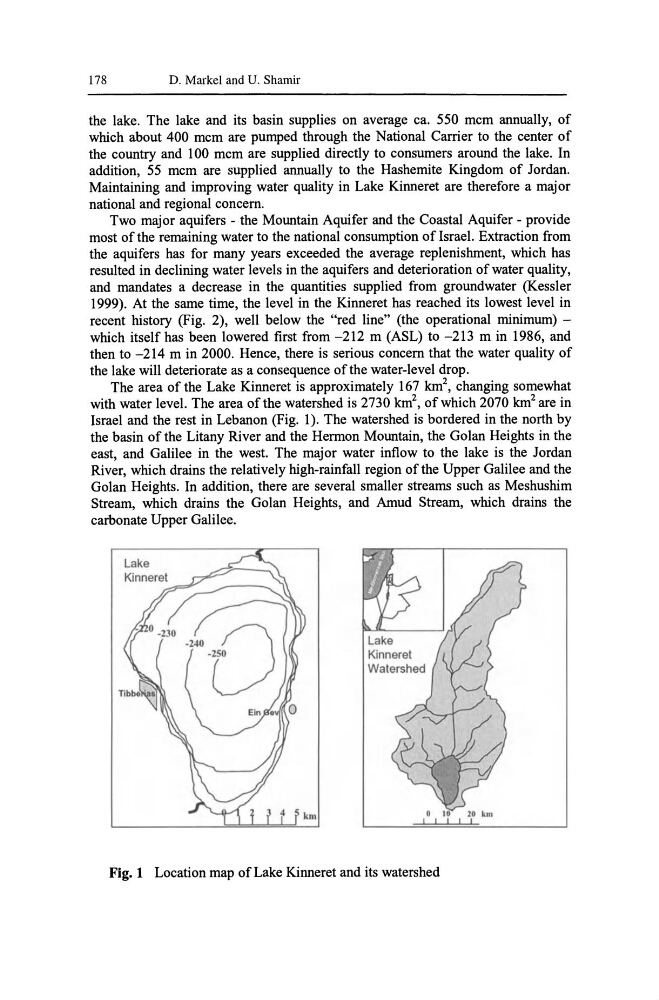
The area of the Lake Kinneret is approximately 167 km 2 , changing somewhat
with water level. The area of the watershed is 2730 km 2 , of which 2070 km 2 are in
Israel and the rest in Lebanon (Fig. 1). The watershed is bordered in the north by
the basin of the Litany River and the Hennon Mountain, the Golan Heights in the
east, and Galilee in the west. The major water inflow to the lake is the Jordan
River, which drains the relatively high-rainfall region of the Upper Galilee and the
Golan Heights. In addition, there are several smaller streams such as Meshushim
Stream, which drains the Golan Heights, and Amud Stream, which drains the
carbonate Upper Galilee.
Fig. 1 Location map of Lake Kinneret and its watershed
D. Markel and U. Shamir
the lake. The lake and its basin supplies on average ca. 550 mcm annually, of
which about 400 mcm are pumped through the National Carrier to the center of
the country and 100 mcm are supplied directly to consumers around the lake. In
addition, 55 mcm are supplied annually to the Hashemite Kingdom of Jordan.
Maintaining and improving water quality in Lake Kinneret are therefore a major
national and regional concern.
Two major aquifers - the Mountain Aquifer and the Coastal Aquifer - provide
most of the remaining water to the national consumption of Israel. Extraction from
the aquifers has for many years exceeded the average replenishment, which has
resulted in declining water levels in the aquifers and deterioration of water quality,
and mandates a decrease in the quantities supplied from groundwater (Kessler
1999). At the same time, the level in the Kinneret has reached its lowest level in
recent history (Fig. 2), well below the "red line" (the operational minimum) -
which itself has been lowered first from -212 m (ASL) to -213 min 1986, and
then to -214 min 2000. Hence, there is serious concern that the water quality of
the lake will deteriorate as a consequence of the water-level drop.
The area of the Lake Kinneret is approximately 167 km 2 , changing somewhat
with water level. The area of the watershed is 2730 km 2 , of which 2070 km 2 are in
Israel and the rest in Lebanon (Fig. 1). The watershed is bordered in the north by
the basin of the Litany River and the Hennon Mountain, the Golan Heights in the
east, and Galilee in the west. The major water inflow to the lake is the Jordan
River, which drains the relatively high-rainfall region of the Upper Galilee and the
Golan Heights. In addition, there are several smaller streams such as Meshushim
Stream, which drains the Golan Heights, and Amud Stream, which drains the
carbonate Upper Galilee.
Fig. 1 Location map of Lake Kinneret and its watershed