

152
J. Atkinson
other nonindigenous species, especially after the opening of the St. Lawrence
Seaway (Fig. 1). Eutrophication was associated with algal blooms, low dissolved
oxygen (DO) levels, fish kills, odor, and other problems. There were mUltiple
concerns about the effects of DDT on ecosystem health, and the sea lamprey was
effectively destroying the fishing industry, particularly in Lake Ontario. This
prompted the establishment of the Great Lakes Fisheries Commission, in 1955.
Nonindigenous species continue to be a problem even today.
The eutrophication problem grew during the 1950s and 1960s, especially in
Lake Erie, which at one time was described as being "dead". This lake was
especially susceptible due to heavy population and smaller size, compared with
the other lakes. There was increasing public concern, and the IJC concluded in a
1970 report that the main cause of eutrophication was excess phosphorus. Several
management options were proposed, including establishment of uniform effluent
limits from industrial and municipal sewage treatment plant discharges, overland
runoff control and limitations placed on use of phosphates in detergents.
A significant result of the 1970 study was the signing of the Great Lakes Water
Quality Agreement of 1972, which presented a formal cooperative strategy to
address pollution in the lakes. Until that agreement, there was no effective
management structure to address water-quality control in the Great Lakes. One of
the major goals was to significantly reduce pollutant discharges in order to deal
with the main problems of eutrophication and DDT contamination. Municipal
sewage works were upgraded and limits on phosphorus use were imposed.
The results of these actions were obvious: algal blooms occurred less
frequently, DO levels improved, odor problems diminished, oil slicks began to
disappear, and many beaches were reopened. The initiatives of the 1970s
demonstrated that improvements could be made and they also provided several
important lessons beyond the immediate goals of restoration. Mainly, it was
determined that the lakes would respond to human management and that lakewide or even basin-wide approaches were needed to achieve desired results.
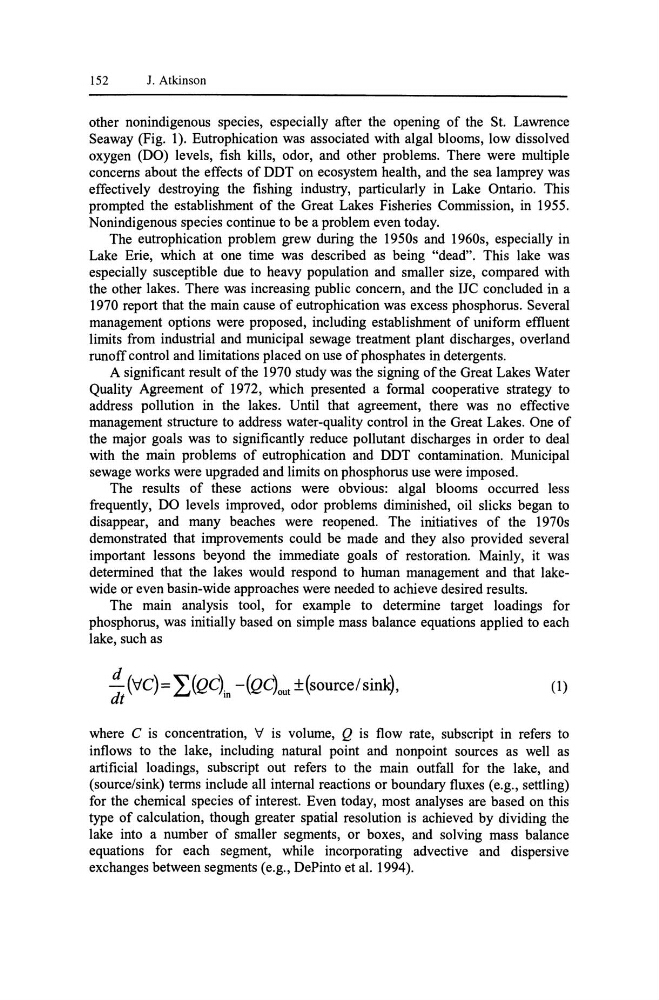
The main analysis tool, for example to determine target loadings for
phosphorus, was initially based on simple mass balance equations applied to each
lake, such as
~(\;jC)= ~ (QC). -(Qc)out ±(source/ sink),
dt
L.J
10
(1)
where C is concentration, 'if is volume, Q is flow rate, subscript in refers to
inflows to the lake, including natural point and nonpoint sources as well as
artificial loadings, subscript out refers to the main outfall for the lake, and
(source/sink) terms include all internal reactions or boundary fluxes (e.g., settling)
for the chemical species of interest. Even today, most analyses are based on this
type of calculation, though greater spatial resolution is achieved by dividing the
lake into a number of smaller segments, or boxes, and solving mass balance
equations for each segment, while incorporating advective and dispersive
exchanges between segments (e.g., DePinto et al. 1994).
J. Atkinson
other nonindigenous species, especially after the opening of the St. Lawrence
Seaway (Fig. 1). Eutrophication was associated with algal blooms, low dissolved
oxygen (DO) levels, fish kills, odor, and other problems. There were mUltiple
concerns about the effects of DDT on ecosystem health, and the sea lamprey was
effectively destroying the fishing industry, particularly in Lake Ontario. This
prompted the establishment of the Great Lakes Fisheries Commission, in 1955.
Nonindigenous species continue to be a problem even today.
The eutrophication problem grew during the 1950s and 1960s, especially in
Lake Erie, which at one time was described as being "dead". This lake was
especially susceptible due to heavy population and smaller size, compared with
the other lakes. There was increasing public concern, and the IJC concluded in a
1970 report that the main cause of eutrophication was excess phosphorus. Several
management options were proposed, including establishment of uniform effluent
limits from industrial and municipal sewage treatment plant discharges, overland
runoff control and limitations placed on use of phosphates in detergents.
A significant result of the 1970 study was the signing of the Great Lakes Water
Quality Agreement of 1972, which presented a formal cooperative strategy to
address pollution in the lakes. Until that agreement, there was no effective
management structure to address water-quality control in the Great Lakes. One of
the major goals was to significantly reduce pollutant discharges in order to deal
with the main problems of eutrophication and DDT contamination. Municipal
sewage works were upgraded and limits on phosphorus use were imposed.
The results of these actions were obvious: algal blooms occurred less
frequently, DO levels improved, odor problems diminished, oil slicks began to
disappear, and many beaches were reopened. The initiatives of the 1970s
demonstrated that improvements could be made and they also provided several
important lessons beyond the immediate goals of restoration. Mainly, it was
determined that the lakes would respond to human management and that lakewide or even basin-wide approaches were needed to achieve desired results.
The main analysis tool, for example to determine target loadings for
phosphorus, was initially based on simple mass balance equations applied to each
lake, such as
~(\;jC)= ~ (QC). -(Qc)out ±(source/ sink),
dt
L.J
10
(1)
where C is concentration, 'if is volume, Q is flow rate, subscript in refers to
inflows to the lake, including natural point and nonpoint sources as well as
artificial loadings, subscript out refers to the main outfall for the lake, and
(source/sink) terms include all internal reactions or boundary fluxes (e.g., settling)
for the chemical species of interest. Even today, most analyses are based on this
type of calculation, though greater spatial resolution is achieved by dividing the
lake into a number of smaller segments, or boxes, and solving mass balance
equations for each segment, while incorporating advective and dispersive
exchanges between segments (e.g., DePinto et al. 1994).