

0
0
..... 1
E
"'0 -..
B 2
c
CIS
-
:63
~
0
1;:4
5
Numerical Simulation as a Tool to Improve Subsurface Flow
97
measured TOe, simulated total COD [mg/l]
50
------------100
150
--- -
/ '
- • simulated COD (1 minute)
- - -simulated COD (10 minutes)
~ simulated COD (30 minutes)
--A- simulated COD (1 hour)
o measured TOC
200
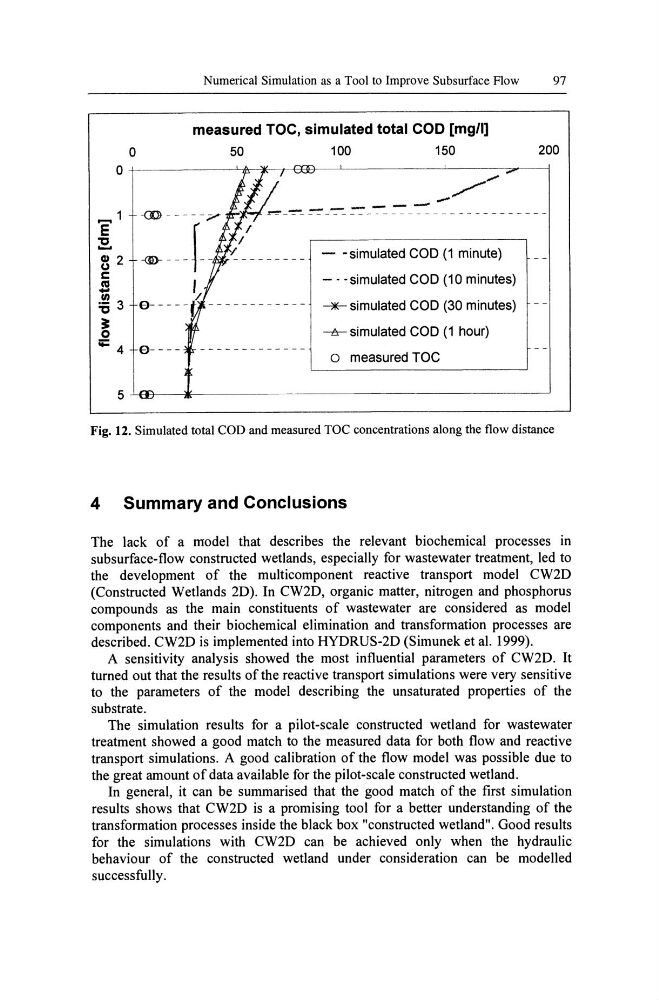
Fig. 12. Simulated total COD and measured TOe concentrations along the flow distance
4 Summary and Conclusions
The lack of a model that describes the relevant biochemical processes in
subsurface-flow constructed wetlands, especially for wastewater treatment, led to
the development of the mUlticomponent reactive transport model CW2D
(Constructed Wetlands 2D). In CW2D, organic matter, nitrogen and phosphorus
compounds as the main constituents of wastewater are considered as model
components and their biochemical elimination and transformation processes are
described. CW2D is implemented into HYDRUS-2D (Simunek et al. 1999).
A sensitivity analysis showed the most influential parameters of CW2D. It
turned out that the results of the reactive transport simulations were very sensitive
to the parameters of the model describing the unsaturated properties of the
substrate.
The simulation results for a pilot-scale constructed wetland for wastewater
treatment showed a good match to the measured data for both flow and reactive
transport simulations. A good calibration of the flow model was possible due to
the great amount of data available for the pilot-scale constructed wetland.
In general, it can be summarised that the good match of the first simulation
results shows that CW2D is a promising tool for a better understanding of the
transformation processes inside the black box "constructed wetland". Good results
for the simulations with CW2D can be achieved only when the hydraulic
behaviour of the constructed wetland under consideration can be modelled
successfully.
0
..... 1
E
"'0 -..
B 2
c
CIS
-
:63
~
0
1;:4
5
Numerical Simulation as a Tool to Improve Subsurface Flow
97
measured TOe, simulated total COD [mg/l]
50
------------100
150
--- -
/ '
- • simulated COD (1 minute)
- - -simulated COD (10 minutes)
~ simulated COD (30 minutes)
--A- simulated COD (1 hour)
o measured TOC
200
Fig. 12. Simulated total COD and measured TOe concentrations along the flow distance
4 Summary and Conclusions
The lack of a model that describes the relevant biochemical processes in
subsurface-flow constructed wetlands, especially for wastewater treatment, led to
the development of the mUlticomponent reactive transport model CW2D
(Constructed Wetlands 2D). In CW2D, organic matter, nitrogen and phosphorus
compounds as the main constituents of wastewater are considered as model
components and their biochemical elimination and transformation processes are
described. CW2D is implemented into HYDRUS-2D (Simunek et al. 1999).
A sensitivity analysis showed the most influential parameters of CW2D. It
turned out that the results of the reactive transport simulations were very sensitive
to the parameters of the model describing the unsaturated properties of the
substrate.
The simulation results for a pilot-scale constructed wetland for wastewater
treatment showed a good match to the measured data for both flow and reactive
transport simulations. A good calibration of the flow model was possible due to
the great amount of data available for the pilot-scale constructed wetland.
In general, it can be summarised that the good match of the first simulation
results shows that CW2D is a promising tool for a better understanding of the
transformation processes inside the black box "constructed wetland". Good results
for the simulations with CW2D can be achieved only when the hydraulic
behaviour of the constructed wetland under consideration can be modelled
successfully.