

Numerical Simulation as a Tool to Improve Subsurface Flow
85
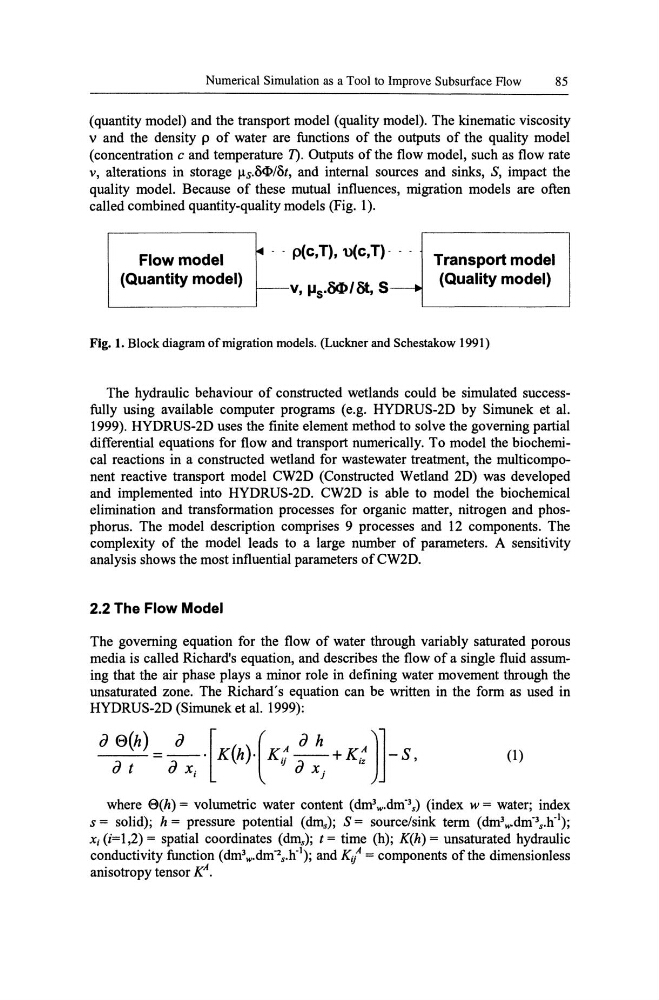
(quantity model) and the transport model (quality model). The kinematic viscosity
v and the density p of water are functions of the outputs of the quality model
(concentration c and temperature T). Outputs of the flow model, such as flow rate
v, alterations in storage Ils.o/Ot, and internal sources and sinks, S, impact the
quality model. Because of these mutual influences, migration models are often
called combined quantity-quality models (Fig. 1) .
Flow model
(Quantity model)
.. - - p(c,T), u(c,T)- v , J.l s .M>15t, S-----Transport model
(Quality model)
Fig. 1. Block diagram of migration models. (Luckner and Schestakow 1991)
The hydraulic behaviour of constructed wetlands could be simulated successfully using available computer programs (e.g. HYDRUS-2D by Simunek et al.
1999). HYDRUS-2D uses the finite element method to solve the governing partial
differential equations for flow and transport numerically. To model the biochemical reactions in a constructed wetland for wastewater treatment, the multicomponent reactive transport model CW2D (Constructed Wetland 2D) was developed
and implemented into HYDRUS-2D. CW2D is able to model the biochemical
elimination and transformation processes for organic matter, nitrogen and phosphorus. The model description comprises 9 processes and 12 components. The
complexity of the model leads to a large number of parameters. A sensitivity
analysis shows the most influential parameters of CW2D.
2.2 The Flow Model
The governing equation for the flow of water through variably saturated porous
media is called Richard's equation, and describes the flow of a single fluid assuming that the air phase plays a minor role in defining water movement through the
unsaturated zone. The Richard's equation can be written in the form as used in
HYDRUS-2D (Simunek et al. 1999):
(1)
where 8(h) = volumetric water content (dm 3 w.dm· 3 s) (index w = water; index
s = solid); h = pressure potential (dms); S= source/sink term (dml",.dm- 3 s.h- I );
Xi (i= 1,2) = spatial coordinates (dms); t = time (h); K(h) = unsaturated hydraulic
conductivity function (dm 3 w.dm-2s.h·I); and K/ = components of the dimensionless
anisotropy tensor KA.
85
(quantity model) and the transport model (quality model). The kinematic viscosity
v and the density p of water are functions of the outputs of the quality model
(concentration c and temperature T). Outputs of the flow model, such as flow rate
v, alterations in storage Ils.o
quality model. Because of these mutual influences, migration models are often
called combined quantity-quality models (Fig. 1) .
Flow model
(Quantity model)
.. - - p(c,T), u(c,T)- v , J.l s .M>15t, S-----Transport model
(Quality model)
Fig. 1. Block diagram of migration models. (Luckner and Schestakow 1991)
The hydraulic behaviour of constructed wetlands could be simulated successfully using available computer programs (e.g. HYDRUS-2D by Simunek et al.
1999). HYDRUS-2D uses the finite element method to solve the governing partial
differential equations for flow and transport numerically. To model the biochemical reactions in a constructed wetland for wastewater treatment, the multicomponent reactive transport model CW2D (Constructed Wetland 2D) was developed
and implemented into HYDRUS-2D. CW2D is able to model the biochemical
elimination and transformation processes for organic matter, nitrogen and phosphorus. The model description comprises 9 processes and 12 components. The
complexity of the model leads to a large number of parameters. A sensitivity
analysis shows the most influential parameters of CW2D.
2.2 The Flow Model
The governing equation for the flow of water through variably saturated porous
media is called Richard's equation, and describes the flow of a single fluid assuming that the air phase plays a minor role in defining water movement through the
unsaturated zone. The Richard's equation can be written in the form as used in
HYDRUS-2D (Simunek et al. 1999):
(1)
where 8(h) = volumetric water content (dm 3 w.dm· 3 s) (index w = water; index
s = solid); h = pressure potential (dms); S= source/sink term (dml",.dm- 3 s.h- I );
Xi (i= 1,2) = spatial coordinates (dms); t = time (h); K(h) = unsaturated hydraulic
conductivity function (dm 3 w.dm-2s.h·I); and K/ = components of the dimensionless
anisotropy tensor KA.