

CD
U
c:
.e
~
«
0.16 AUFS
o
2
A DEHP
4
0.04
AUFS
6
Retention time (min)
Organics
55
DBP
8
10
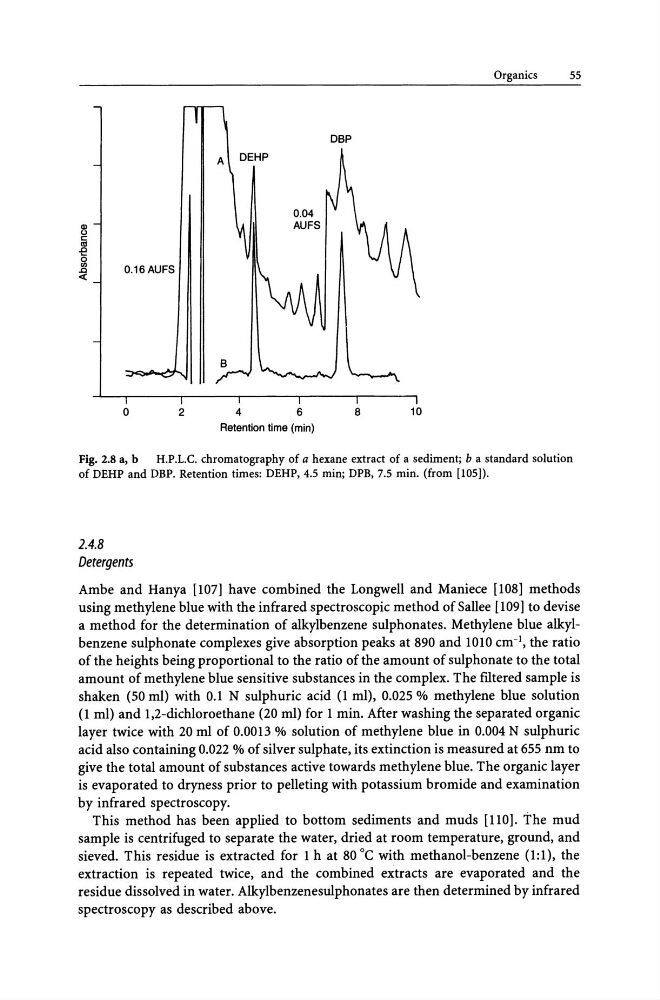
Fig. 2.8 a, b
H.P.L.e. chromatography of a hexane extract of a sediment; b a standard solution
of DEHP and DBP. Retention times: DEHP, 4.5 min; DPB, 7.5 min. (from [105]).
2.4.8
Detergents
Ambe and Hanya [107] have combined the Longwell and Maniece [108] methods
using methylene blue with the infrared spectroscopic method of Sallee [109] to devise
a method for the determination of alkylbenzene sulphonates. Methylene blue alkylbenzene sulphonate complexes give absorption peaks at 890 and 1010 cm- I , the ratio
of the heights being proportional to the ratio of the amount of sulphonate to the total
amount of methylene blue sensitive substances in the complex. The filtered sample is
shaken (50 ml) with 0.1 N sulphuric acid (1 ml), 0.025 % methylene blue solution
(1 ml) and 1,2-dichloroethane (20 ml) for 1 min. After washing the separated organic
layer twice with 20 ml of 0.0013 % solution of methylene blue in 0.004 N sulphuric
acid also containing 0.022 % of silver sulphate, its extinction is measured at 655 nm to
give the total amount of substances active towards methylene blue. The organic layer
is evaporated to dryness prior to pelleting with potassium bromide and examination
by infrared spectroscopy.
This method has been applied to bottom sediments and muds [llO]. The mud
sample is centrifuged to separate the water, dried at room temperature, ground, and
sieved. This residue is extracted for 1 h at 80°C with methanol-benzene (1:1), the
extraction is repeated twice, and the combined extracts are evaporated and the
residue dissolved in water. Alkylbenzenesulphonates are then determined by infrared
spectroscopy as described above.
U
c:
.e
~
«
0.16 AUFS
o
2
A DEHP
4
0.04
AUFS
6
Retention time (min)
Organics
55
DBP
8
10
Fig. 2.8 a, b
H.P.L.e. chromatography of a hexane extract of a sediment; b a standard solution
of DEHP and DBP. Retention times: DEHP, 4.5 min; DPB, 7.5 min. (from [105]).
2.4.8
Detergents
Ambe and Hanya [107] have combined the Longwell and Maniece [108] methods
using methylene blue with the infrared spectroscopic method of Sallee [109] to devise
a method for the determination of alkylbenzene sulphonates. Methylene blue alkylbenzene sulphonate complexes give absorption peaks at 890 and 1010 cm- I , the ratio
of the heights being proportional to the ratio of the amount of sulphonate to the total
amount of methylene blue sensitive substances in the complex. The filtered sample is
shaken (50 ml) with 0.1 N sulphuric acid (1 ml), 0.025 % methylene blue solution
(1 ml) and 1,2-dichloroethane (20 ml) for 1 min. After washing the separated organic
layer twice with 20 ml of 0.0013 % solution of methylene blue in 0.004 N sulphuric
acid also containing 0.022 % of silver sulphate, its extinction is measured at 655 nm to
give the total amount of substances active towards methylene blue. The organic layer
is evaporated to dryness prior to pelleting with potassium bromide and examination
by infrared spectroscopy.
This method has been applied to bottom sediments and muds [llO]. The mud
sample is centrifuged to separate the water, dried at room temperature, ground, and
sieved. This residue is extracted for 1 h at 80°C with methanol-benzene (1:1), the
extraction is repeated twice, and the combined extracts are evaporated and the
residue dissolved in water. Alkylbenzenesulphonates are then determined by infrared
spectroscopy as described above.