

Organic Carbon Parameters
51
2.3
Organic Carbon Parameters
2.3.1
Percentage Carbon
Various workers have discussed the determination of organic carbon in river sediments [82-85]. Suzuki et al. [82] applied wet combustion to the sediment and absorbed the carbon dioxide produced in sodium hydroxide solution, prior to determination in a TOC analyser. Whitfield and McKinley [83] recommended that samples for
determination of organic carbon should be fIltered immediately and analysed as soon
as possible. Charles and Simmons [84] stated that greater accuracy is obtained with
dry microcombustion techniques and that wet oxidations with potassium dichromate
lead to incomplete oxidation of certain compounds and interference from oxidizable
inorganic compounds such as chlorides.
McQuaker and Fung [85] used a Model DC-50 Total Organic Carbon Analyser
(Dohrmann Envirotech Corp) to determine both total carbon and organic carbon in
sediments. Samples for total carbon determination are dispersed in deionized water
and injected onto the analyser. Samples for organic carbon determination are dispensed in 0.1 N hydrochloric acid (to decompose inorganic carbonates), then injected
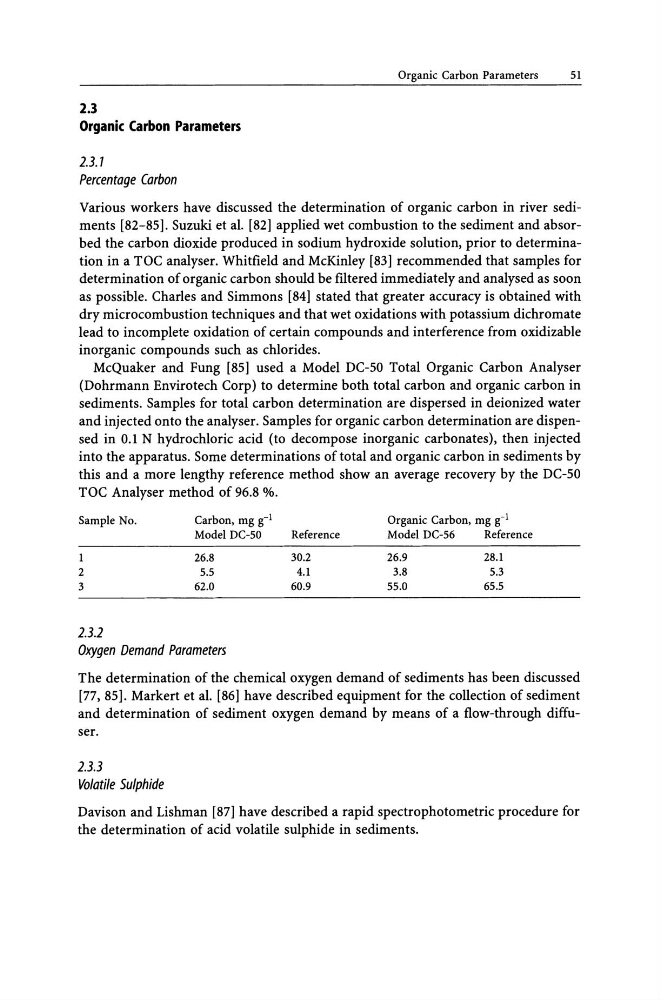
into the apparatus. Some determinations of total and organic carbon in sediments by
this and a more lengthy reference method show an average recovery by the DC-50
TOC Analyser method of 96.8 %.
Sample No.
Carbon, mg g-l
Model DC-50
26.8
2
5.5
3
62.0
2.3.2
Oxygen Demand Parameters
Reference
30.2
4.1
60.9
Organic Carbon, mg g-l
Model DC-56
Reference
26.9
3.8
55.0
28.1
5.3
65.5
The determination of the chemical oxygen demand of sediments has been discussed
[77,85]. Markert et al. [86] have described equipment for the collection of sediment
and determination of sediment oxygen demand by means of a flow-through diffuser.
2.3.3
Volatile Sulphide
Davison and Lishman [87] have described a rapid spectrophotometric procedure for
the determination of acid volatile sulphide in sediments.
51
2.3
Organic Carbon Parameters
2.3.1
Percentage Carbon
Various workers have discussed the determination of organic carbon in river sediments [82-85]. Suzuki et al. [82] applied wet combustion to the sediment and absorbed the carbon dioxide produced in sodium hydroxide solution, prior to determination in a TOC analyser. Whitfield and McKinley [83] recommended that samples for
determination of organic carbon should be fIltered immediately and analysed as soon
as possible. Charles and Simmons [84] stated that greater accuracy is obtained with
dry microcombustion techniques and that wet oxidations with potassium dichromate
lead to incomplete oxidation of certain compounds and interference from oxidizable
inorganic compounds such as chlorides.
McQuaker and Fung [85] used a Model DC-50 Total Organic Carbon Analyser
(Dohrmann Envirotech Corp) to determine both total carbon and organic carbon in
sediments. Samples for total carbon determination are dispersed in deionized water
and injected onto the analyser. Samples for organic carbon determination are dispensed in 0.1 N hydrochloric acid (to decompose inorganic carbonates), then injected
into the apparatus. Some determinations of total and organic carbon in sediments by
this and a more lengthy reference method show an average recovery by the DC-50
TOC Analyser method of 96.8 %.
Sample No.
Carbon, mg g-l
Model DC-50
26.8
2
5.5
3
62.0
2.3.2
Oxygen Demand Parameters
Reference
30.2
4.1
60.9
Organic Carbon, mg g-l
Model DC-56
Reference
26.9
3.8
55.0
28.1
5.3
65.5
The determination of the chemical oxygen demand of sediments has been discussed
[77,85]. Markert et al. [86] have described equipment for the collection of sediment
and determination of sediment oxygen demand by means of a flow-through diffuser.
2.3.3
Volatile Sulphide
Davison and Lishman [87] have described a rapid spectrophotometric procedure for
the determination of acid volatile sulphide in sediments.