

Metals
49
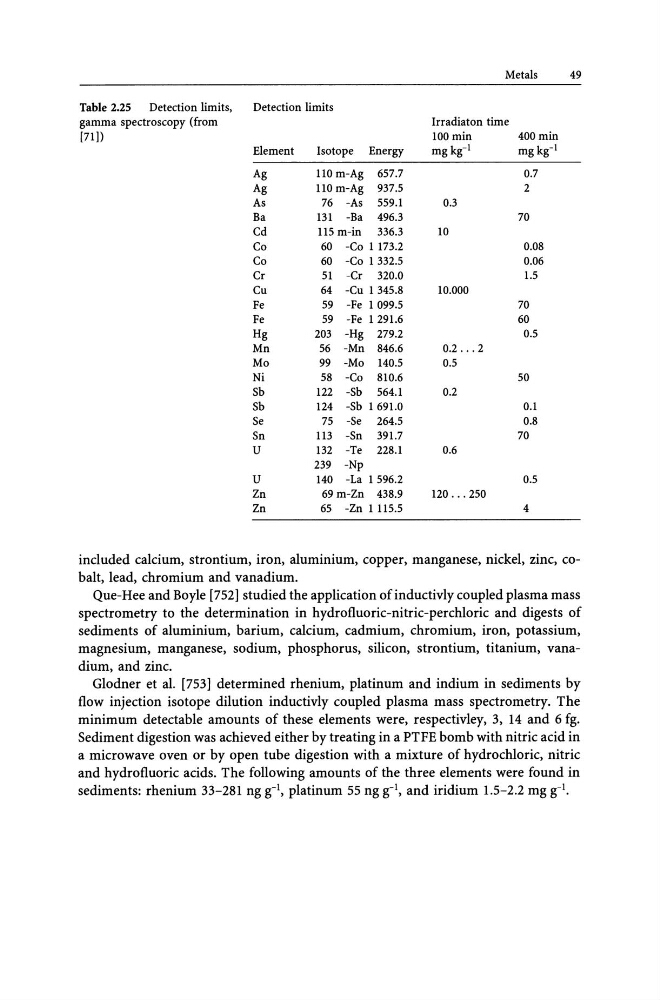
Table 2.25
Detection limits,
Detection limits
gamma spectroscopy (from
Irradiaton time
[71])
100 min
400 min
Element
Isotope Energy
mgkg-l
mgkg- l
Ag
110 m-Ag 657.7
0.7
Ag
110 m-Ag 937.5
2
As
76 -As 559.1
0.3
Ba
131 -Ba 496.3
70
Cd
115 m-in 336.3
10
Co
60 -Co 1173.2
0.08
Co
60 -Co 1332.5
0.06
Cr
51 -Cr 320.0
1.5
Cu
64 -Cu 1345.8
10.000
Fe
59 -Fe 1099.5
70
Fe
59 -Fe 1 291.6
60
Hg
203 -Hg 279.2
0.5
Mn
56 -Mn 846.6
0.2 ... 2
Mo
99 -Mo 140.5
0.5
Ni
58 -Co 810,6
50
Sb
122 -Sb 564.1
0.2
Sb
124 -Sb 1691.0
0.1
Se
75 -Se 264.5
0.8
Sn
113 -Sn 391.7
70
U
132 -Te 228.1
0.6
239 -Np
U
140 -La 1596.2
0.5
Zn
69 m-Zn 438.9
120 ... 250
Zn
65 -Zn 1115.5
4
included calcium, strontium, iron, aluminium, copper, manganese, nickel, zinc, cobalt, lead, chromium and vanadium.
Que-Hee and Boyle [752] studied the application of inductivly coupled plasma mass
spectrometry to the determination in hydrofluoric-nitric-perchloric and digests of
sediments of aluminium, barium, calcium, cadmium, chromium, iron, potassium,
magnesium, manganese, sodium, phosphorus, silicon, strontium, titanium, vanadium, and zinc.
Glodner et al. [753] determined rhenium, platinum and indium in sediments by
flow injection isotope dilution inductivly coupled plasma mass spectrometry. The
minimum detectable amounts of these elements were, respectivley, 3, 14 and 6 fg.
Sediment digestion was achieved either by treating in a PTFE bomb with nitric acid in
a microwave oven or by open tube digestion with a mixture of hydrochloric, nitric
and hydrofluoric acids. The following amounts of the three elements were found in
sediments: rhenium 33-281 ng g-l, platinum 55 ng g-l, and iridium 1.5-2.2 mg g-l.
49
Table 2.25
Detection limits,
Detection limits
gamma spectroscopy (from
Irradiaton time
[71])
100 min
400 min
Element
Isotope Energy
mgkg-l
mgkg- l
Ag
110 m-Ag 657.7
0.7
Ag
110 m-Ag 937.5
2
As
76 -As 559.1
0.3
Ba
131 -Ba 496.3
70
Cd
115 m-in 336.3
10
Co
60 -Co 1173.2
0.08
Co
60 -Co 1332.5
0.06
Cr
51 -Cr 320.0
1.5
Cu
64 -Cu 1345.8
10.000
Fe
59 -Fe 1099.5
70
Fe
59 -Fe 1 291.6
60
Hg
203 -Hg 279.2
0.5
Mn
56 -Mn 846.6
0.2 ... 2
Mo
99 -Mo 140.5
0.5
Ni
58 -Co 810,6
50
Sb
122 -Sb 564.1
0.2
Sb
124 -Sb 1691.0
0.1
Se
75 -Se 264.5
0.8
Sn
113 -Sn 391.7
70
U
132 -Te 228.1
0.6
239 -Np
U
140 -La 1596.2
0.5
Zn
69 m-Zn 438.9
120 ... 250
Zn
65 -Zn 1115.5
4
included calcium, strontium, iron, aluminium, copper, manganese, nickel, zinc, cobalt, lead, chromium and vanadium.
Que-Hee and Boyle [752] studied the application of inductivly coupled plasma mass
spectrometry to the determination in hydrofluoric-nitric-perchloric and digests of
sediments of aluminium, barium, calcium, cadmium, chromium, iron, potassium,
magnesium, manganese, sodium, phosphorus, silicon, strontium, titanium, vanadium, and zinc.
Glodner et al. [753] determined rhenium, platinum and indium in sediments by
flow injection isotope dilution inductivly coupled plasma mass spectrometry. The
minimum detectable amounts of these elements were, respectivley, 3, 14 and 6 fg.
Sediment digestion was achieved either by treating in a PTFE bomb with nitric acid in
a microwave oven or by open tube digestion with a mixture of hydrochloric, nitric
and hydrofluoric acids. The following amounts of the three elements were found in
sediments: rhenium 33-281 ng g-l, platinum 55 ng g-l, and iridium 1.5-2.2 mg g-l.