

Metals
47
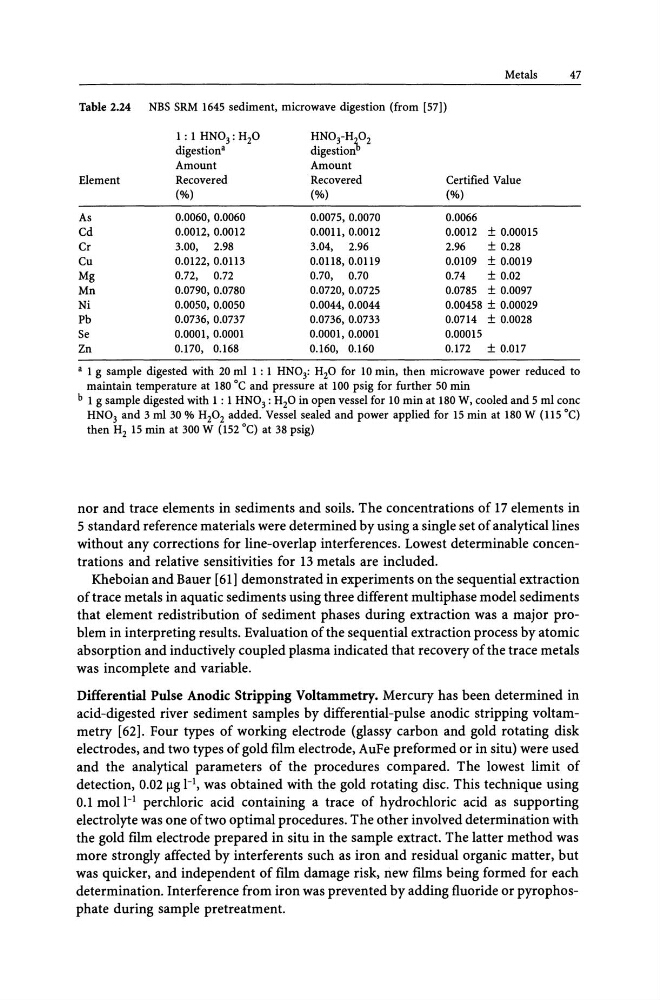
Table 2.24
NBS SRM 1645 sediment, microwave digestion (from [57])
1: 1 HN0 3 : H 2 O
HN03-H~02
digestion"
digestion
Amount
Amount
Element
Recovered
Recovered
Certified Value
(%)
(%)
(%)
As
0.0060, 0.0060
0.0075, 0.0070
0.0066
Cd
0.0012, 0.0012
0.0011, 0.0012
0.0012 ± 0.00015
Cr
3.00, 2.98
3.04, 2.96
2.96
± 0.28
Cu
0.0122, 0.0113
0.0118, 0.0119
0.0109 ± 0.0019
Mg
0.72, 0.72
0.70, 0.70
0.74
± 0.02
Mn
0.0790, 0.0780
0.0720, 0.0725
0.0785 ± 0.0097
Ni
0.0050, 0.0050
0.0044, 0.0044
0.00458 ± 0.00029
Ph
0.0736, 0.0737
0.0736, 0.0733
0.0714 ± 0.0028
Se
0.0001, 0.0001
0.0001, 0.0001
0.00015
Zn
0.170, 0.168
0.160, 0.160
0.172 ± 0.017
" 1 g sample digested with 20 mil: 1 HN0 3 : Hp for 10 min, then microwave power reduced to
maintain temperature at 180°C and pressure at 100 psig for further 50 min
bIg sample digested with 1 : 1 HN0 3 : H 2 0 in open vessel for 10 min at 180 W, cooled and 5 ml cone
HN0 3 and 3 ml 30 % H 2 0 2 added. Vessel sealed and power applied for 15 min at 180 W (115°C)
then H2 15 min at 300 W (152°C) at 38 psig)
nor and trace elements in sediments and soils. The concentrations of 17 elements in
5 standard reference materials were determined by using a single set of analytical lines
without any corrections for line-overlap interferences. Lowest determinable concentrations and relative sensitivities for 13 metals are included.
Kheboian and Bauer [61] demonstrated in experiments on the sequential extraction
of trace metals in aquatic sediments using three different multiphase model sediments
that element redistribution of sediment phases during extraction was a major problem in interpreting results. Evaluation of the sequential extraction process by atomic
absorption and inductively coupled plasma indicated that recovery of the trace metals
was incomplete and variable.
Differential Pulse Anodic Stripping Voltammetry. Mercury has been determined in
acid-digested river sediment samples by differential-pulse anodic stripping voltammetry [62]. Four types of working electrode (glassy carbon and gold rotating disk
electrodes, and two types of gold fIlm electrode, AuFe preformed or in situ) were used
and the analytical parameters of the procedures compared. The lowest limit of
detection, 0.0211g I-I, was obtained with the gold rotating disc. This technique using
0.1 moll-I perchloric acid containing a trace of hydrochloric acid as supporting
electrolyte was one of two optimal procedures. The other involved determination with
the gold film electrode prepared in situ in the sample extract. The latter method was
more strongly affected by interferents such as iron and residual organic matter, but
was quicker, and independent of fIlm damage risk, riew films being formed for each
determination. Interference from iron was prevented by adding fluoride or pyrophosphate during sample pretreatment.
47
Table 2.24
NBS SRM 1645 sediment, microwave digestion (from [57])
1: 1 HN0 3 : H 2 O
HN03-H~02
digestion"
digestion
Amount
Amount
Element
Recovered
Recovered
Certified Value
(%)
(%)
(%)
As
0.0060, 0.0060
0.0075, 0.0070
0.0066
Cd
0.0012, 0.0012
0.0011, 0.0012
0.0012 ± 0.00015
Cr
3.00, 2.98
3.04, 2.96
2.96
± 0.28
Cu
0.0122, 0.0113
0.0118, 0.0119
0.0109 ± 0.0019
Mg
0.72, 0.72
0.70, 0.70
0.74
± 0.02
Mn
0.0790, 0.0780
0.0720, 0.0725
0.0785 ± 0.0097
Ni
0.0050, 0.0050
0.0044, 0.0044
0.00458 ± 0.00029
Ph
0.0736, 0.0737
0.0736, 0.0733
0.0714 ± 0.0028
Se
0.0001, 0.0001
0.0001, 0.0001
0.00015
Zn
0.170, 0.168
0.160, 0.160
0.172 ± 0.017
" 1 g sample digested with 20 mil: 1 HN0 3 : Hp for 10 min, then microwave power reduced to
maintain temperature at 180°C and pressure at 100 psig for further 50 min
bIg sample digested with 1 : 1 HN0 3 : H 2 0 in open vessel for 10 min at 180 W, cooled and 5 ml cone
HN0 3 and 3 ml 30 % H 2 0 2 added. Vessel sealed and power applied for 15 min at 180 W (115°C)
then H2 15 min at 300 W (152°C) at 38 psig)
nor and trace elements in sediments and soils. The concentrations of 17 elements in
5 standard reference materials were determined by using a single set of analytical lines
without any corrections for line-overlap interferences. Lowest determinable concentrations and relative sensitivities for 13 metals are included.
Kheboian and Bauer [61] demonstrated in experiments on the sequential extraction
of trace metals in aquatic sediments using three different multiphase model sediments
that element redistribution of sediment phases during extraction was a major problem in interpreting results. Evaluation of the sequential extraction process by atomic
absorption and inductively coupled plasma indicated that recovery of the trace metals
was incomplete and variable.
Differential Pulse Anodic Stripping Voltammetry. Mercury has been determined in
acid-digested river sediment samples by differential-pulse anodic stripping voltammetry [62]. Four types of working electrode (glassy carbon and gold rotating disk
electrodes, and two types of gold fIlm electrode, AuFe preformed or in situ) were used
and the analytical parameters of the procedures compared. The lowest limit of
detection, 0.0211g I-I, was obtained with the gold rotating disc. This technique using
0.1 moll-I perchloric acid containing a trace of hydrochloric acid as supporting
electrolyte was one of two optimal procedures. The other involved determination with
the gold film electrode prepared in situ in the sample extract. The latter method was
more strongly affected by interferents such as iron and residual organic matter, but
was quicker, and independent of fIlm damage risk, riew films being formed for each
determination. Interference from iron was prevented by adding fluoride or pyrophosphate during sample pretreatment.