

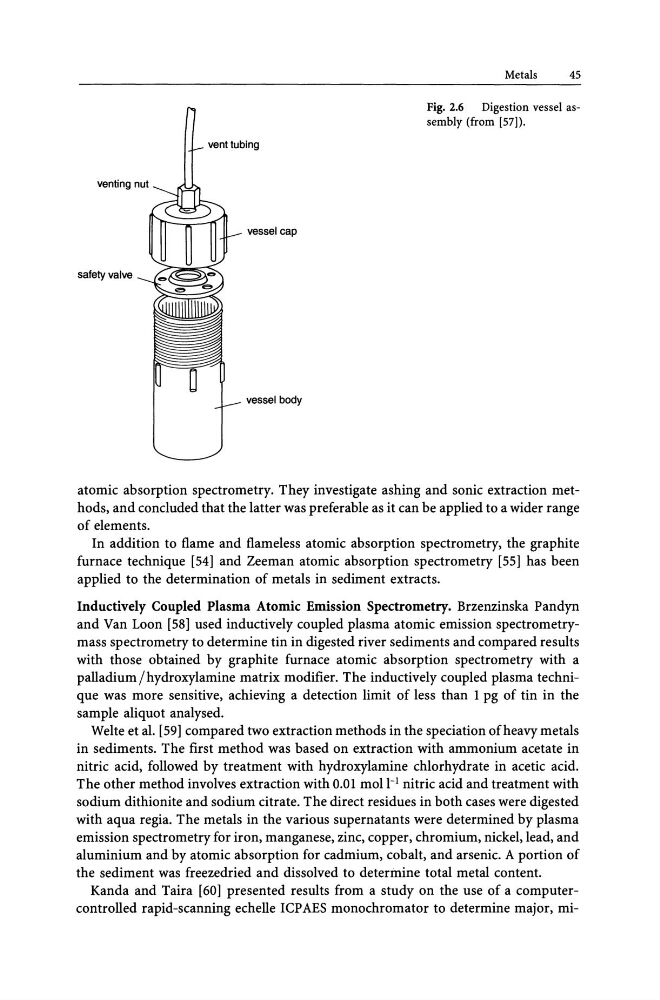
vent tubing
vessel cap
safety valve
vessel body
Metals
45
Fig. 2.6 Digestion vessel assembly (from [57)).
atomic absorption spectrometry. They investigate ashing and sonic extraction methods, and concluded that the latter was preferable as it can be applied to a wider range
of elements.
In addition to flame and flameless atomic absorption spectrometry, the graphite
furnace technique [54] and Zeeman atomic absorption spectrometry [55] has been
applied to the determination of metals in sediment extracts.
Inductively Coupled Plasma Atomic Emission Spectrometry. Brzenzinska Pandyn
and Van Loon [58] used inductively coupled plasma atomic emission spectrometrymass spectrometry to determine tin in digested river sediments and compared results
with those obtained by graphite furnace atomic absorption spectrometry with a
palladium/hydroxylamine matrix modifier. The inductively coupled plasma technique was more sensitive, achieving a detection limit of less than 1 pg of tin in the
sample aliquot analysed.
Welte et al. [59] compared two extraction methods in the speciation of heavy metals
in sediments. The first method was based on extraction with ammonium acetate in
nitric acid, followed by treatment with hydroxylamine chlorhydrate in acetic acid.
The other method involves extraction with 0.01 mol t-l nitric acid and treatment with
sodium dithionite and sodium citrate. The direct residues in both cases were digested
with aqua regia. The metals in the various supernatants were determined by plasma
emission spectrometry for iron, manganese, zinc, copper, chromium, nickel, lead, and
aluminium and by atomic absorption for cadmium, cobalt, and arsenic. A portion of
the sediment was freezedried and dissolved to determine total metal content.
Kanda and Taira [60] presented results from a study on the use of a computercontrolled rapid-scanning echelle ICPAES monochromator to determine major, mi-
vessel cap
safety valve
vessel body
Metals
45
Fig. 2.6 Digestion vessel assembly (from [57)).
atomic absorption spectrometry. They investigate ashing and sonic extraction methods, and concluded that the latter was preferable as it can be applied to a wider range
of elements.
In addition to flame and flameless atomic absorption spectrometry, the graphite
furnace technique [54] and Zeeman atomic absorption spectrometry [55] has been
applied to the determination of metals in sediment extracts.
Inductively Coupled Plasma Atomic Emission Spectrometry. Brzenzinska Pandyn
and Van Loon [58] used inductively coupled plasma atomic emission spectrometrymass spectrometry to determine tin in digested river sediments and compared results
with those obtained by graphite furnace atomic absorption spectrometry with a
palladium/hydroxylamine matrix modifier. The inductively coupled plasma technique was more sensitive, achieving a detection limit of less than 1 pg of tin in the
sample aliquot analysed.
Welte et al. [59] compared two extraction methods in the speciation of heavy metals
in sediments. The first method was based on extraction with ammonium acetate in
nitric acid, followed by treatment with hydroxylamine chlorhydrate in acetic acid.
The other method involves extraction with 0.01 mol t-l nitric acid and treatment with
sodium dithionite and sodium citrate. The direct residues in both cases were digested
with aqua regia. The metals in the various supernatants were determined by plasma
emission spectrometry for iron, manganese, zinc, copper, chromium, nickel, lead, and
aluminium and by atomic absorption for cadmium, cobalt, and arsenic. A portion of
the sediment was freezedried and dissolved to determine total metal content.
Kanda and Taira [60] presented results from a study on the use of a computercontrolled rapid-scanning echelle ICPAES monochromator to determine major, mi-