

Metals
31
chloric acid to be of the same order of magnitude as that of 0.05 N EDTA. It is
interesting to note that the mean levels oflead with all four partial extraction methods
were very similar.
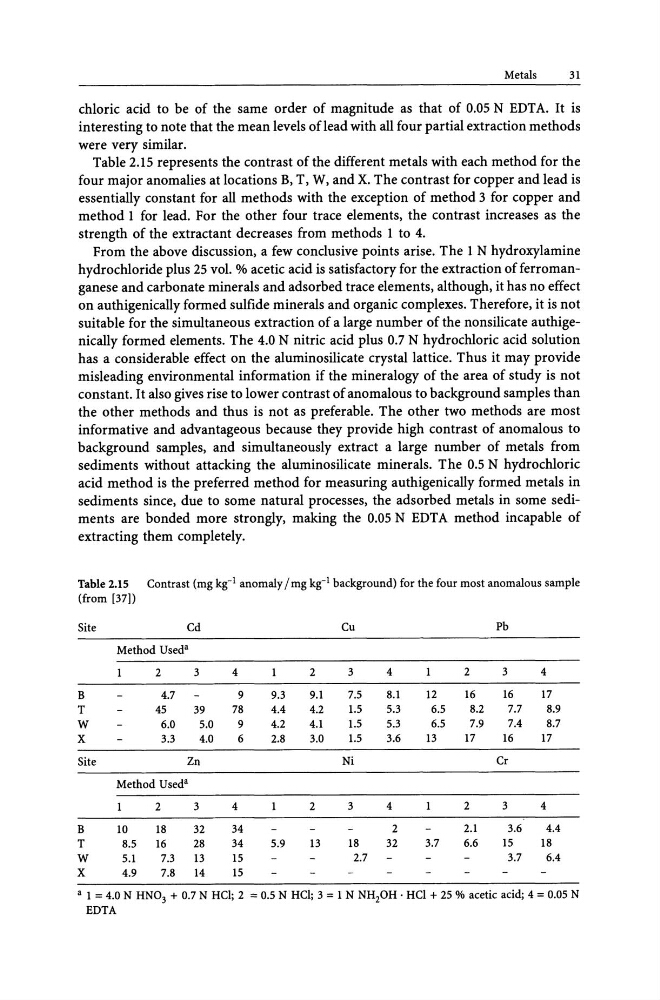
Table 2.15 represents the contrast of the different metals with each method for the
four major anomalies at locations B, T, W, and X. The contrast for copper and lead is
essentially constant for all methods with the exception of method 3 for copper and
method 1 for lead. For the other four trace elements, the contrast increases as the
strength of the extractant decreases from methods 1 to 4.
From the above discussion, a few conclusive points arise. The 1 N hydroxylamine
hydrochloride plus 25 vol. % acetic acid is satisfactory for the extraction of ferromanganese and carbonate minerals and adsorbed trace elements, although, it has no effect
on authigenically formed sulfide minerals and organic complexes. Therefore, it is not
suitable for the simultaneous extraction of a large number of the nonsilicate authigenically formed elements. The 4.0 N nitric acid plus 0.7 N hydrochloric acid solution
has a considerable effect on the alumino silicate crystal lattice. Thus it may provide
misleading environmental information if the mineralogy of the area of study is not
constant. It also gives rise to lower contrast of anomalous to background samples than
the other methods and thus is not as preferable. The other two methods are most
informative and advantageous because they provide high contrast of anomalous to
background samples, and simultaneously extract a large number of metals from
sediments without attacking the alumino silicate minerals. The 0.5 N hydrochloric
acid method is the preferred method for measuring authigenically formed metals in
sediments since, due to some natural processes, the adsorbed metals in some sediments are bonded more strongly, making the 0.05 N EDTA method incapable of
extracting them completely.
Table 2.1S
Contrast (mg kg- 1 anomaly /mg kg- 1 background) for the four most anomalous sample
(from [37])
Site
Cd
Cu
Pb
Method Used"
2
3
4
2
3
4
2
3
4
B
4.7
9
9.3
9.1
7.5
8.1
12
16
16
17
T
45
39
78
4.4
4.2
1.5
5.3
6.5
8.2
7.7
8.9
W
6.0
5.0
9
4.2
4.1
1.5
5.3
6.5
7.9
7.4
8.7
X
3.3
4.0
6
2.8
3.0
1.5
3.6
13
17
16
17
Site
Zn
Ni
Cr
Method Used"
2
3
4
2
3
4
2
3
4
B
10
18
32
34
2
2.1
3.6
4.4
T
8.5
16
28
34
5.9
13
18
32
3.7
6.6
15
18
W
5.1
7.3
l3
15
2.7
3.7
6.4
X
4.9
7.8
14
15
" 1 = 4.0 N HN0 3 + 0.7 N HCl; 2 = 0.5 N HCl; 3 = 1 N NHzOH . HCl + 25 % acetic acid; 4 = 0.05 N
EDTA
31
chloric acid to be of the same order of magnitude as that of 0.05 N EDTA. It is
interesting to note that the mean levels oflead with all four partial extraction methods
were very similar.
Table 2.15 represents the contrast of the different metals with each method for the
four major anomalies at locations B, T, W, and X. The contrast for copper and lead is
essentially constant for all methods with the exception of method 3 for copper and
method 1 for lead. For the other four trace elements, the contrast increases as the
strength of the extractant decreases from methods 1 to 4.
From the above discussion, a few conclusive points arise. The 1 N hydroxylamine
hydrochloride plus 25 vol. % acetic acid is satisfactory for the extraction of ferromanganese and carbonate minerals and adsorbed trace elements, although, it has no effect
on authigenically formed sulfide minerals and organic complexes. Therefore, it is not
suitable for the simultaneous extraction of a large number of the nonsilicate authigenically formed elements. The 4.0 N nitric acid plus 0.7 N hydrochloric acid solution
has a considerable effect on the alumino silicate crystal lattice. Thus it may provide
misleading environmental information if the mineralogy of the area of study is not
constant. It also gives rise to lower contrast of anomalous to background samples than
the other methods and thus is not as preferable. The other two methods are most
informative and advantageous because they provide high contrast of anomalous to
background samples, and simultaneously extract a large number of metals from
sediments without attacking the alumino silicate minerals. The 0.5 N hydrochloric
acid method is the preferred method for measuring authigenically formed metals in
sediments since, due to some natural processes, the adsorbed metals in some sediments are bonded more strongly, making the 0.05 N EDTA method incapable of
extracting them completely.
Table 2.1S
Contrast (mg kg- 1 anomaly /mg kg- 1 background) for the four most anomalous sample
(from [37])
Site
Cd
Cu
Pb
Method Used"
2
3
4
2
3
4
2
3
4
B
4.7
9
9.3
9.1
7.5
8.1
12
16
16
17
T
45
39
78
4.4
4.2
1.5
5.3
6.5
8.2
7.7
8.9
W
6.0
5.0
9
4.2
4.1
1.5
5.3
6.5
7.9
7.4
8.7
X
3.3
4.0
6
2.8
3.0
1.5
3.6
13
17
16
17
Site
Zn
Ni
Cr
Method Used"
2
3
4
2
3
4
2
3
4
B
10
18
32
34
2
2.1
3.6
4.4
T
8.5
16
28
34
5.9
13
18
32
3.7
6.6
15
18
W
5.1
7.3
l3
15
2.7
3.7
6.4
X
4.9
7.8
14
15
" 1 = 4.0 N HN0 3 + 0.7 N HCl; 2 = 0.5 N HCl; 3 = 1 N NHzOH . HCl + 25 % acetic acid; 4 = 0.05 N
EDTA