

22
River and Stream Sediments
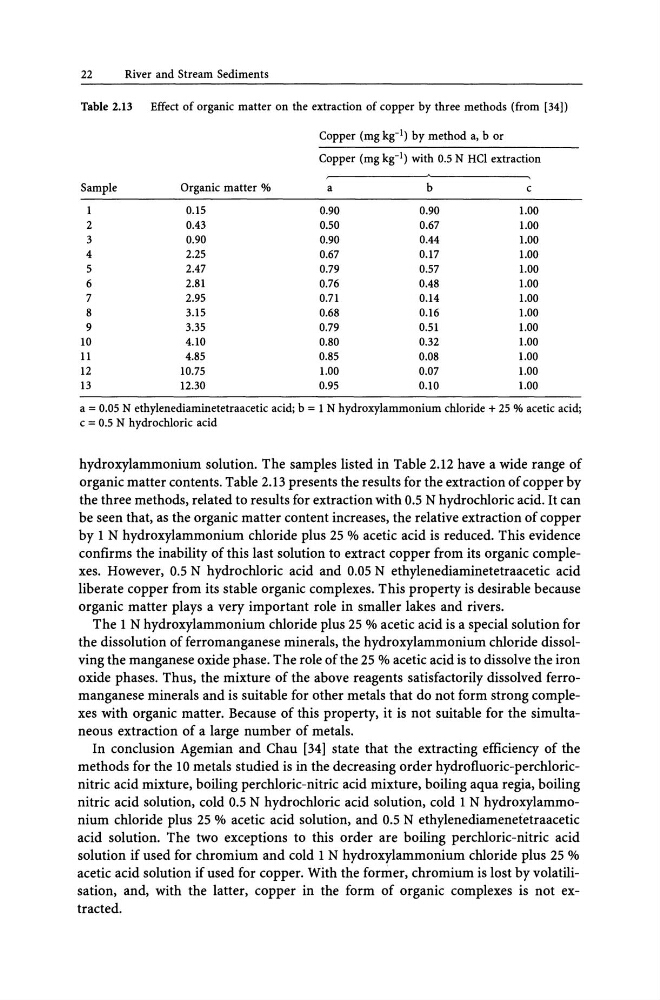
Table 2.13
Effect of organic matter on the extraction of copper by three methods (from [34))
Copper (mg kg-I) by method a, b or
Copper (mg kg-I) with 0.5 N HCl extraction
Sample
Organic matter %
a
b
c
0.15
0.90
0.90
1.00
2
0.43
0.50
0.67
1.00
3
0.90
0.90
0.44
1.00
4
2.25
0.67
0.17
1.00
5
2.47
0.79
0.57
1.00
6
2.81
0.76
0.48
1.00
7
2.95
0.71
0.14
1.00
8
3.15
0.68
0.16
1.00
9
3.35
0.79
0.51
1.00
10
4.10
0.80
0.32
1.00
11
4.85
0.85
0.08
1.00
12
10.75
1.00
0.07
1.00
13
12.30
0.95
0.10
1.00
a = 0.05 N ethylenediaminetetraacetic acid; b = 1 N hydroxylammonium chloride + 25 % acetic acid;
c = 0.5 N hydrochloric acid
hydroxylammonium solution. The samples listed in Table 2.12 have a wide range of
organic matter contents. Table 2.13 presents the results for the extraction of copper by
the three methods, related to results for extraction with 0.5 N hydrochloric acid. It can
be seen that, as the organic matter content increases, the relative extraction of copper
by 1 N hydroxylammonium chloride plus 25 % acetic acid is reduced. This evidence
confirms the inability of this last solution to extract copper from its organic complexes. However, 0.5 N hydrochloric acid and 0.05 N ethylenediaminetetraacetic acid
liberate copper from its stable organic complexes. This property is desirable because
organic matter plays a very important role in smaller lakes and rivers.
The 1 N hydroxylammonium chloride plus 25 % acetic acid is a special solution for
the dissolution of ferromanganese minerals, the hydroxylammonium chloride dissolving the manganese oxide phase. The role of the 25 % acetic acid is to dissolve the iron
oxide phases. Thus, the mixture of the above reagents satisfactorily dissolved ferromanganese minerals and is suitable for other metals that do not form strong complexes with organic matter. Because of this property, it is not suitable for the simultaneous extraction of a large number of metals.
In conclusion Agemian and Chau [34] state that the extracting efficiency of the
methods for the 10 metals studied is in the decreasing order hydrofluoric-perchloricnitric acid mixture, boiling perchloric-nitric acid mixture, boiling aqua regia, boiling
nitric acid solution, cold 0.5 N hydrochloric acid solution, cold 1 N hydroxylammonium chloride plus 25 % acetic acid solution, and 0.5 N ethylenediamenetetraacetic
acid solution. The two exceptions to this order are boiling perchloric-nitric acid
solution if used for chromium and cold 1 N hydroxylammonium chloride plus 25 %
acetic acid solution if used for copper. With the fonner, chromium is lost by volatilisation, and, with the latter, copper in the form of organic complexes is not extracted.
River and Stream Sediments
Table 2.13
Effect of organic matter on the extraction of copper by three methods (from [34))
Copper (mg kg-I) by method a, b or
Copper (mg kg-I) with 0.5 N HCl extraction
Sample
Organic matter %
a
b
c
0.15
0.90
0.90
1.00
2
0.43
0.50
0.67
1.00
3
0.90
0.90
0.44
1.00
4
2.25
0.67
0.17
1.00
5
2.47
0.79
0.57
1.00
6
2.81
0.76
0.48
1.00
7
2.95
0.71
0.14
1.00
8
3.15
0.68
0.16
1.00
9
3.35
0.79
0.51
1.00
10
4.10
0.80
0.32
1.00
11
4.85
0.85
0.08
1.00
12
10.75
1.00
0.07
1.00
13
12.30
0.95
0.10
1.00
a = 0.05 N ethylenediaminetetraacetic acid; b = 1 N hydroxylammonium chloride + 25 % acetic acid;
c = 0.5 N hydrochloric acid
hydroxylammonium solution. The samples listed in Table 2.12 have a wide range of
organic matter contents. Table 2.13 presents the results for the extraction of copper by
the three methods, related to results for extraction with 0.5 N hydrochloric acid. It can
be seen that, as the organic matter content increases, the relative extraction of copper
by 1 N hydroxylammonium chloride plus 25 % acetic acid is reduced. This evidence
confirms the inability of this last solution to extract copper from its organic complexes. However, 0.5 N hydrochloric acid and 0.05 N ethylenediaminetetraacetic acid
liberate copper from its stable organic complexes. This property is desirable because
organic matter plays a very important role in smaller lakes and rivers.
The 1 N hydroxylammonium chloride plus 25 % acetic acid is a special solution for
the dissolution of ferromanganese minerals, the hydroxylammonium chloride dissolving the manganese oxide phase. The role of the 25 % acetic acid is to dissolve the iron
oxide phases. Thus, the mixture of the above reagents satisfactorily dissolved ferromanganese minerals and is suitable for other metals that do not form strong complexes with organic matter. Because of this property, it is not suitable for the simultaneous extraction of a large number of metals.
In conclusion Agemian and Chau [34] state that the extracting efficiency of the
methods for the 10 metals studied is in the decreasing order hydrofluoric-perchloricnitric acid mixture, boiling perchloric-nitric acid mixture, boiling aqua regia, boiling
nitric acid solution, cold 0.5 N hydrochloric acid solution, cold 1 N hydroxylammonium chloride plus 25 % acetic acid solution, and 0.5 N ethylenediamenetetraacetic
acid solution. The two exceptions to this order are boiling perchloric-nitric acid
solution if used for chromium and cold 1 N hydroxylammonium chloride plus 25 %
acetic acid solution if used for copper. With the fonner, chromium is lost by volatilisation, and, with the latter, copper in the form of organic complexes is not extracted.