

Metals
13
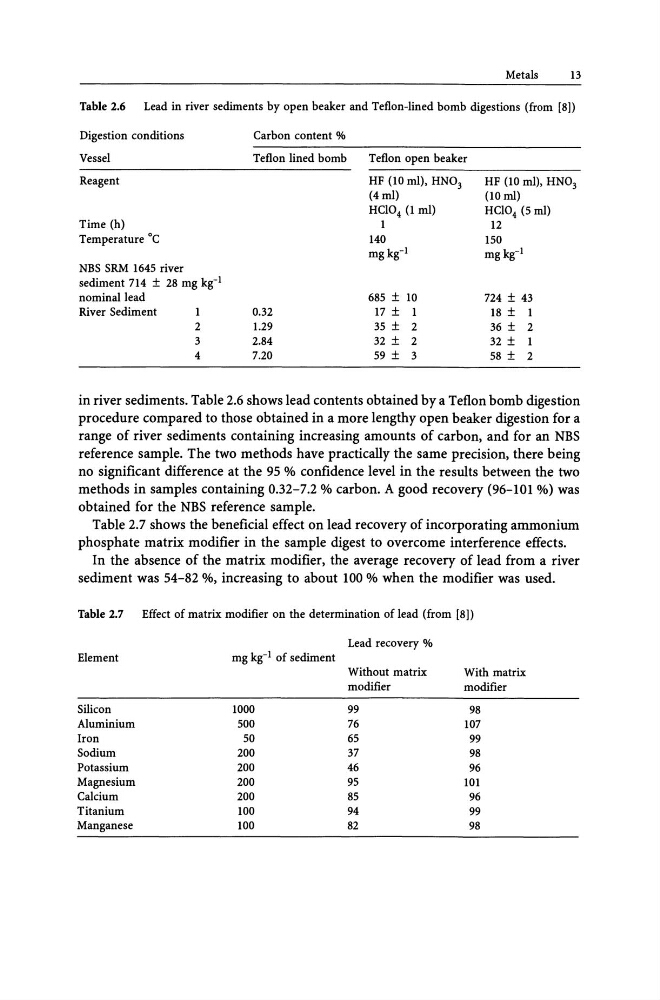
Table 2.6 Lead in river sediments by open beaker and Teflon-lined bomb digestions (from [8))
Digestion conditions
Carbon content %
Vessel
Teflon lined bomb
Teflon open beaker
Reagent
HF (10 ml), HN0 3
HF (10 ml), HN0 3
(4ml)
(10 ml)
HCI0 4 (1 ml)
HCI0 4 (5 ml)
Time (h)
1
12
Temperature DC
140
150
mgkg-1
mgkg- 1
NBS SRM 1645 river
sediment 714 ± 28 mg kg- 1
nominal lead
685 ± 10
724 ± 43
River Sediment
1
0.32
17 ±
18 ± 1
2
1.29
35 ± 2
36 ± 2
3
2.84
32 ± 2
32 ± 1
4
7.20
59 ± 3
58 ± 2
in river sediments. Table 2.6 shows lead contents obtained by a Teflon bomb digestion
procedure compared to those obtained in a more lengthy open beaker digestion for a
range of river sediments containing increasing amounts of carbon, and for an NBS
reference sample. The two methods have practically the same precision, there being
no significant difference at the 95 % confidence level in the results between the two
methods in samples containing 0.32-7.2 % carbon. A good recovery (96-101 %) was
obtained for the NBS reference sample.
Table 2.7 shows the beneficial effect on lead recovery of incorporating ammonium
phosphate matrix modifier in the sample digest to overcome interference effects.
In the absence of the matrix modifier, the average recovery of lead from a river
sediment was 54-82 %, increasing to about 100 % when the modifier was used.
Table 2.7 Effect of matrix modifier on the determination of lead (from (8))
Lead recovery %
Element
mg kg- 1 of sediment
Without matrix
With matrix
modifier
modifier
Silicon
1000
99
98
Aluminium
500
76
107
Iron
50
65
99
Sodium
200
37
98
Potassium
200
46
96
Magnesium
200
95
101
Calcium
200
85
96
Titanium
100
94
99
Manganese
100
82
98
13
Table 2.6 Lead in river sediments by open beaker and Teflon-lined bomb digestions (from [8))
Digestion conditions
Carbon content %
Vessel
Teflon lined bomb
Teflon open beaker
Reagent
HF (10 ml), HN0 3
HF (10 ml), HN0 3
(4ml)
(10 ml)
HCI0 4 (1 ml)
HCI0 4 (5 ml)
Time (h)
1
12
Temperature DC
140
150
mgkg-1
mgkg- 1
NBS SRM 1645 river
sediment 714 ± 28 mg kg- 1
nominal lead
685 ± 10
724 ± 43
River Sediment
1
0.32
17 ±
18 ± 1
2
1.29
35 ± 2
36 ± 2
3
2.84
32 ± 2
32 ± 1
4
7.20
59 ± 3
58 ± 2
in river sediments. Table 2.6 shows lead contents obtained by a Teflon bomb digestion
procedure compared to those obtained in a more lengthy open beaker digestion for a
range of river sediments containing increasing amounts of carbon, and for an NBS
reference sample. The two methods have practically the same precision, there being
no significant difference at the 95 % confidence level in the results between the two
methods in samples containing 0.32-7.2 % carbon. A good recovery (96-101 %) was
obtained for the NBS reference sample.
Table 2.7 shows the beneficial effect on lead recovery of incorporating ammonium
phosphate matrix modifier in the sample digest to overcome interference effects.
In the absence of the matrix modifier, the average recovery of lead from a river
sediment was 54-82 %, increasing to about 100 % when the modifier was used.
Table 2.7 Effect of matrix modifier on the determination of lead (from (8))
Lead recovery %
Element
mg kg- 1 of sediment
Without matrix
With matrix
modifier
modifier
Silicon
1000
99
98
Aluminium
500
76
107
Iron
50
65
99
Sodium
200
37
98
Potassium
200
46
96
Magnesium
200
95
101
Calcium
200
85
96
Titanium
100
94
99
Manganese
100
82
98