

Organics
227
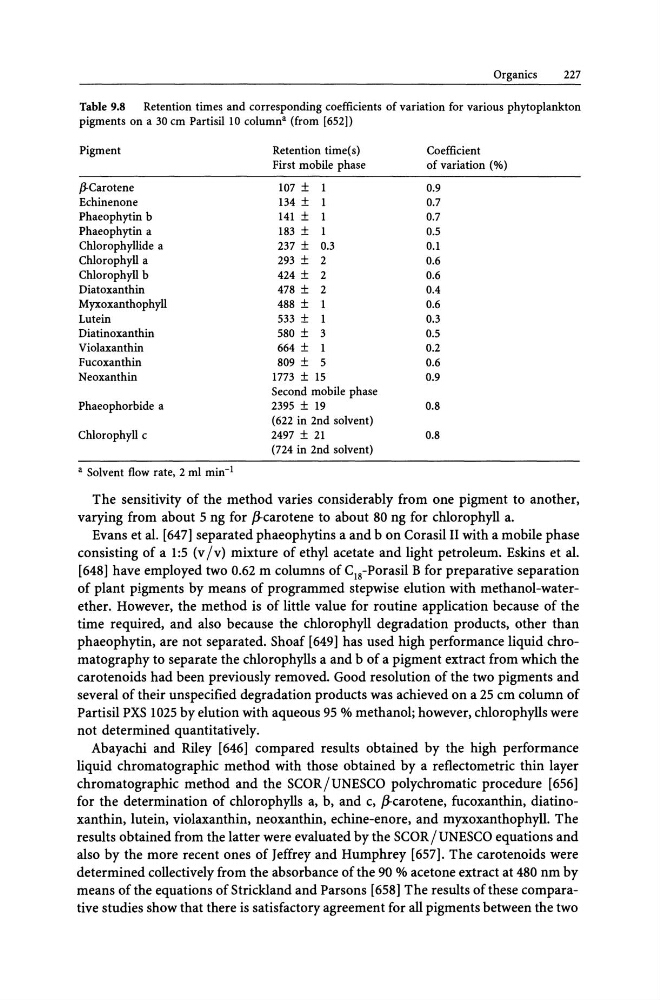
Table 9.8
Retention times and corresponding coefficients of variation for various phytoplankton
pigments on a 30 cm PartisillO columna (from [652])
Pigment
Retention time(s)
Coefficient
First mobile phase
of variation (%)
/JCarotene
107 ±
0.9
Echinenone
134 ±
0.7
Phaeophytin b
141 ±
0.7
Phaeophytin a
183 ±
0.5
Chlorophyllide a
237 ± 0.3
0.1
Chlorophyll a
293 ± 2
0.6
Chlorophyll b
424 ± 2
0.6
Diatoxanthin
478 ± 2
0.4
Myxoxanthophyll
488 ± 1
0.6
Lutein
533 ± 1
0.3
Diatinoxanthin
580 ± 3
0.5
Violaxanthin
664 ±
0.2
Fucoxanthin
809 ± 5
0.6
Neoxanthin
1773 ± 15
0.9
Second mobile phase
Phaeophorbide a
2395 ± 19
0.8
(622 in 2nd solvent)
Chlorophyll c
2497 ± 21
0.8
(724 in 2nd solvent)
a Solvent flow rate, 2 rnl min- 1
The sensitivity of the method varies considerably from one pigment to another,
varying from about 5 ng for fJ-carotene to about 80 ng for chlorophyll a.
Evans et al. [647] separated phaeophytins a and bon Corasil II with a mobile phase
consisting of a 1:5 (v Iv) mixture of ethyl acetate and light petroleum. Eskins et al.
[648] have employed two 0.62 m columns of C1s-Porasil B for preparative separation
of plant pigments by means of programmed stepwise elution with methanol-waterether. However, the method is of little value for routine application because of the
time required, and also because the chlorophyll degradation products, other than
phaeophytin, are not separated. Shoaf [649] has used high performance liquid chromatography to separate the chlorophylls a and b of a pigment extract from which the
carotenoids had been previously removed. Good resolution of the two pigments and
several of their unspecified degradation products was achieved on a 25 cm column of
Partisil PXS 1025 by elution with aqueous 95 % methanol; however, chlorophylls were
not determined quantitatively.
Abayachi and Riley [646] compared results obtained by the high performance
liquid chromatographic method with those obtained by a reflectometric thin layer
chromatographic method and the SCOR/UNESCO polychromatic procedure [656]
for the determination of chlorophylls a, b, and c, fJ-carotene, fucoxanthin, diatinoxanthin, lutein, violaxanthin, neoxanthin, echine-enore, and myxoxanthophyll. The
results obtained from the latter were evaluated by the SCOR / UNESCO equations and
also by the more recent ones of Jeffrey and Humphrey [657]. The carotenoids were
determined collectively from the absorbance of the 90 % acetone extract at 480 nm by
means of the equations of Strickland and Parsons [658] The results of these comparative studies show that there is satisfactory agreement for all pigments between the two
227
Table 9.8
Retention times and corresponding coefficients of variation for various phytoplankton
pigments on a 30 cm PartisillO columna (from [652])
Pigment
Retention time(s)
Coefficient
First mobile phase
of variation (%)
/JCarotene
107 ±
0.9
Echinenone
134 ±
0.7
Phaeophytin b
141 ±
0.7
Phaeophytin a
183 ±
0.5
Chlorophyllide a
237 ± 0.3
0.1
Chlorophyll a
293 ± 2
0.6
Chlorophyll b
424 ± 2
0.6
Diatoxanthin
478 ± 2
0.4
Myxoxanthophyll
488 ± 1
0.6
Lutein
533 ± 1
0.3
Diatinoxanthin
580 ± 3
0.5
Violaxanthin
664 ±
0.2
Fucoxanthin
809 ± 5
0.6
Neoxanthin
1773 ± 15
0.9
Second mobile phase
Phaeophorbide a
2395 ± 19
0.8
(622 in 2nd solvent)
Chlorophyll c
2497 ± 21
0.8
(724 in 2nd solvent)
a Solvent flow rate, 2 rnl min- 1
The sensitivity of the method varies considerably from one pigment to another,
varying from about 5 ng for fJ-carotene to about 80 ng for chlorophyll a.
Evans et al. [647] separated phaeophytins a and bon Corasil II with a mobile phase
consisting of a 1:5 (v Iv) mixture of ethyl acetate and light petroleum. Eskins et al.
[648] have employed two 0.62 m columns of C1s-Porasil B for preparative separation
of plant pigments by means of programmed stepwise elution with methanol-waterether. However, the method is of little value for routine application because of the
time required, and also because the chlorophyll degradation products, other than
phaeophytin, are not separated. Shoaf [649] has used high performance liquid chromatography to separate the chlorophylls a and b of a pigment extract from which the
carotenoids had been previously removed. Good resolution of the two pigments and
several of their unspecified degradation products was achieved on a 25 cm column of
Partisil PXS 1025 by elution with aqueous 95 % methanol; however, chlorophylls were
not determined quantitatively.
Abayachi and Riley [646] compared results obtained by the high performance
liquid chromatographic method with those obtained by a reflectometric thin layer
chromatographic method and the SCOR/UNESCO polychromatic procedure [656]
for the determination of chlorophylls a, b, and c, fJ-carotene, fucoxanthin, diatinoxanthin, lutein, violaxanthin, neoxanthin, echine-enore, and myxoxanthophyll. The
results obtained from the latter were evaluated by the SCOR / UNESCO equations and
also by the more recent ones of Jeffrey and Humphrey [657]. The carotenoids were
determined collectively from the absorbance of the 90 % acetone extract at 480 nm by
means of the equations of Strickland and Parsons [658] The results of these comparative studies show that there is satisfactory agreement for all pigments between the two