

Organics
225
superiority of the column method was more pronounced when the small green alga
(00CY5ti5 sp.) and the blue-green alga (Oscillatoria sp.) were used as test organisms.
The coprostanol extraction efficiency was again shown to be comparable to that of the
hexane liquid-liquid partitioning process.
It was apparent that a more complete extraction of phytoplankton chlorophyll a
from water samples could be obtained by the column method. Furthermore, the
column procedure is much faster; a 1-1 sample required a processing time of approximately 1-2 h compared to 24 h for the conventional aqueous acetone method. Coprostanol contents of these samples were too low « 0.2 ppb) for meaningful comparisons and are not presented.
Thin Layer Chromatography. Garside and Riley [650] have used thin-layer chromatography to achieve a preliminary separation of chlorophylls on solvent extracts of
water and algae prior to a final determination by spectrophotometry or fluorimetry.
Garside and Riley [650] filtered sea water samples (0.5-51) through Whatman GF IC
glass fibre coated with a layer, 1-2 mm thick, of light magnesium carbonate. This
retains the smallest particles of organic matter and it is easy to extract the pigment
from it. The filter is extracted with acetone and then with methanol using ultrasonic
vibration. The solution is passed through anhydrous sodium sulphate to remove
water and then evaporated in vacuo at less than 50°C. The residue is dissolved in ethyl
ether-dimethylamine (99:1, 1-2 ml) and this applied as a spot to a plate coated with
silica gel PF 254 • The chromatogram is developed with light petroleum (60-80)-ethyl
acetate-dimethylamine (55:32:13)and the plate scanned by reflection of the light
passing through an Ilford 601 fIlter (603 urn). The integration reading for each peak is
measured and the Rr values noted relative to chlorophyll a. Xanthophylls are identified by scraping off the spots and measuring the absorption spectrum of an extract of
the scrapings. Chlorophyll c remains at the origin and can be developed in light
petroleum-ethyl acetate-dimethylformamide (1:2:2) and scanned as before. Chlorophylls a, b, and c, carotene, xanthophylls, and certain degradation products can be
determined. The sensitivity for chlorophyll is about 0.12 J1f, and the precision for most
pigments is ± 5 % or better at the 0.5 J1f, level.
Shoaf and Lium [642] used thin layer chromatography to separate algal chlorophylls from their degradation products. Chlorophyll is extracted from the algae with
dimethyl sulphide and chromatographed on commercially available thin-layer cellulose sheets, using 2 % methanol and 98 % petroleum ether as solvents, before determination by either spectrophotometry or fluorimetry.
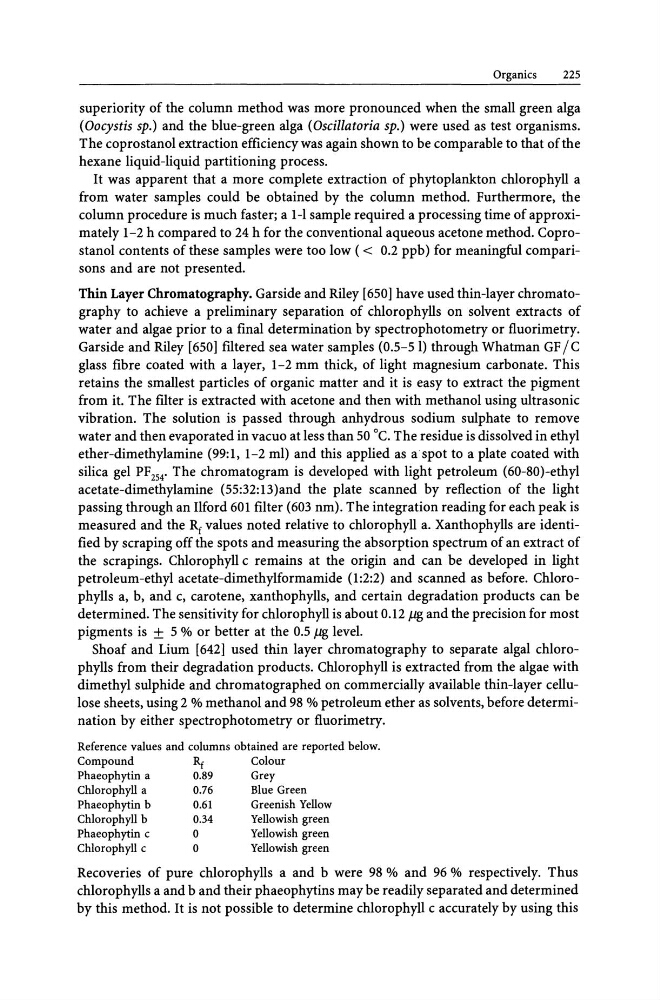
Reference values and columns obtained are reported below.
Compound
Rr
Colour
Phaeophytin a
0.89
Grey
Chlorophyll a
0.76
Blue Green
Phaeophytin b
0.61
Greenish Yellow
Chlorophyll b
0.34
Yellowish green
Phaeophytin c
0
Yellowish green
Chlorophyll c
0
Yellowish green
Recoveries of pure chlorophylls a and b were 98 % and 96 % respectively. Thus
chlorophylls a and b and their phaeophytins may be readily separated and determined
by this method. It is not possible to determine chlorophyll c accurately by using this
225
superiority of the column method was more pronounced when the small green alga
(00CY5ti5 sp.) and the blue-green alga (Oscillatoria sp.) were used as test organisms.
The coprostanol extraction efficiency was again shown to be comparable to that of the
hexane liquid-liquid partitioning process.
It was apparent that a more complete extraction of phytoplankton chlorophyll a
from water samples could be obtained by the column method. Furthermore, the
column procedure is much faster; a 1-1 sample required a processing time of approximately 1-2 h compared to 24 h for the conventional aqueous acetone method. Coprostanol contents of these samples were too low « 0.2 ppb) for meaningful comparisons and are not presented.
Thin Layer Chromatography. Garside and Riley [650] have used thin-layer chromatography to achieve a preliminary separation of chlorophylls on solvent extracts of
water and algae prior to a final determination by spectrophotometry or fluorimetry.
Garside and Riley [650] filtered sea water samples (0.5-51) through Whatman GF IC
glass fibre coated with a layer, 1-2 mm thick, of light magnesium carbonate. This
retains the smallest particles of organic matter and it is easy to extract the pigment
from it. The filter is extracted with acetone and then with methanol using ultrasonic
vibration. The solution is passed through anhydrous sodium sulphate to remove
water and then evaporated in vacuo at less than 50°C. The residue is dissolved in ethyl
ether-dimethylamine (99:1, 1-2 ml) and this applied as a spot to a plate coated with
silica gel PF 254 • The chromatogram is developed with light petroleum (60-80)-ethyl
acetate-dimethylamine (55:32:13)and the plate scanned by reflection of the light
passing through an Ilford 601 fIlter (603 urn). The integration reading for each peak is
measured and the Rr values noted relative to chlorophyll a. Xanthophylls are identified by scraping off the spots and measuring the absorption spectrum of an extract of
the scrapings. Chlorophyll c remains at the origin and can be developed in light
petroleum-ethyl acetate-dimethylformamide (1:2:2) and scanned as before. Chlorophylls a, b, and c, carotene, xanthophylls, and certain degradation products can be
determined. The sensitivity for chlorophyll is about 0.12 J1f, and the precision for most
pigments is ± 5 % or better at the 0.5 J1f, level.
Shoaf and Lium [642] used thin layer chromatography to separate algal chlorophylls from their degradation products. Chlorophyll is extracted from the algae with
dimethyl sulphide and chromatographed on commercially available thin-layer cellulose sheets, using 2 % methanol and 98 % petroleum ether as solvents, before determination by either spectrophotometry or fluorimetry.
Reference values and columns obtained are reported below.
Compound
Rr
Colour
Phaeophytin a
0.89
Grey
Chlorophyll a
0.76
Blue Green
Phaeophytin b
0.61
Greenish Yellow
Chlorophyll b
0.34
Yellowish green
Phaeophytin c
0
Yellowish green
Chlorophyll c
0
Yellowish green
Recoveries of pure chlorophylls a and b were 98 % and 96 % respectively. Thus
chlorophylls a and b and their phaeophytins may be readily separated and determined
by this method. It is not possible to determine chlorophyll c accurately by using this