

204
Crustacea and Molluscs
separated by thin layer chromatography, and the 1\ values of radioactive spots were
compared to 1\ values for non-radioactive DDD and radioactive DDE. The results
show a conversion of DDT to DDE of about 13.6 %.
Extract residues by
elution w~h 120 ml
n - hexane - acetone 2:1
Extract A
(adjusted to 100 ml)
I
Evaporate solvent of
50 ml extract A in vee.,
add 5 ml n - hexane
Remove lipids on AI203 column
by elution whh 30 ml n - hexane
Eluate A
Evaporate in vac.,
add 5 ml n - hexane
Separete on Florisil column
whh 90 ml n - hexane (= fraction I)
and 40 ml n - hexane-ether 1: 1
(= fraction ll)
Fraction I
G.c. analysis A
of PCBs, DOE
and HCB b
Fraction II
G.c. analysis A
of DDT, DOD
andy-HCH b
Tissue sample
(8 9 musculature or 4 9 liver)
I
Grind frozen (-20 ·C) sample in two
equal portions· each with 16 g Na2S04
Dry tissue powder
Distribute each portion equally
on columns A and B
I Combine 50 ml of
each extract
100 ml extract
Lipid determination
Fraction II
Extract residues by
elution whh 120 ml
n - hexane - acetone 2: 1
Extract B
(adjusted to 100 ml)
I
Proceed as
described for
extract A
Eluate B
Proceed as
described for
extract A
Fraction I
G.c. analysis B
of DDT, DOD
andy-HCH b
G.c. analysis B
of PCBs, DOE
and HCBb
• Limhed size of the mortar mill requires grinding in two portiOns.
b HCB and 1'-HCH are not determined.
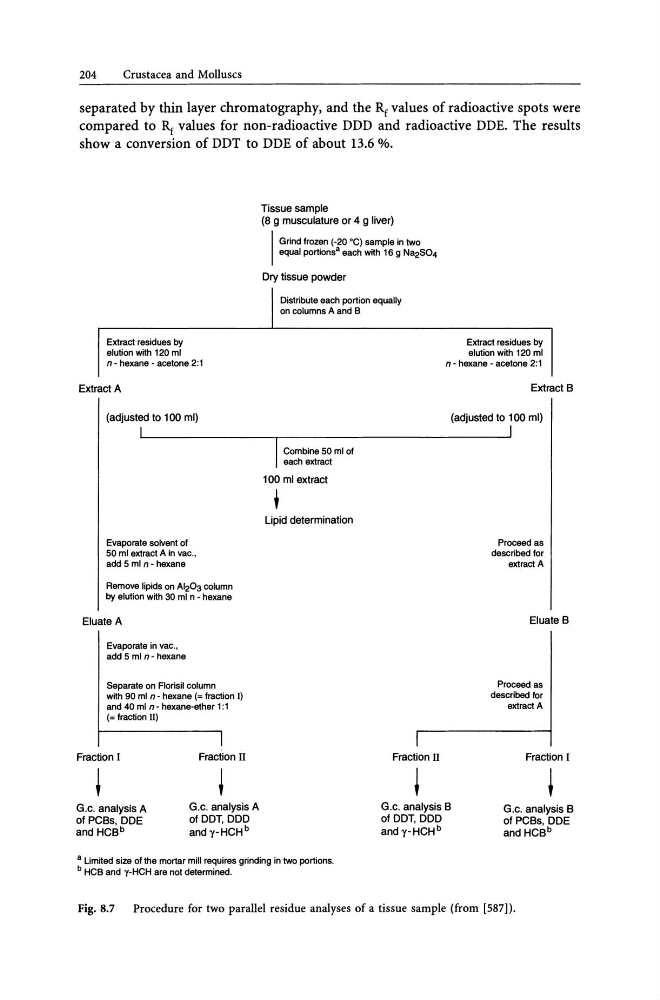
Fig. 8.7 Procedure for two parallel residue analyses of a tissue sample (from [587]).
Crustacea and Molluscs
separated by thin layer chromatography, and the 1\ values of radioactive spots were
compared to 1\ values for non-radioactive DDD and radioactive DDE. The results
show a conversion of DDT to DDE of about 13.6 %.
Extract residues by
elution w~h 120 ml
n - hexane - acetone 2:1
Extract A
(adjusted to 100 ml)
I
Evaporate solvent of
50 ml extract A in vee.,
add 5 ml n - hexane
Remove lipids on AI203 column
by elution whh 30 ml n - hexane
Eluate A
Evaporate in vac.,
add 5 ml n - hexane
Separete on Florisil column
whh 90 ml n - hexane (= fraction I)
and 40 ml n - hexane-ether 1: 1
(= fraction ll)
Fraction I
G.c. analysis A
of PCBs, DOE
and HCB b
Fraction II
G.c. analysis A
of DDT, DOD
andy-HCH b
Tissue sample
(8 9 musculature or 4 9 liver)
I
Grind frozen (-20 ·C) sample in two
equal portions· each with 16 g Na2S04
Dry tissue powder
Distribute each portion equally
on columns A and B
I Combine 50 ml of
each extract
100 ml extract
Lipid determination
Fraction II
Extract residues by
elution whh 120 ml
n - hexane - acetone 2: 1
Extract B
(adjusted to 100 ml)
I
Proceed as
described for
extract A
Eluate B
Proceed as
described for
extract A
Fraction I
G.c. analysis B
of DDT, DOD
andy-HCH b
G.c. analysis B
of PCBs, DOE
and HCBb
• Limhed size of the mortar mill requires grinding in two portiOns.
b HCB and 1'-HCH are not determined.
Fig. 8.7 Procedure for two parallel residue analyses of a tissue sample (from [587]).