

Metals
191
techniques are applicable and reliable; that for the elements selenium, cadmium and
lead, where appreciable losses were detected, the application of existing techniques
without additional precautions or corrections would probably lead to inaccurate
results; that antimony and arsenic were not studied owing to 100 % mortality among
the oysters; and that although these results are applicable only to C. gigas, this study
points to the need to re-investigate the analytical validity of dehydration processes in
other biological systems.
The Mussel Watch Programme. Perhaps the most extensive set of data relating metal
concentrations in mussels and oysters to those presumed in the environment have
come from the Mussel Watch Programmes [563]. Both geographical and temporal
trends in seawater concentrations are sought through soft-tissue analyses. In the US
Programme [564], bivalves (oysters and mussels) were collected at over 100 stations
along the East, West, and Gulf coasts of the United States. Animals of uniform size
were sought, where possible, approximately 5-8 cm long, although oysters were
slightly larger. Elements determined in this programme include lead, cadmium, silver,
zinc, copper, nickel, plutonium, and uranium.
Two laboratories carried out the metal analyses, usually by atomic absorption
spectrometry - the Scripps Institution of Oceanography and the Moss Landing Marine Laboratories, both in California.
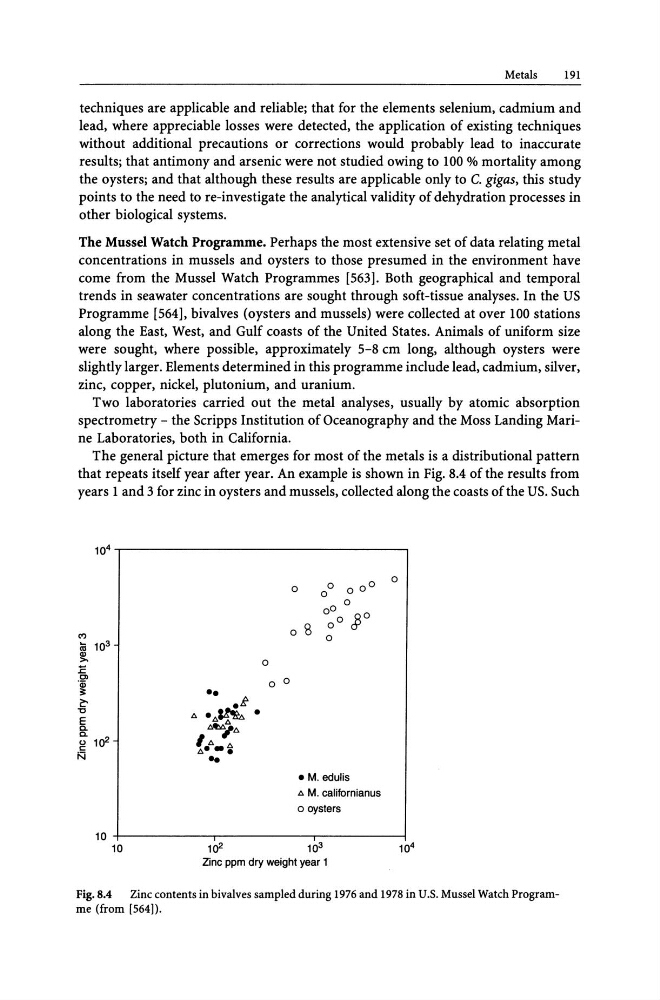
The general picture that emerges for most of the metals is a distributional pattern
that repeats itself year after year. An example is shown in Fig. 8.4 of the results from
years 1 and 3 for zinc in oysters and mussels, collected along the coasts of the US. Such
104~----------------------------------~
o
o 0
000
0
0
0 o 0
o
J30
o S
00
0
• M. edulis
A M. californianus
o oysters
0
10 +-----------r-----------r---------~
10
102
10 3
10 4
Zinc ppm dry weight year 1
Fig. 8.4
Zinc contents in bivalves sampled during 1976 and 1978 in U.S. Mussel Watch Programme (from [564]).
191
techniques are applicable and reliable; that for the elements selenium, cadmium and
lead, where appreciable losses were detected, the application of existing techniques
without additional precautions or corrections would probably lead to inaccurate
results; that antimony and arsenic were not studied owing to 100 % mortality among
the oysters; and that although these results are applicable only to C. gigas, this study
points to the need to re-investigate the analytical validity of dehydration processes in
other biological systems.
The Mussel Watch Programme. Perhaps the most extensive set of data relating metal
concentrations in mussels and oysters to those presumed in the environment have
come from the Mussel Watch Programmes [563]. Both geographical and temporal
trends in seawater concentrations are sought through soft-tissue analyses. In the US
Programme [564], bivalves (oysters and mussels) were collected at over 100 stations
along the East, West, and Gulf coasts of the United States. Animals of uniform size
were sought, where possible, approximately 5-8 cm long, although oysters were
slightly larger. Elements determined in this programme include lead, cadmium, silver,
zinc, copper, nickel, plutonium, and uranium.
Two laboratories carried out the metal analyses, usually by atomic absorption
spectrometry - the Scripps Institution of Oceanography and the Moss Landing Marine Laboratories, both in California.
The general picture that emerges for most of the metals is a distributional pattern
that repeats itself year after year. An example is shown in Fig. 8.4 of the results from
years 1 and 3 for zinc in oysters and mussels, collected along the coasts of the US. Such
104~----------------------------------~
o
o 0
000
0
0
0 o 0
o
J30
o S
00
0
• M. edulis
A M. californianus
o oysters
0
10 +-----------r-----------r---------~
10
102
10 3
10 4
Zinc ppm dry weight year 1
Fig. 8.4
Zinc contents in bivalves sampled during 1976 and 1978 in U.S. Mussel Watch Programme (from [564]).