

188
Crustacea and Molluscs
has been applied to the determination of major, minor, and trace elements in reference oyster hepatopancreas samples (NBS 1566 and TORT-I). The reference samples
were homogenized, spray dried, acetone extracted, vacuum dried, screened, blended,
bottled, and, finally, irradiation sterilized. All samples were dried at 105°C to remove
residual water, and photon activation analysis was performed on the samples in
aluminium vials using the National Research Council of Canada electron linear accelerator, using the bremsstrahlung produced by the impact of a focussed electron beam
on a tungsten converter. After irradiation, the samples were allowed to decay for a
specified time and the gamma ray spectrum was then prepared.
Examples of typical gamma ray spectra of samples of NBS 1566 oyster tissue
following photon irradiation at 30 MeV electron energy are shown in Figs. 8.2 and 8.3.
These spectra represent irradiation times of 6 h and decay times of 1 day and 14 days
respectively.
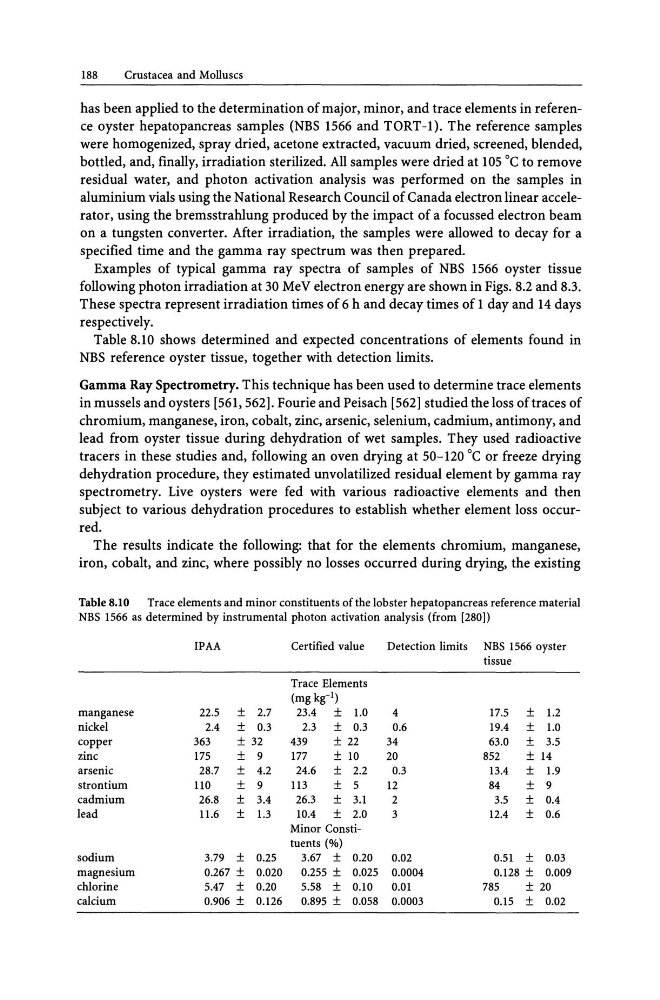
Table 8.10 shows determined and expected concentrations of elements found in
NBS reference oyster tissue, together with detection limits.
Gamma Ray Spectrometry. This technique has been used to determine trace elements
in mussels and oysters [561,562]. Fourie and Peisach [562] studied the loss of traces of
chromium, manganese, iron, cobalt, zinc, arsenic, selenium, cadmium, antimony, and
lead from oyster tissue during dehydration of wet samples. They used radioactive
tracers in these studies and, following an oven drying at 50-120°C or freeze drying
dehydration procedure, they estimated unvolatilized residual element by gamma ray
spectrometry. Live oysters were fed with various radioactive elements and then
subject to various dehydration procedures to establish whether element loss occurred.
The results indicate the following: that for the elements chromium, manganese,
iron, cobalt, and zinc, where possibly no losses occurred during drying, the existing
Table 8.10
Trace elements and minor constituents of the lobster hepatopancreas reference material
NBS 1566 as determined by instrumental photon activation analysis (from [280])
IPAA
Certified value
Detection limits NBS 1566 oyster
tissue
Trace Elements
(mgkg-l)
manganese
22.5
± 2.7
23.4
± 1.0 4
17.5
± 1.2
nickel
2.4
± 0.3
2.3
± 0.3
0.6
19.4 ± 1.0
copper
363
± 32
439
± 22
34
63.0
± 3.5
zinc
175
± 9
177
± 10
20
852
± 14
arsenic
28.7
± 4.2
24.6
± 2.2
0.3
13.4
± 1.9
strontium
110
± 9
113
± 5
12
84
± 9
cadmium
26.8
± 3.4
26.3
± 3.1
2
3.5
± 0.4
lead
11.6
± 1.3
10.4
± 2.0
3
12.4
± 0.6
Minor Constituents (%)
sodium
3.79 ± 0.25
3.67 ± 0.20 0.02
0.51 ± 0.03
magnesium
0.267 ± 0.020 0.255 ± 0.025 0.0004
0.128 ± 0.009
chlorine
5.47 ± 0.20
5.58 ± 0.10 O.oI
785
± 20
calcium
0.906 ± 0.126 0.895 ± 0.058 0.0003
0.15 ± 0.02
Crustacea and Molluscs
has been applied to the determination of major, minor, and trace elements in reference oyster hepatopancreas samples (NBS 1566 and TORT-I). The reference samples
were homogenized, spray dried, acetone extracted, vacuum dried, screened, blended,
bottled, and, finally, irradiation sterilized. All samples were dried at 105°C to remove
residual water, and photon activation analysis was performed on the samples in
aluminium vials using the National Research Council of Canada electron linear accelerator, using the bremsstrahlung produced by the impact of a focussed electron beam
on a tungsten converter. After irradiation, the samples were allowed to decay for a
specified time and the gamma ray spectrum was then prepared.
Examples of typical gamma ray spectra of samples of NBS 1566 oyster tissue
following photon irradiation at 30 MeV electron energy are shown in Figs. 8.2 and 8.3.
These spectra represent irradiation times of 6 h and decay times of 1 day and 14 days
respectively.
Table 8.10 shows determined and expected concentrations of elements found in
NBS reference oyster tissue, together with detection limits.
Gamma Ray Spectrometry. This technique has been used to determine trace elements
in mussels and oysters [561,562]. Fourie and Peisach [562] studied the loss of traces of
chromium, manganese, iron, cobalt, zinc, arsenic, selenium, cadmium, antimony, and
lead from oyster tissue during dehydration of wet samples. They used radioactive
tracers in these studies and, following an oven drying at 50-120°C or freeze drying
dehydration procedure, they estimated unvolatilized residual element by gamma ray
spectrometry. Live oysters were fed with various radioactive elements and then
subject to various dehydration procedures to establish whether element loss occurred.
The results indicate the following: that for the elements chromium, manganese,
iron, cobalt, and zinc, where possibly no losses occurred during drying, the existing
Table 8.10
Trace elements and minor constituents of the lobster hepatopancreas reference material
NBS 1566 as determined by instrumental photon activation analysis (from [280])
IPAA
Certified value
Detection limits NBS 1566 oyster
tissue
Trace Elements
(mgkg-l)
manganese
22.5
± 2.7
23.4
± 1.0 4
17.5
± 1.2
nickel
2.4
± 0.3
2.3
± 0.3
0.6
19.4 ± 1.0
copper
363
± 32
439
± 22
34
63.0
± 3.5
zinc
175
± 9
177
± 10
20
852
± 14
arsenic
28.7
± 4.2
24.6
± 2.2
0.3
13.4
± 1.9
strontium
110
± 9
113
± 5
12
84
± 9
cadmium
26.8
± 3.4
26.3
± 3.1
2
3.5
± 0.4
lead
11.6
± 1.3
10.4
± 2.0
3
12.4
± 0.6
Minor Constituents (%)
sodium
3.79 ± 0.25
3.67 ± 0.20 0.02
0.51 ± 0.03
magnesium
0.267 ± 0.020 0.255 ± 0.025 0.0004
0.128 ± 0.009
chlorine
5.47 ± 0.20
5.58 ± 0.10 O.oI
785
± 20
calcium
0.906 ± 0.126 0.895 ± 0.058 0.0003
0.15 ± 0.02