

182
Crustacea and Molluscs
Table 8.6
Results of the analysis oflead in samples B and C (fifth exercise) in relation to analytical
technique (from [552])
Sample B
Sample C
Technique
No. of
Mean Value CVa
No. of
Mean Value
analysts
(11 mol kg-I)
analysts
(11 mol kg-I)
Wet digestion/ AASc
30
13.0
58
24
4.42
Dry ashing / AAS
9
13.6
24
3
3.36
Wet digestion / chelation /
extraction / AAS
7
12.3
14
2
1.44
IDSSMSd
13.9
5 b
1.68
Nominal value
12.8
17
16
a Intralaboratory coefficient of variation based on mean values submitted by analysts
b Intralaboratory coefficient of variation based on six replicate analyses
C Atomic Absorption Spectrometry
d Isotope dilution solid-source mass sepctrometry
CVa
86
76
2
18 b
18
accurate data at concentrations which cover the range of values encountered in
shellfish (coefficients of variation 47 to 71 %) - see Table 8.5.
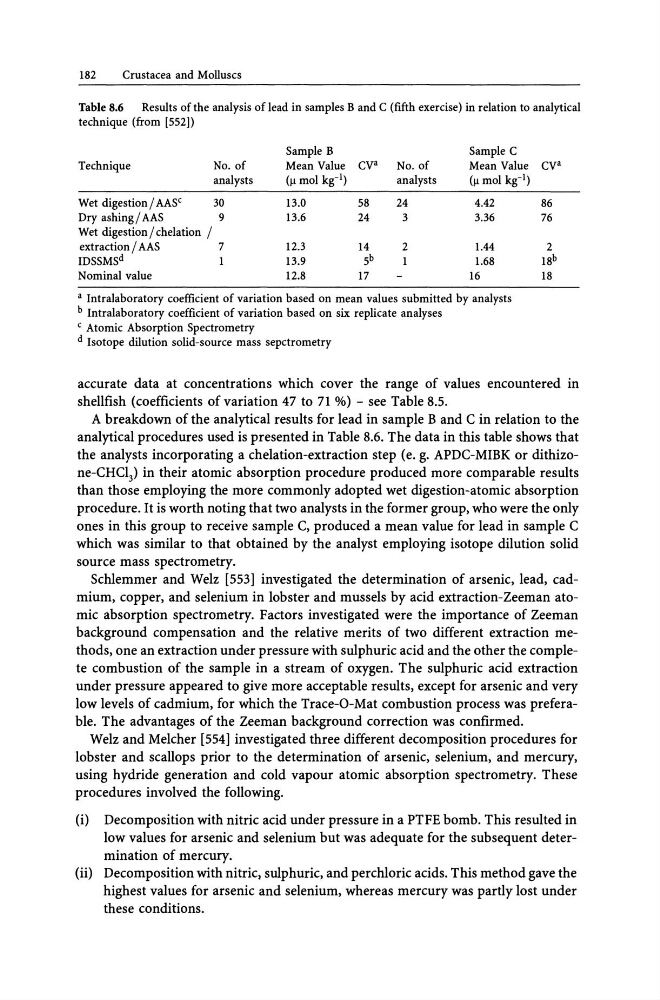
A breakdown of the analytical results for lead in sample Band C in relation to the
analytical procedures used is presented in Table 8.6. The data in this table shows that
the analysts incorporating a chelation-extraction step (e. g. APDC-MIBK or dithizone-CHCI 3 ) in their atomic absorption procedure produced more comparable results
than those employing the more commonly adopted wet digestion-atomic absorption
procedure. It is worth noting that two analysts in the former group, who were the only
ones in this group to receive sample C, produced a mean value for lead in sample C
which was similar to that obtained by the analyst employing isotope dilution solid
source mass spectrometry.
Schlemmer and Welz [553] investigated the determination of arsenic, lead, cadmium, copper, and selenium in lobster and mussels by acid extraction-Zeeman atomic absorption spectrometry. Factors investigated were the importance of Zeeman
background compensation and the relative merits of two different extraction methods, one an extraction under pressure with sulphuric acid and the other the complete combustion of the sample in a stream of oxygen. The sulphuric acid extraction
under pressure appeared to give more acceptable results, except for arsenic and very
low levels of cadmium, for which the Trace-O-Mat combustion process was preferable. The advantages of the Zeeman background correction was confirmed.
Welz and Melcher [554] investigated three different decomposition procedures for
lobster and scallops prior to the determination of arsenic, selenium, and mercury,
using hydride generation and cold vapour atomic absorption spectrometry. These
procedures involved the following.
(i) Decomposition with nitric acid under pressure in a PTFE bomb. This resulted in
low values for arsenic and selenium but was adequate for the subsequent determination of mercury.
(ii) Decomposition with nitric, sulphuric, and perchloric acids. This method gave the
highest values for arsenic and selenium, whereas mercury was partly lost under
these conditions.
Crustacea and Molluscs
Table 8.6
Results of the analysis oflead in samples B and C (fifth exercise) in relation to analytical
technique (from [552])
Sample B
Sample C
Technique
No. of
Mean Value CVa
No. of
Mean Value
analysts
(11 mol kg-I)
analysts
(11 mol kg-I)
Wet digestion/ AASc
30
13.0
58
24
4.42
Dry ashing / AAS
9
13.6
24
3
3.36
Wet digestion / chelation /
extraction / AAS
7
12.3
14
2
1.44
IDSSMSd
13.9
5 b
1.68
Nominal value
12.8
17
16
a Intralaboratory coefficient of variation based on mean values submitted by analysts
b Intralaboratory coefficient of variation based on six replicate analyses
C Atomic Absorption Spectrometry
d Isotope dilution solid-source mass sepctrometry
CVa
86
76
2
18 b
18
accurate data at concentrations which cover the range of values encountered in
shellfish (coefficients of variation 47 to 71 %) - see Table 8.5.
A breakdown of the analytical results for lead in sample Band C in relation to the
analytical procedures used is presented in Table 8.6. The data in this table shows that
the analysts incorporating a chelation-extraction step (e. g. APDC-MIBK or dithizone-CHCI 3 ) in their atomic absorption procedure produced more comparable results
than those employing the more commonly adopted wet digestion-atomic absorption
procedure. It is worth noting that two analysts in the former group, who were the only
ones in this group to receive sample C, produced a mean value for lead in sample C
which was similar to that obtained by the analyst employing isotope dilution solid
source mass spectrometry.
Schlemmer and Welz [553] investigated the determination of arsenic, lead, cadmium, copper, and selenium in lobster and mussels by acid extraction-Zeeman atomic absorption spectrometry. Factors investigated were the importance of Zeeman
background compensation and the relative merits of two different extraction methods, one an extraction under pressure with sulphuric acid and the other the complete combustion of the sample in a stream of oxygen. The sulphuric acid extraction
under pressure appeared to give more acceptable results, except for arsenic and very
low levels of cadmium, for which the Trace-O-Mat combustion process was preferable. The advantages of the Zeeman background correction was confirmed.
Welz and Melcher [554] investigated three different decomposition procedures for
lobster and scallops prior to the determination of arsenic, selenium, and mercury,
using hydride generation and cold vapour atomic absorption spectrometry. These
procedures involved the following.
(i) Decomposition with nitric acid under pressure in a PTFE bomb. This resulted in
low values for arsenic and selenium but was adequate for the subsequent determination of mercury.
(ii) Decomposition with nitric, sulphuric, and perchloric acids. This method gave the
highest values for arsenic and selenium, whereas mercury was partly lost under
these conditions.