

Metals
177
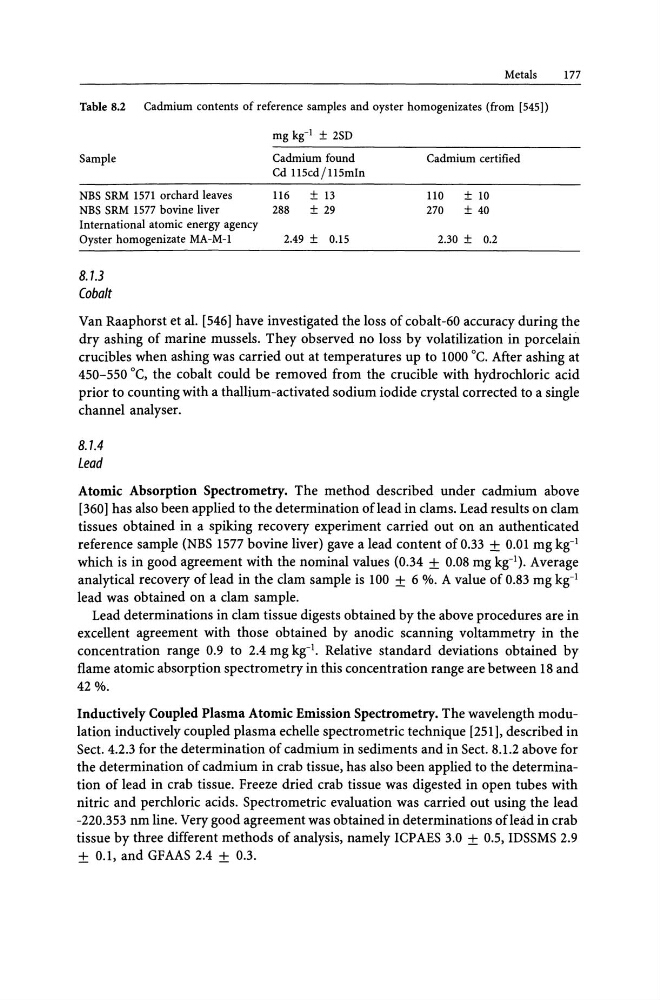
Table 8.2
Cadmium contents of reference samples and oyster homogenizates (from [545])
Sample
NBS SRM 1571 orchard leaves
NBS SRM 1577 bovine liver
International atomic energy agency
Oyster homogenizate MA-M-l
8.1.3
Cobalt
mg kg- I ± 2SD
Cadmium found
Cd 115cd/115mIn
116
± 13
288
± 29
2.49 ± 0.15
Cadmium certified
110
± 10
270
± 40
2.30 ± 0.2
Van Raaphorst et al. [546] have investigated the loss of cobalt-60 accuracy during the
dry ashing of marine mussels. They observed no loss by volatilization in porcelain
crucibles when ashing was carried out at temperatures up to 1000 °C. After ashing at
450-550°C, the cobalt could be removed from the crucible with hydrochloric acid
prior to counting with a thallium-activated sodium iodide crystal corrected to a single
channel analyser.
8.1.4
Lead
Atomic Absorption Spectrometry. The method described under cadmium a~ove
[360] has also been applied to the determination oflead in clams. Lead results on clam
tissues obtained in a spiking recovery experiment carried out on an authenticated
reference sample (NBS 1577 bovine liver) gave a lead content of 0.33 ± 0.01 mg kg- I
which is in good agreement with the nominal values (0.34 ± 0.08 mg kg-I). Average
analytical recovery of lead in the clam sample is 100 ± 6 %. A value of 0.83 mg kg-I
lead was obtained on a clam sample.
Lead determinations in clam tissue digests obtained by the above procedures are in
excellent agreement with those obtained by anodic scanning voltammetry in the
concentration range 0.9 to 2.4 mg kg-I. Relative standard deviations obtained by
flame atomic absorption spectrometry in this concentration range are between 18 and
42 %.
Inductively Coupled Plasma Atomic Emission Spectrometry. The wavelength modulation inductively coupled plasma echelle spectrometric technique [251], described in
Sect. 4.2.3 for the determination of cadmium in sediments and in Sect. 8.1.2 above for
the determination of cadmium in crab tissue, has also been applied to the determination of lead in crab tissue. Freeze dried crab tissue was digested in open tubes with
nitric and perchloric acids. Spectrometric evaluation was carried out using the lead
-220.353 nm line. Very good agreement was obtained in determinations oflead in crab
tissue by three different methods of analysis, namely ICPAES 3.0 ± 0.5, IDSSMS 2.9
± 0.1, and GFAAS 2.4 ± 0.3.
177
Table 8.2
Cadmium contents of reference samples and oyster homogenizates (from [545])
Sample
NBS SRM 1571 orchard leaves
NBS SRM 1577 bovine liver
International atomic energy agency
Oyster homogenizate MA-M-l
8.1.3
Cobalt
mg kg- I ± 2SD
Cadmium found
Cd 115cd/115mIn
116
± 13
288
± 29
2.49 ± 0.15
Cadmium certified
110
± 10
270
± 40
2.30 ± 0.2
Van Raaphorst et al. [546] have investigated the loss of cobalt-60 accuracy during the
dry ashing of marine mussels. They observed no loss by volatilization in porcelain
crucibles when ashing was carried out at temperatures up to 1000 °C. After ashing at
450-550°C, the cobalt could be removed from the crucible with hydrochloric acid
prior to counting with a thallium-activated sodium iodide crystal corrected to a single
channel analyser.
8.1.4
Lead
Atomic Absorption Spectrometry. The method described under cadmium a~ove
[360] has also been applied to the determination oflead in clams. Lead results on clam
tissues obtained in a spiking recovery experiment carried out on an authenticated
reference sample (NBS 1577 bovine liver) gave a lead content of 0.33 ± 0.01 mg kg- I
which is in good agreement with the nominal values (0.34 ± 0.08 mg kg-I). Average
analytical recovery of lead in the clam sample is 100 ± 6 %. A value of 0.83 mg kg-I
lead was obtained on a clam sample.
Lead determinations in clam tissue digests obtained by the above procedures are in
excellent agreement with those obtained by anodic scanning voltammetry in the
concentration range 0.9 to 2.4 mg kg-I. Relative standard deviations obtained by
flame atomic absorption spectrometry in this concentration range are between 18 and
42 %.
Inductively Coupled Plasma Atomic Emission Spectrometry. The wavelength modulation inductively coupled plasma echelle spectrometric technique [251], described in
Sect. 4.2.3 for the determination of cadmium in sediments and in Sect. 8.1.2 above for
the determination of cadmium in crab tissue, has also been applied to the determination of lead in crab tissue. Freeze dried crab tissue was digested in open tubes with
nitric and perchloric acids. Spectrometric evaluation was carried out using the lead
-220.353 nm line. Very good agreement was obtained in determinations oflead in crab
tissue by three different methods of analysis, namely ICPAES 3.0 ± 0.5, IDSSMS 2.9
± 0.1, and GFAAS 2.4 ± 0.3.