

Organometallic Compounds
167
Table 7.17
Determination of total mercury and methylmercury in lyophilised samples of tunafish
(from (517»
Mercury as total mercury, J.I!l g-l
CapeJli517
Mercury as methylmercury, J.I!l g-l
CapeJli5J7
Uthe 521 Average"
95 %
Uthe 521 Average"
95%
confidence
interval
Sample
(glc)
(aas)
confidence (glc)
(aas)
interval
Lypophilised 29-63
(Liver of white tunafish
from the Atlantic) ...... 0.50
0.52
± 0.03
0.34
0.33.
± 0.012
Lyophilised 78-31
(Muscle of red tunafish
from the Mediterranean
Sea)
.. 3.00
3.14
± 0.19
1.90
1.89
± 0.02 5
Lyophilised CG-56
(Muscle of red tunafish
from the Mediterranean
Sea)
.. 11.50
10.7
± 0.6
8.20
8.29
± 0.12
" The average values are the results of five determinations
centrifuged, and 5 ml of the aqueous phase is diluted with water to 50 ml. Mercury is
determined in this solution by atomic absorption spectroscopy with the cold vapour
technique, using the standard additions method. Then 5 ml of the solution is placed in
the bubbler and 2 ml of 45 wt % sodium hydroxide solution and 1 ml of the reducing
solution [tin(II) chloride-cadmium chloride] are added. A stream of air or argon at 0.3
I min- 1 is used to strip the mercury vapour and to convey it into the silica-walled cell
across the spectrophotometer beam.
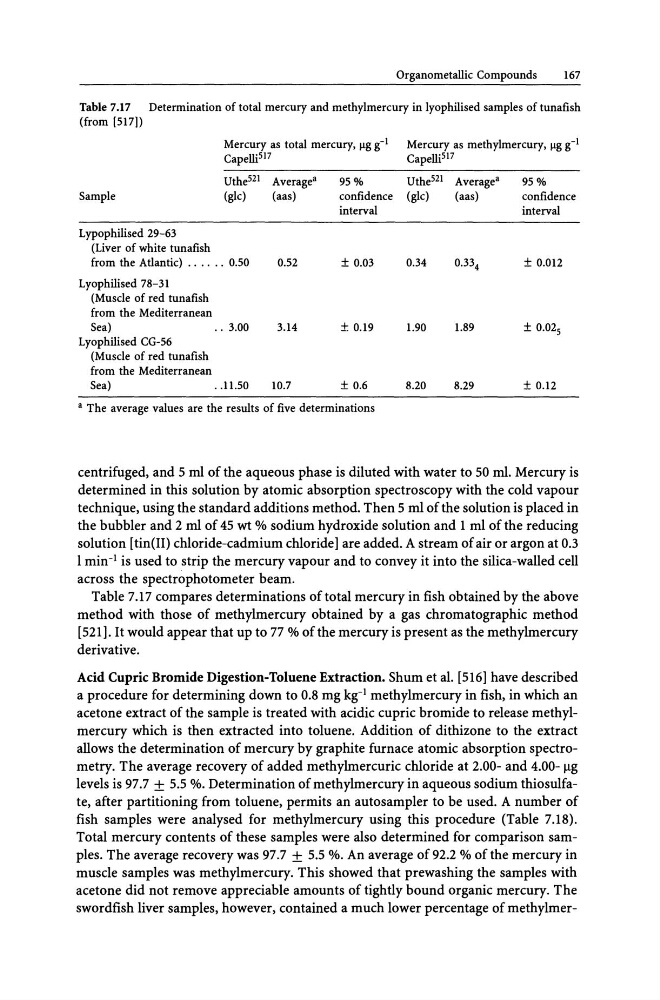
Table 7.17 compares determinations of total mercury in fish obtained by the above
method with those of methylmercury obtained by a gas chromatographic method
[521]. It would appear that up to 77 % of the mercury is present as the methylmercury
derivative.
Acid Cupric Bromide Digestion-Toluene Extraction. Shum et al. [516] have described
a procedure for determining down to 0.8 mg kg- 1 methylmercury in fish, in which an
acetone extract of the sample is treated with acidic cupric bromide to release methylmercury which is then extracted into toluene. Addition of dithizone to the extract
allows the determination of mercury by graphite furnace atomic absorption spectrometry. The average recovery of added methylmercuric chloride at 2.00- and 4.00- I1g
levels is 97.7 ± 5.5 %. Determination of methylmercury in aqueous sodium thiosulfate, after partitioning from toluene, permits an autosampler to be used. A number of
fish samples were analysed for methylmercury using this procedure (Table 7.18).
Total mercury contents of these samples were also determined for comparison samples. The average recovery was 97.7 ± 5.5 %. An average of 92.2 % of the mercury in
muscle samples was methylmercury. This showed that prewashing the samples with
acetone did not remove appreciable amounts of tightly bound organic mercury. The
swordfish liver samples, however, contained a much lower percentage of methylmer-
167
Table 7.17
Determination of total mercury and methylmercury in lyophilised samples of tunafish
(from (517»
Mercury as total mercury, J.I!l g-l
CapeJli517
Mercury as methylmercury, J.I!l g-l
CapeJli5J7
Uthe 521 Average"
95 %
Uthe 521 Average"
95%
confidence
interval
Sample
(glc)
(aas)
confidence (glc)
(aas)
interval
Lypophilised 29-63
(Liver of white tunafish
from the Atlantic) ...... 0.50
0.52
± 0.03
0.34
0.33.
± 0.012
Lyophilised 78-31
(Muscle of red tunafish
from the Mediterranean
Sea)
.. 3.00
3.14
± 0.19
1.90
1.89
± 0.02 5
Lyophilised CG-56
(Muscle of red tunafish
from the Mediterranean
Sea)
.. 11.50
10.7
± 0.6
8.20
8.29
± 0.12
" The average values are the results of five determinations
centrifuged, and 5 ml of the aqueous phase is diluted with water to 50 ml. Mercury is
determined in this solution by atomic absorption spectroscopy with the cold vapour
technique, using the standard additions method. Then 5 ml of the solution is placed in
the bubbler and 2 ml of 45 wt % sodium hydroxide solution and 1 ml of the reducing
solution [tin(II) chloride-cadmium chloride] are added. A stream of air or argon at 0.3
I min- 1 is used to strip the mercury vapour and to convey it into the silica-walled cell
across the spectrophotometer beam.
Table 7.17 compares determinations of total mercury in fish obtained by the above
method with those of methylmercury obtained by a gas chromatographic method
[521]. It would appear that up to 77 % of the mercury is present as the methylmercury
derivative.
Acid Cupric Bromide Digestion-Toluene Extraction. Shum et al. [516] have described
a procedure for determining down to 0.8 mg kg- 1 methylmercury in fish, in which an
acetone extract of the sample is treated with acidic cupric bromide to release methylmercury which is then extracted into toluene. Addition of dithizone to the extract
allows the determination of mercury by graphite furnace atomic absorption spectrometry. The average recovery of added methylmercuric chloride at 2.00- and 4.00- I1g
levels is 97.7 ± 5.5 %. Determination of methylmercury in aqueous sodium thiosulfate, after partitioning from toluene, permits an autosampler to be used. A number of
fish samples were analysed for methylmercury using this procedure (Table 7.18).
Total mercury contents of these samples were also determined for comparison samples. The average recovery was 97.7 ± 5.5 %. An average of 92.2 % of the mercury in
muscle samples was methylmercury. This showed that prewashing the samples with
acetone did not remove appreciable amounts of tightly bound organic mercury. The
swordfish liver samples, however, contained a much lower percentage of methylmer-