

Determination of Metals
3
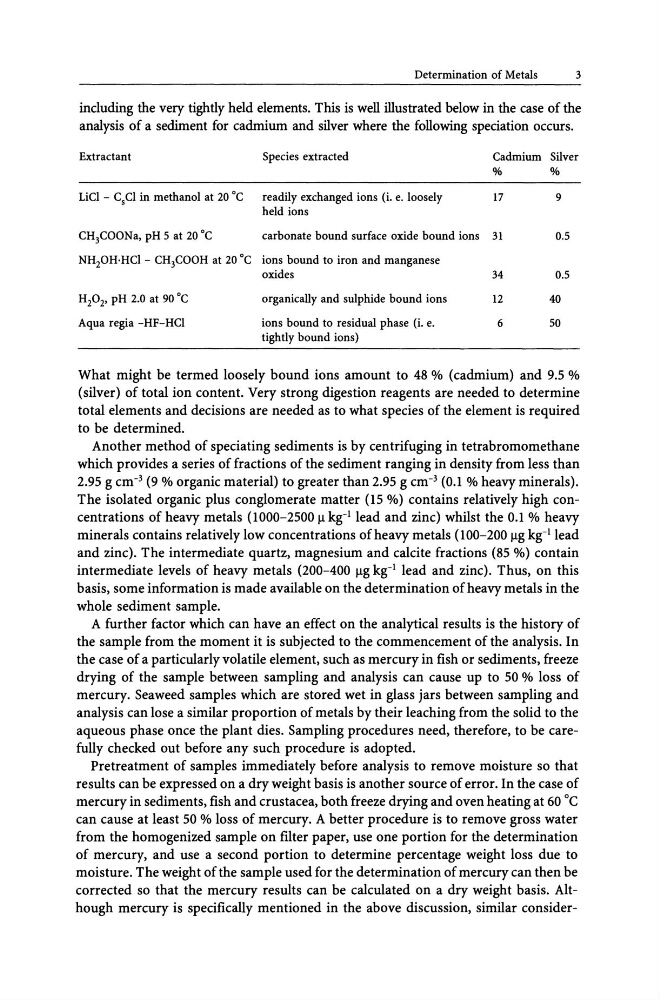
including the very tightly held elements. This is well illustrated below in the case of the
analysis of a sediment for cadmium and silver where the following speciation occurs.
Extractant
Species extracted
Cadmium Silver
%
%
LiCI - CsCI in methanol at 20°C
readily exchanged ions (i. e. loosely
17
9
held ions
CH 3 COONa, pH 5 at 20°C
carbonate bound surface oxide bound ions 31
0.5
NH 2 0H·HCl - CH 3 COOH at 20°C ions bound to iron and manganese
oxides
34
0.5
H 2 0 2 , pH 2.0 at 90°C
organically and sulphide bound ions
12
40
Aqua regia -HF-HCl
ions bound to residual phase (i. e.
6
50
tightly bound ions)
What might be termed loosely bound ions amount to 48 % (cadmium) and 9.5 %
(silver) of total ion content. Very strong digestion reagents are needed to determine
total elements and decisions are needed as to what species of the element is required
to be determined.
Another method of speciating sediments is by centrifuging in tetrabromomethane
which provides a series of fractions of the sediment ranging in density from less than
2.95 g cm- 3 (9 % organic material) to greater than 2.95 g cm- 3 (0.1 % heavy minerals).
The isolated organic plus conglomerate matter (15 %) contains relatively high concentrations of heavy metals (1000-250011 kg-l lead and zinc) whilst the 0.1 % heavy
minerals contains relatively low concentrations of heavy metals (100-200 I1g kg-l lead
and zinc). The intermediate quartz, magnesium and calcite fractions (85 %) contain
intermediate levels of heavy metals (200-400 I1S kg- 1 lead and zinc). Thus, on this
basis, some information is made available on the determination of heavy metals in the
whole sediment sample.
A further factor which can have an effect on the analytical results is the history of
the sample from the moment it is subjected to the commencement of the analysis. In
the case of a particularly volatile element, such as mercury in fish or sediments, freeze
drying of the sample between sampling and analysis can cause up to 50 % loss of
mercury. Seaweed samples which are stored wet in glass jars between sampling and
analysis can lose a similar proportion of metals by their leaching from the solid to the
aqueous phase once the plant dies. Sampling procedures need, therefore, to be carefully checked out before any such procedure is adopted.
Pretreatment of samples immediately before analysis to remove moisture so that
results can be expressed on a dry weight basis is another source of error. In the case of
mercury in sediments, fish and crustacea, both freeze drying and oven heating at 60°C
can cause at least 50 % loss of mercury. A better procedure is to remove gross water
from the homogenized sample on mter paper, use one portion for the determination
of mercury, and use a second portion to determine percentage weight loss due to
moisture. The weight of the sample used for the determination of mercury can then be
corrected so that the mercury results can be calculated on a dry weight basis. Although mercury is specifically mentioned in the above discussion, similar consider-
3
including the very tightly held elements. This is well illustrated below in the case of the
analysis of a sediment for cadmium and silver where the following speciation occurs.
Extractant
Species extracted
Cadmium Silver
%
%
LiCI - CsCI in methanol at 20°C
readily exchanged ions (i. e. loosely
17
9
held ions
CH 3 COONa, pH 5 at 20°C
carbonate bound surface oxide bound ions 31
0.5
NH 2 0H·HCl - CH 3 COOH at 20°C ions bound to iron and manganese
oxides
34
0.5
H 2 0 2 , pH 2.0 at 90°C
organically and sulphide bound ions
12
40
Aqua regia -HF-HCl
ions bound to residual phase (i. e.
6
50
tightly bound ions)
What might be termed loosely bound ions amount to 48 % (cadmium) and 9.5 %
(silver) of total ion content. Very strong digestion reagents are needed to determine
total elements and decisions are needed as to what species of the element is required
to be determined.
Another method of speciating sediments is by centrifuging in tetrabromomethane
which provides a series of fractions of the sediment ranging in density from less than
2.95 g cm- 3 (9 % organic material) to greater than 2.95 g cm- 3 (0.1 % heavy minerals).
The isolated organic plus conglomerate matter (15 %) contains relatively high concentrations of heavy metals (1000-250011 kg-l lead and zinc) whilst the 0.1 % heavy
minerals contains relatively low concentrations of heavy metals (100-200 I1g kg-l lead
and zinc). The intermediate quartz, magnesium and calcite fractions (85 %) contain
intermediate levels of heavy metals (200-400 I1S kg- 1 lead and zinc). Thus, on this
basis, some information is made available on the determination of heavy metals in the
whole sediment sample.
A further factor which can have an effect on the analytical results is the history of
the sample from the moment it is subjected to the commencement of the analysis. In
the case of a particularly volatile element, such as mercury in fish or sediments, freeze
drying of the sample between sampling and analysis can cause up to 50 % loss of
mercury. Seaweed samples which are stored wet in glass jars between sampling and
analysis can lose a similar proportion of metals by their leaching from the solid to the
aqueous phase once the plant dies. Sampling procedures need, therefore, to be carefully checked out before any such procedure is adopted.
Pretreatment of samples immediately before analysis to remove moisture so that
results can be expressed on a dry weight basis is another source of error. In the case of
mercury in sediments, fish and crustacea, both freeze drying and oven heating at 60°C
can cause at least 50 % loss of mercury. A better procedure is to remove gross water
from the homogenized sample on mter paper, use one portion for the determination
of mercury, and use a second portion to determine percentage weight loss due to
moisture. The weight of the sample used for the determination of mercury can then be
corrected so that the mercury results can be calculated on a dry weight basis. Although mercury is specifically mentioned in the above discussion, similar consider-