

l
~
'iii
33,8
,~ 100
i CD
II:
o
Predator Fish
m/z 176
m/z 182
200
400
600
Scan number
800
Non-Metals
151
(TCDD)1000
1200
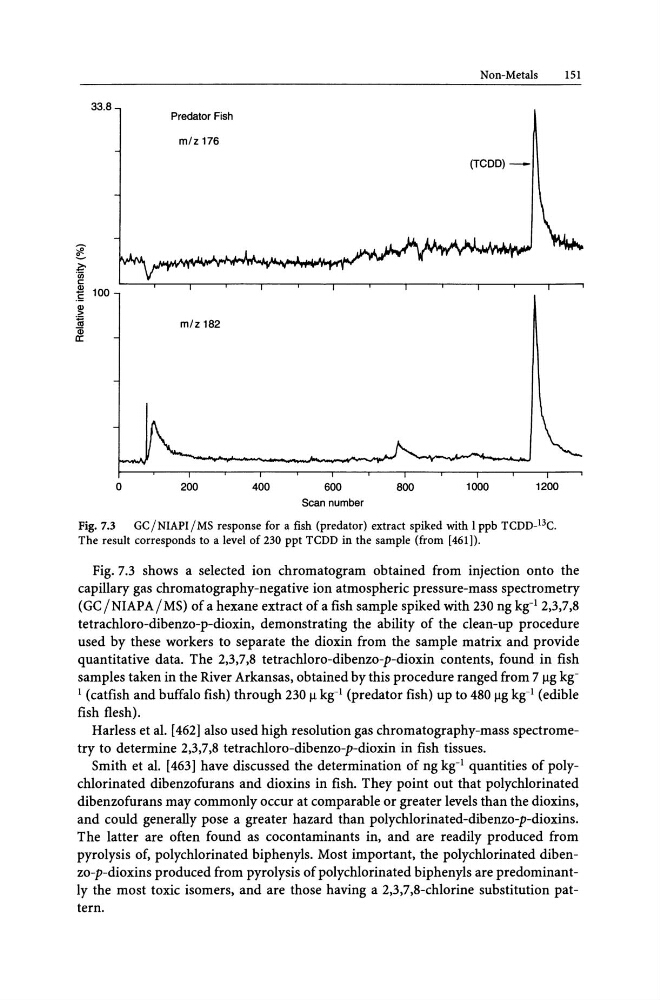
Fig. 7.3
GC/NIAPI/MS response for a fish (predator) extract spiked with lppb TCDD-J3C,
The result corresponds to a level of 230 ppt TCDD in the sample (from [461]).
Fig. 7.3 shows a selected ion chromatogram obtained from injection onto the
capillary gas chromatography-negative ion atmospheric pressure-mass spectrometry
(GC/NIAPA/MS) of a hexane extract of a fish sample spiked with 230 ng kg- 1 2,3,7,8
tetrachloro-dibenzo-p-dioxin, demonstrating the ability of the clean-up procedure
used by these workers to separate the dioxin from the sample matrix and provide
quantitative data. The 2,3,7,8 tetrachloro-dibenzo-p-dioxin contents, found in fish
samples taken in the River Arkansas, obtained by this procedure ranged from 7 Ilg kg1 (catfish and buffalo fish) through 230 Il kg-l (predator fish) up to 480 Ilg kg- 1 (edible
fish flesh).
Harless et al. [462] also used high resolution gas chromatography-mass spectrometry to determine 2,3,7,8 tetrachloro-dibenzo-p-dioxin in fish tissues.
Smith et al. [463] have discussed the determination of ng kg- 1 quantities of polychlorinated dibenzofurans and dioxins in fish. They point out that polychlorinated
dibenzofurans may commonly occur at comparable or greater levels than the dioxins,
and could generally pose a greater hazard than polychlorinated-dibenzo-p-dioxins.
The latter are often found as cocontaminants in, and are readily produced from
pyrolysis of, polychlorinated biphenyls. Most important, the polychlorinated dibenzo-p-dioxins produced from pyrolysis of polychlorinated biphenyls are predominantly the most toxic isomers, and are those having a 2,3,7,8-chlorine substitution pattern.
~
'iii
33,8
,~ 100
i CD
II:
o
Predator Fish
m/z 176
m/z 182
200
400
600
Scan number
800
Non-Metals
151
(TCDD)1000
1200
Fig. 7.3
GC/NIAPI/MS response for a fish (predator) extract spiked with lppb TCDD-J3C,
The result corresponds to a level of 230 ppt TCDD in the sample (from [461]).
Fig. 7.3 shows a selected ion chromatogram obtained from injection onto the
capillary gas chromatography-negative ion atmospheric pressure-mass spectrometry
(GC/NIAPA/MS) of a hexane extract of a fish sample spiked with 230 ng kg- 1 2,3,7,8
tetrachloro-dibenzo-p-dioxin, demonstrating the ability of the clean-up procedure
used by these workers to separate the dioxin from the sample matrix and provide
quantitative data. The 2,3,7,8 tetrachloro-dibenzo-p-dioxin contents, found in fish
samples taken in the River Arkansas, obtained by this procedure ranged from 7 Ilg kg1 (catfish and buffalo fish) through 230 Il kg-l (predator fish) up to 480 Ilg kg- 1 (edible
fish flesh).
Harless et al. [462] also used high resolution gas chromatography-mass spectrometry to determine 2,3,7,8 tetrachloro-dibenzo-p-dioxin in fish tissues.
Smith et al. [463] have discussed the determination of ng kg- 1 quantities of polychlorinated dibenzofurans and dioxins in fish. They point out that polychlorinated
dibenzofurans may commonly occur at comparable or greater levels than the dioxins,
and could generally pose a greater hazard than polychlorinated-dibenzo-p-dioxins.
The latter are often found as cocontaminants in, and are readily produced from
pyrolysis of, polychlorinated biphenyls. Most important, the polychlorinated dibenzo-p-dioxins produced from pyrolysis of polychlorinated biphenyls are predominantly the most toxic isomers, and are those having a 2,3,7,8-chlorine substitution pattern.